Showing posts with label Chickasaw National Recreation Area. Show all posts

Sunday, June 5, 2016

Oklahomacystis

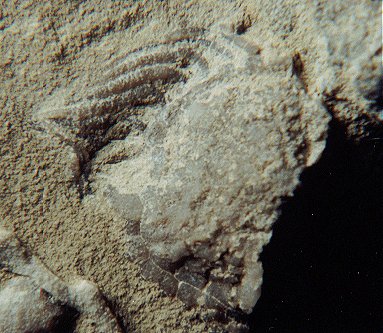
Something I'd hoped to find at Chickasaw National Recreation Area was an example of Oklahomacystis. The Bromide Formation is one of the great rock units for echinoderm diversity, and Oklahomacystis is one of the classic forms. Unfortunately, we didn't end up getting into the Bromide in the recreation area, although it should be there, so it will have to wait for another time. I did see plenty of Oklahomacystis in the collections of the Sam Noble Museum, as well as one slab featuring a group of them at the Travertine Nature Center in the recreation area. Here are some photos of the slab:

Oklahomacystis tribrachiatus

Other photos of the same slab are on the Internet, but my photos may be the only ones without the glass, so they've got that going for them. The scale is important, because for some reason, when taken without it, the fossils look to be about the size of dates, when they are actually more like the size of the first joint of a finger. The fossils represent the body, or "theca".

Mysteriously larger

These are visually unusual fossils, looking something like a pine cone, or a pineapple, or a cluster of berries, or a grenade. A close look shows that their surfaces are covered by shared circular arrangements of six (usually) wedge shapes, kind of like Trivial Pursuit pies that share wedges with other pies. If you're familiar with the kinds of words that are frequently used in scientific names, you may have already guessed that we're dealing with an echinoderm. If you guessed "paracrinoid", congratulations, either you are really good with echinoderms or you already know something about Oklahoma's fossils.* A paracrinoid is one of the numerous varieties of stalked echinoderms that flourished for a relatively brief span of time during the Paleozoic and then went extinct. The name suggests affinities with crinoids, but it should be noted that sometimes they are classified more distantly, with relatives to blastoids ("sea buds") or as their own group distinct from either crinoids or blastoids. Like those two groups, a complete paracrinoid would have also featured a stalk attaching it to the seafloor. Presumably Oklahomacystis would have had a fairly simple feeding apparatus compared to crinoids, like the similar paracrinoids Amygdalocystites or Comarocystites (which looks quite a bit different because its thecal plates are strongly concave, giving it that "puckered hexagon" look that was such a craze in the Ordovician). Oklahomacystis had recumbent arms which are part of the thecal structure; as the species name "tribrachiatus" indicates, there are three of these (tri + brachi, meaning arm, which of course we know from Brachiosaurus, the "arm lizard". Snuck in a dinosaur!). Like the other two genera mentioned above, Oklahomacystis's filter feeding apparatus would have consisted of pinnules attached to the arms. If you'd like more technical information on paracrinoids, there's a monograph on the subject available here (no. 288; it just happens to name Oklahomacystis as well).

(*Oklahomacystis is sometimes identified as a cystoid echinoderm, as under the "Bromide Formation" page at Wikipedia. I hinted at this a little bit in a previous post, but in the past people have occasionally had recourse to shovel various enigmatic extinct echinoderms into the cystoids. I'd just stick with paracrinoids here.)

I'll be at an event for Interstate State Park next weekend, so expect some Cambrian in the next post. After that, I'll try to do something dinosaurian; otherwise they'll take away my card!

Friday, May 27, 2016

After-action from Chickasaw National Recreation Area

And so, "how did the PaleoBlitz go?", you ask. "Well", I would say. It's a work in progress, given that we'd never done one before, but I think the results were encouraging. As I mentioned, it isn't exactly the same as a BioBlitz, given that too much public exposure is often detrimental to fossils if you want to find them where you left them, but the parts about getting other organizations interested, and providing outreach to the public, those worked out just fine.

We had a core group of about ten people. Our park contact at Chickasaw National Recreation Area, who got things going on the ground for us, was Chief of Resources Noel Osborn. From the Washington office, in his capacity as the NPS paleontology program coordinator, was Vince Santucci. To better document Chickasaw NRA paleontology and to help with the event workload, we had two Geoscientist-In-the-Parks participants, Alysia Korn (recent graduate student at the South Dakota School of Mines) and Madison Armstrong (recent undergraduate at the University of Oklahoma). From the Sam Noble Museum/University of Oklahoma, we had the expert contributions of Roger Burkhalter (collections manager, invertebrate paleontology) and Steve Westrop (curator, invertebrate paleontology). In the field and at the public event, we also had the assistance of Clayton Edgar (Goddard Youth Camp), Steve Vanlandingham (Sam Noble Museum of Natural History), Don Weeks (NPS Natural Resources Division), and Dan Winings (Chickasaw NRA), as well as representatives from the Oklahoma Geological Survey at the public event. Finally, there was me, who was responsible for some of the background research, most of the photodocumentation (I got this position through the time-honored reason that I brought the camera), and a lingulid brachiopod that was not without merit.

Vince and I got into Oklahoma City on the 17th, and then traveled to Sulphur, Oklahoma the following day, spending the morning at the Sam Noble Museum on the University of Oklahoma campus in Norman, where we visited Roger and Steve, taped some brief interviews, and saw some of the collections. As part of the Centennial BioBlitz program, ours was one of the events tapped to provide a short video for the JumboTron on the Mall in DC; originally, we were told to have it in by the end of the day on Friday, but the deadline was pushed up to Wednesday, which in the end was probably a good thing because we all had to take a breather after Friday's fieldwork to prepare for Saturday's public event. You can see the original video here; the GIPs did practically all of the video editing, and I can't compliment them enough on how it turned out. On Thursday, we scouted several areas of interest for visiting on Friday.

Friday was our big field day. With a crew of Alysia, Dan, Madison, Roger, the two Steves, Vince, and myself, and some water transport courtesy of Clayton Edgar, we hunted for fossils in several areas, with primarily Ordovician rocks. Not to toot my own horn, but I found the second best piece, a large lingulid brachiopod at the first locality (the best piece for my money was a reworked crinoid calyx found by Steve Vanlandingham at a later site). Following an inviolate rule, I found it looking for a solid place to get a handhold; it wasn't solid, but things turned out all right. The weather was quite pleasant for Oklahoma in late May, with relatively cool temperatures, low humidity, and enough cloud cover to fool you into skipping sunscreen. I did lose a trilobite pygidium while engaged in a life-or-death struggle with the local plant life, so it wasn't a perfect day, but it was pretty good. The next day, Saturday, was the public event, which we held at the Goddard Youth Camp on the south side of the lake. Madison and Alysia have prepared a follow-up video, which can be seen here.

Finally, the stuff that people really want: photos!

The famous lingulid.

From left to right: Alysia (with brachiopod), Vince, Madison (foreground), and Steve Vanlandingham (background).

Another group shot in this picturesque area. L-R: Roger, me, Steve Westrop, Vince, Madison, and Alysia.

Steve Vanlandingham's crinoid calyx.

A reworked cobble of fossil hash.

Traveling on the Lake of the Arbuckles.

Dan Winings (left) and Steve Vanlandingham (right) traversing an outcrop featuring a carpet of wildflowers.

Echinoderm fragments.

A newly minted Junior Paleontologist.