Showing posts with label sloths. Show all posts

Sunday, October 29, 2023

Fossils at Airports

This year's annual Society of Vertebrate Paleontology meeting was held in Cincinnati, and I was quite pleased to be greeted in Concourse B of Cincinnati/Northern Kentucky Airport by a mastodon skeleton.

This seemed like a good omen.

This is hardly the only airport to have fossils. Sometimes they are part of the building stone; at Minneapolis–St. Paul International Airport, for example, you can hardly walk around without seeing fossils in the (non-local) flooring stone. Most of the fossils are bits and pieces of shells, but there are some nice coiled cephalopods, and if you have time they're certainly worth a pause. (It would be fun to do a thorough photographic inventory, but I imagine it would probably have to be explained so as not to appear nefarious.)

Two cephalopods with part of my foot for scale.

A generous assortment of large fossil debris.

In other cases the fossils are on display, as at Cincinnati. One of my favorite examples is the Brachiosaurus at Chicago O'Hare. I've become fairly familiar with this mount over the years since I first saw it on the way to Mongolia, as O'Hare has been practically a required stop on my trips east from MSP.

On this visit in 2019 the brachiosaur was decked out in Chicago Bears livery for the NFL's centenary.

Back to Cincinnati. (Well, not literally; the airport is actually across the Ohio River in Kentucky.) In the mastodon photo above another skeleton can be seen in the distance. I'd been in a hurry when I arrived, so I hadn't explored farther, but made it a point to do so when I departed. It turned out there were five more mounts in the concourse, which makes me wonder if there were any in Concourse A. The animals chosen for exhibit are all typical Ice Age fauna of the area (in fact, all have been found at Big Bone Lick not too far down the river). One notable absence, if only by name, was the giant beaver Castoroides ohioensis, so I kind of hope there were more in Concourse A.

Cervalces scotti, the "stag-moose"; think of a moose with fancier antlers.

A dire wolf pursues an extinct peccary.

A giant ground sloth; the mounts are convenient to walk around, particularly nice for appreciating the unusual anatomy of this animal.

A Smilodon smiling.

Sunday, April 10, 2022

Mitchell Caverns

Back in the fall of 2021, I made a work visit to Mojave National Preserve, located logically enough within the Mojave Desert of southern California. While there, I had the opportunity to tour Mitchell Caverns. Mitchell Caverns is in the unusual position of being part of a state land parcel (Mitchell Caverns Natural Preserve or State Natural Preserve, depending on the source), entirely surrounded by another parcel of state land (Providence Mountains State Recreation Area), which is itself surrounded by a National Park Service unit (Mojave National Preserve). For good measure, the cave system is also a National Natural Landmark. It's parks all the way down in the Providence Mountains. (To be fair, the natural preserve designation is kind of a map artifact; it's not really distinct from the state recreation area.)

Sunday, May 3, 2020

On the mis-location of a giant sloth

To start off, I though you might be interested in a new series of pages on the National Park Service paleontology site, concerning the history of paleontology in NPS lands (including going back to before the sites were parks). We're always on the lookout for historical information. One odd case we've recently come across is a sloth which was at one time thought to come from a cave in the Mammoth Cave system.

Sunday, April 29, 2018

Tracking sloths and people at White Sands National Monument

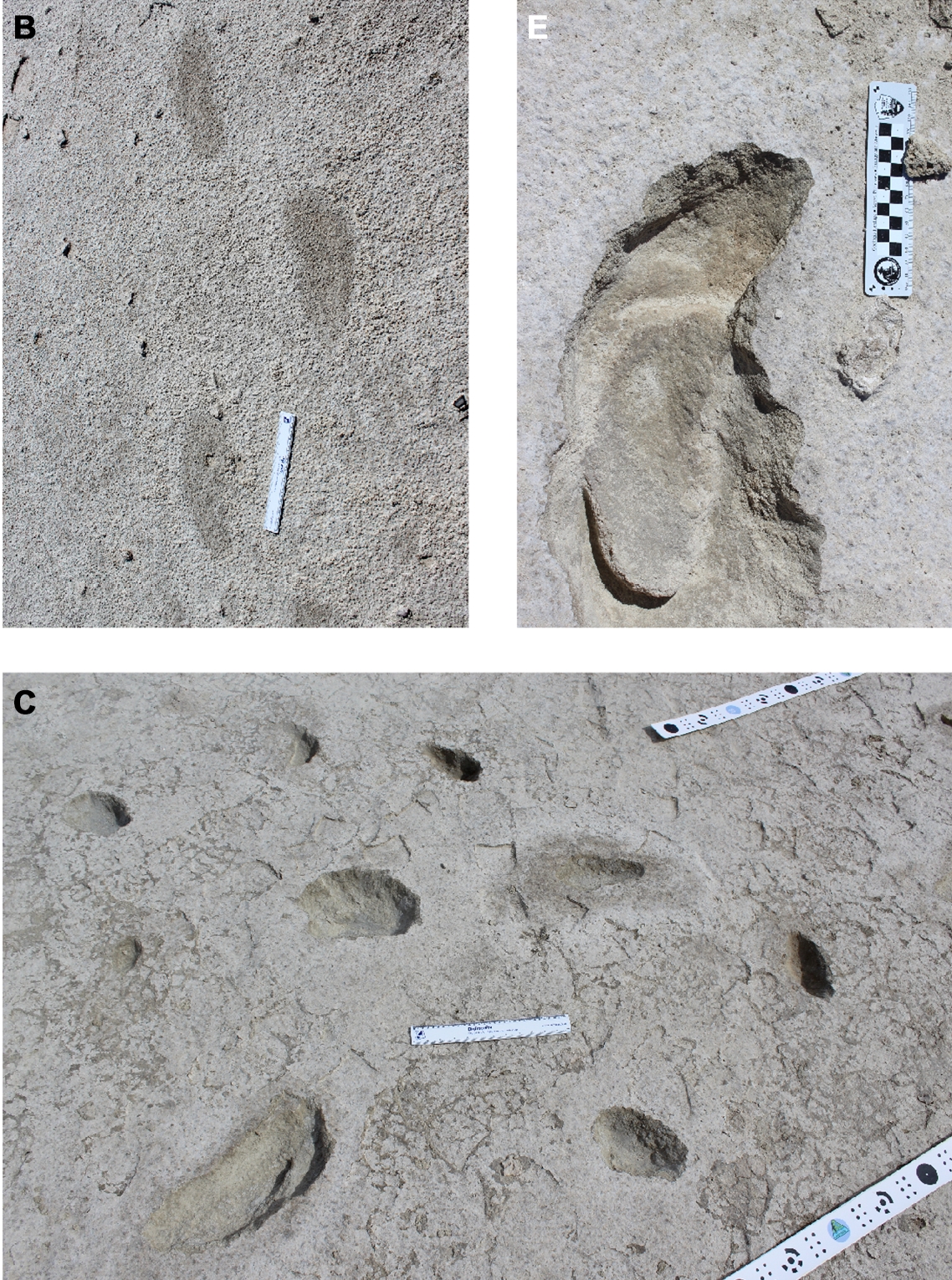
Earlier this week came some of the biggest news concerning National Park Service paleontology in quite some time: the discovery of tracks, including overlapping tracks, of extinct ground sloths and humans at White Sands National Monument, New Mexico. These finds were published in an article by Bustos et al. (2018), which can be accessed here (don't forget the supplement; less technical summary here). It's a pretty darn substantial way of showing humans and extinct sloths as contemporaries, and new evidence on the early history of humans in the Americas and the twilight of the Pleistocene megafauna. About the only ways you could make the tracks more notable would be to have them continue into the end of a hunt, or to have some dateable material that placed them significantly pre-Clovis.

Part of Figure 2 from Bustos et al. (2018). Part B has some faint sloth tracks (when poorly preserved, it can be difficult to distinguish similarly sized human and sloth tracks). Part C shows a "flailing circle" where a sloth appears to have swung its arms at a human. Part E shows a human track inside a much larger sloth track.