Showing posts with label Uŋčí Makhá Park. Show all posts

Saturday, October 31, 2026

Five Years of Uŋčí Makhá Park

I've been doing some paleo events concerning hometown Mississippi National River & Recreation Area, giving me the opportunity to revisit some places. While doing this I realized A) I'd been visiting Uŋčí Makhá Park for almost exactly 5 years, and B) I'd inadvertently been doing an unplanned but reasonably effective version of repeat monitoring of specific fossils (in other words, I kept taking pictures of the same things). Previously I'd commented on how fossils had gotten along over the winter of 2022–2023. Now we can see how some have been faring over four or five years of photographs. First, though, it's instructive to see how the overall setting has changed. Here's the south part of the "quarry" at the end of October in 2022, a few months after the park opened, photo facing south:


Here it is at the end of October, 2026:


Two things stand out (well, three: yes, I was standing at about the same point but took the photos at different angles). First, vegetation is filling in. Second, notice the outcrop wall on the left. In 2026, it's noticeably less clean. The slope here rises to the east (left), so groundwater is draining through the rocks on that side. Similarly, here's the north part of the "quarry" in 2022, again looking south:

And in 2026:


My placement wasn't as precise (since I didn't know I was doing repeat photography), but again, more vegetation and more gunk on the east wall. Now let's see some fossils. First is a bivalve steinkern, first photographed in November 2022:


A photo taken in May 2023 shows it about the same. By October 2024, though, something is definitely different:


A crack has developed, cutting through the margin of the fossil. Note also that the "shelf" just above it in the picture does not look to be as firmly attached. Now let's go to October 2026:


The setting is radically different. The "shelf" is gone (that's where the scale bar is). The block the fossil is on is crumbling; in fact, it was falling out when I got there, and I pushed it back in to take the photo. I would not be surprised if it falls out over the winter, making this the final photo I get of it. Next, let's look at a cheek spine from an Isotelus. Here it is in May 2023:


Here it is in September 2024. Pretty similar, but note the point of the spine:  

It's slightly damaged, appearing to have flaked away a bit. Now here it is in October 2026:


Fortunately, it's about the same. Finally, here are some photos of an enigmatic feature I just call a "potato chip". Here it is in May 2023:


Incidentally, I'm happy to take suggestions! It looks like the outer surface of some nautiloids, although if that's the case where's the rest of it? Is it just a fragment? Anyway, here it is in September 2024:


Like the bivalve, a large crack has developed (and please forgive the different placement of the scale bar. Like I said, this wasn't intentional monitoring). How is it in October 2026?


The crack has gotten wider, although the fossil itself is in about the same condition. We'll see if it goes as far as the bivalve in the next year or two.

All three fossils share a piece of timing: damage of some kind appeared between May of 2023 and September of 2024. The obvious suspect is the second winter of exposure, 2023–2024, although unfortunately my photographic interval isn't fine enough to say for sure. (I have dozens of photos from April 2023, but for some reason did not photograph these fossils.) It's interesting that additional changes have not been as notable; further damage has primarily been "improvements" on the 2023–2024 damage.

I'm rather pleased with this exercise. I don't often think of MNRRA in terms of paleontological monitoring; things come and go so quickly here from the Decorah, and, well, sometimes you don't think of the things at home the same way you think of things at places you have to travel to get to. Completely out of nowhere, whoever it was who decided to daylight Hidden Falls Creek this way has laid a beautiful monitoring case right in my lap, and it only took me five years of puttering around to realize it.

If you've gotten through all this and are weary of Platteville invertebrates, the fall 2026 issue of Park Paleontology News is up. Go check it out!

Tuesday, April 30, 2024

Uŋčí Makhá Park 2024: another winter, more echinoderms

Two years after opening, Uŋčí Makhá Park can be considered a paleontological gem in the Twin Cities. With its Magnolia Member bedding planes, side cuts through the Magnolia and Carimona, easy access, and lack of vehicle traffic, it's nigh-on perfect for getting in touch with St. Paul as it was about 454–453 million years ago. It's kind of like our own Carnegie Quarry wall, except it's tiny marine invertebrates rather than dinosaurs, it probably wasn't planned, and you can walk right out over it. It's always fun to get to spend time there for work, and like last year, I got the opportunity to assist with a training session for Mississippi National River & Recreation Area seasonals there. Then, of course, I just had to make a quick return trip later to follow up on some things we'd seen.

Sunday, June 4, 2023

Uŋčí Makhá Park Revisited, Part 2: Further Fossils

We're now up to the fourth entry in a completely unexpected series on the Platteville–Decorah rocks and fossils of Uŋčí Makhá Park. We've already seen the common fossils from the site, so for this go-round I'm focusing on rarities.

Sunday, May 28, 2023

Uŋčí Makhá Park Revisited, Part 1: Freeze-Thaw

After I'd come across the new exposures at Uŋčí Makhá Park last fall, I was very curious about how a Minnesota winter and spring would treat them. After all, these were fresh, with no previous direct exposure to snow, ice, and freeze-thaw cycles. Would they rapidly degrade, or were they made of sterner material? Last week I had the opportunity to spend some quality time at the park, in preparation for and leading a training session for Mississippi National River & Recreation Area seasonals (and if any of the participants happen on this post, hello! I hope you had a good time!).

What were the results of this natural experiment? A few observations:

The Carimona Member of the Decorah (blue-gray upper interval), particularly the blocks used as landscaping, suffered appreciably more than the Magnolia Member of the Platteville (tan lower interval). I attribute this to the greater shale content of the Carimona.

This is a pretty illustrative comparison. The blue-gray block on the upper left is Carimona, and the tan block on the lower right is Magnolia. The Carimona block's upper surface is littered with small chips, while the only chips on the Magnolia block came from the Carimona block. (Note also the large burrow on the Magnolia block.)

More Carimona landscaping showing exfoliation.

This indicates that the Carimona blocks will weather faster than the Magnolia blocks; eventually, both lithologies will reach equilibrium with their new surroundings, but the "fucoidal" surfaces on the landscaping are going to go away faster than the shell beds.

Note the burrows popping off the surface in some places.

It wasn't all smooth sailing for the Magnolia, though. Although many blocks and beds seemed fine, others had definite signs of damage.

Here a thin bed is breaking up.

This isolated block appears to be shattered. (Colors are weird because when I took this photo, I'd forgotten to reset the lighting from tungsten bulbs.)

Unlike last fall, which was a time of drought, this spring we can also definitely see where the seeps are.

And they're concentrated at the bentonite layers in the Carimona.

Many fossils and features came through without particular damage, though. I included a photo of a bivalve in the fossil guide post. Here it is last week:

Dare I say that it's "happy as a clam"? (Ignore the color balance differences.)

With that out of the way, did we find other fossils I hadn't seen in the fall? Well, of course! Tune in next week for some less-typical fossils!

Sunday, November 13, 2022

Quick Guide to Fossils at Uŋčí Makhá Park

So I went back to Uŋčí Makhá Park last weekend and spent a couple of hours taking photos of fossils, because it makes such an ideal place to see the upper Platteville fauna. After all, a winter of freezes and thaws may not leave these new exposures looking as nice as they do now. Here's a quick guide to what can be seen there. (Let's see how many photos I can squeeze into one post, and how many species I can misidentify!)

Determining where you are stratigraphically

First of all, I'd just like to reiterate the stratigraphy. Most of the vertical extent is in the Magnolia Member of the Platteville Formation, with the upper part composed of the Carimona Member of the Decorah Shale. I'm thinking more or less the entire extent of the Carimona is exposed, based on thickness; at any rate the next thing up would be the shaly part of the Decorah, and there isn't a trace of it to be seen. I'm suspicious because the difference is just so darn clear, but at this site there is an unmistakable color change between the two units: the Carimona is the upper blue-gray interval and the Magnolia is the light tan-gray interval below. The Deicke K-bentonite is the lower and thicker of the two bentonite gaps in the Carimona. (Note that the Carimona is sometimes supplemented or replaced by landscaping, but this is pretty obvious.) As you walk from south to north, the "floor" goes up stratigraphically, so it's not all one bedding plane but a gently rising series of planes, until by the exit you're close to the color change.

The color change is quite evident here. The Deicke K-bentonite is the cut-in about halfway up the blue-gray Carimona (above the scale bar in the center of the photo).

Here we've gone north, and the floor has risen. The Deicke is still the seam in the middle of the blue-gray rocks.

Sunday, October 30, 2022

Strolling on the Magnolia Member by Hidden Falls

If you're looking for something geological to do in the Twin Cities while we're still under our unseasonably warm and dry weather, may I suggest paying a visit to the new park area above Hidden Falls? [Update, 2022/11/01: this park is called Uŋčí Makhá Park.] As part of the conversion of the former Ford Plant environs, part of the area of the creek into Hidden Falls has been daylighted. The landscaping has produced a mini-bedrock gorge that exposes significant vertical and bedding-plane surfaces of the Magnolia Member of the Platteville and the overlying Carimona Member of the Decorah.

There's nothing quite like this kind of exposure in the Twin Cities; we don't have a lot of exposed non-vertical bedrock in the first place, and this particular stratigraphic interval tends to be out of reach. The closest might be the platform below the overlook at Shadow Falls, but that's more limited in extent and has more of a stair-step profile.

Bonus points for spotting the Deicke K-bentonite.

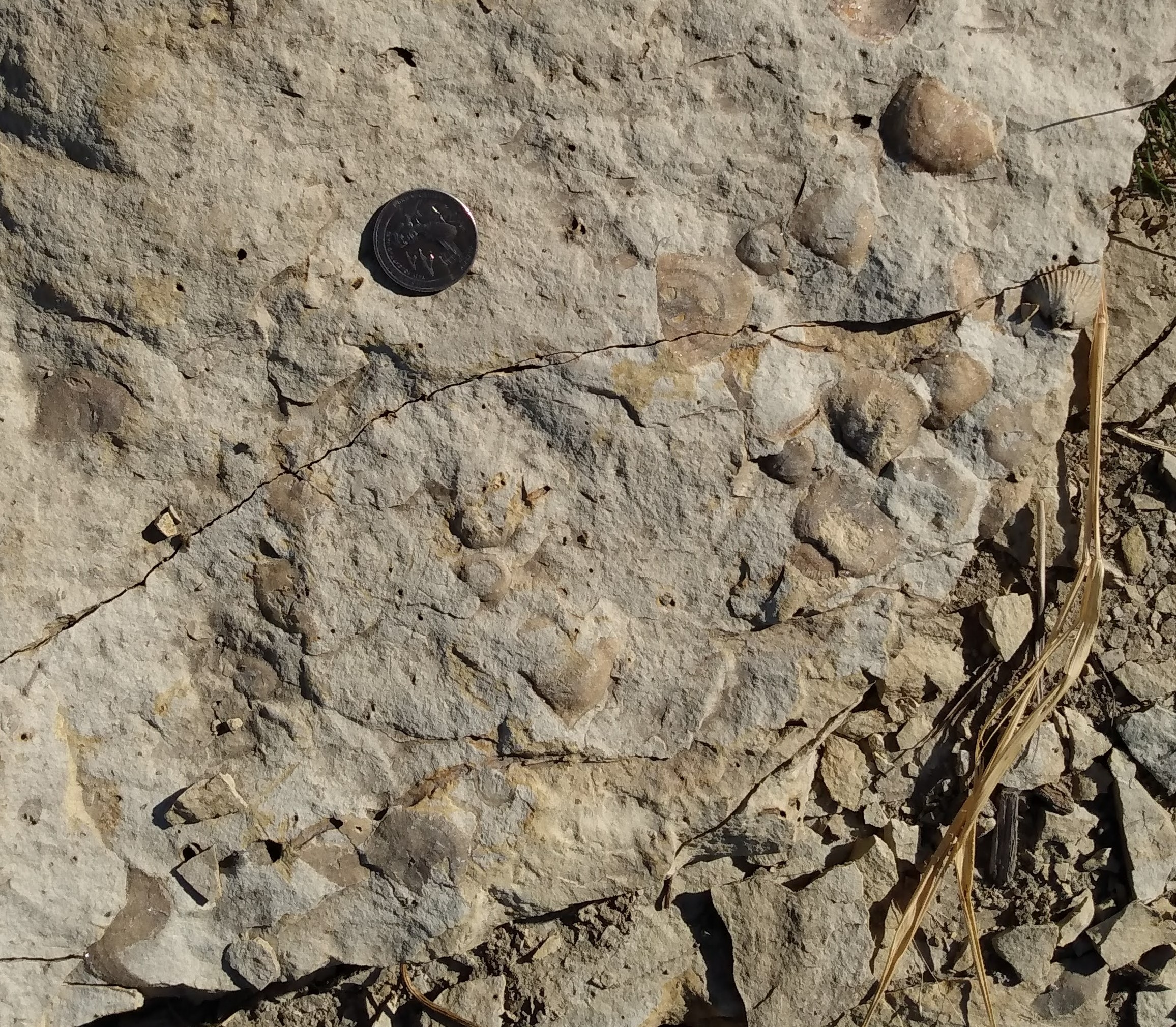
Many of the exposed bedding plane surfaces reveal the shell beds the Magnolia is known for. The fossils are almost entirely brachiopods (with a few snails) and are represented by dolomitized molds and casts, giving them that characteristic sugary appearance.

See the little bumps? Brachs.

Enlarge for a world of brachiopods.

Here's a closer view showing a few nice examples, representing multiple species.

Also, just for fun, some of the stones used for landscaping are loaded with burrows.

If you stop by, please don't attempt to remove the fossils; it's a park, after all, and the fossils aren't really going to come off in one piece because they're molds and casts. Just enjoy the experience of walking on the seafloor without ever getting wet!