Showing posts with label crinoids. Show all posts

Monday, October 7, 2024

Rockford, Part 2: Fossils (exclusive of brachiopods)

Before we get into the festivities, I've recently written an article for the online magazine Agate, about identifying common Paleozoic fossils of Minnesota. It's a compact summary that covers the most abundant groups, so if you're looking for something like that, go have a look!

In our previous post we had a look at the geology of the Fossil & Prairie Park Preserve of Floyd County, Iowa, also known as the Rockford site. For this post I'm going to briefly detail the fossils I collected, with the exception of the brachiopods, which will get a post of their own. For most of the non-brachiopods, I didn't get too far into the weeds on taxonomy, because many of the groups don't lend themselves to simple eye-checks for genera and species. Horn corals and bryozoans, for example, usually require thin sections, and crinoid columnals are generally only diagnostic of the presence of crinoids. I did, though, have recourse to Fenton and Fenton (1924) and other peoples' identifications to get some ideas.

Tuesday, April 30, 2024

Uŋčí Makhá Park 2024: another winter, more echinoderms

Two years after opening, Uŋčí Makhá Park can be considered a paleontological gem in the Twin Cities. With its Magnolia Member bedding planes, side cuts through the Magnolia and Carimona, easy access, and lack of vehicle traffic, it's nigh-on perfect for getting in touch with St. Paul as it was about 454–453 million years ago. It's kind of like our own Carnegie Quarry wall, except it's tiny marine invertebrates rather than dinosaurs, it probably wasn't planned, and you can walk right out over it. It's always fun to get to spend time there for work, and like last year, I got the opportunity to assist with a training session for Mississippi National River & Recreation Area seasonals there. Then, of course, I just had to make a quick return trip later to follow up on some things we'd seen.

Thursday, August 31, 2023

Fossil Collections of the Ancestral Puebloans

Although the ancient biological origin of fossils has only been widely appreciated in the past couple hundred years, people have collected fossils for various reasons for millennia. One of my favorite instances is recorded by Roman biographer Suetonius, who noted that Augustus had a collection of bones of "sea and land monsters" at Capri. (By the way, if you're also a sucker for ancient history as written by ancient historians, "The Twelve Caesars" is a great book.)

One of the things I've come across working with National Park Service paleontology is that the Ancestral Puebloans, represented by numerous locations in the NPS, had a notable interest in fossils. This is something that took a while for me to realize because most of the evidence is in the archeological literature and as a paleontologist, I didn't know to look in it. On the flip side, the archeologists generally didn't make a big deal of finding run-of-the-mill fossils among the artifacts at their sites; for them, fossils were just one class of objects among many. I haven't made an exhaustive survey, but a couple of sites stand out.

Pecos Pueblo is the namesake feature of the complex Pecos National Historical Park. The pueblo was excavated between 1915 and 1925 by Alfred Vincent Kidder of the Robert S. Peabody Museum of Archaeology (Phillips Academy, Andover, Massachusetts). Kidder (1932) reported finding "many hundreds" of fossils at Pecos Pueblo. They were predominantly marine fossils from "the limestone formations underlying the red sandstones of the valley", which appears to correspond to the Pennsylvanian-age Alamitos Formation of the Madera Group. Among these were corals, brachiopods ("bivalves" of the photo caption), snails, and crinoids. Not all were marine; among them was a partial rhino tooth, and there were also many pieces of petrified wood, including colorful Chinle wood and brown or gray wood typical of the area southwest of Santa Fe, possibly selected for its unusual cleavage and the "clear, resonant tone which it gives when tapped". Kidder observed that the majority of the fossils were found in rubbish and suggested they were collected as curios, but I have to wonder. It takes some effort to collect hundreds of fossils (although admittedly Pecos Pueblo was inhabited for a long time).

Pecos Pueblo is hardly a patch on Pueblo Bonito of Chaco Culture National Historical Park, though. Pepper (1920) documented fossils in 18 rooms, not counting artifacts made of petrified wood. Most had just a few, but Room 12 is something else. Room 12 has a floor area less than 10 square meters (108 square feet; a bit less than 3.7 by 2.7 m or 12 ft by 9 ft), and when excavated contained a 1.5 m (5 ft) thick layer including the following:

  • 1,000+ small fossil shells
  • 300 fragments of crinoid stems
  • 140+ water-worn pebbles
  • 125+ chalcedony concretions
  • 125+ fragments of contemporary Pacific shells
  • 50 to 75 specimens of crystals or other rocks and minerals of beauty or interesting form

This is the largest intentional accumulation of fossils predating the rise of museums that I've come across. Furthermore, unlike Pecos Pueblo, a significant chunk of the paleontological collection could not have been collected more or less "in the backyard". Judd (1954) provided taxonomic identifications of some of the fossils from a re-excavation. Chaco Canyon is over Campanian (Late Cretaceous) bedrock. The taxa identified from Room 12 include several Pennsylvanian-age brachiopod species known from central New Mexico, a Cenomanian ammonite (Metoicoceras whitei) with its nearest occurrences in the Black Mesa area of Arizona, and a snail (Gyrodes compressa/Euspira compressa) known from Upper Cretaceous rocks of the Pacific coast of California. This is a gathering of fossils that took some effort.

What exactly were the inhabitants of Pueblo Bonito doing with 1,300+ fossils? Agostini and Notterpek (2020) suggest that the fossil shells, together with the water-worn pebbles and concretions, were symbolic of water and a "past watery world". The canyon itself would also be symbolic of the action of water. It's an interesting idea, although again I do marvel at the sheer number of fossils. The scientific romantic in me wonders if there was someone there who just found fossils and minerals interesting, maybe even had them arranged in some pleasing setup (even sorted by morphology), and perhaps cultivated the collection of rare and unfamiliar objects. Or, maybe concentrating all of those fossils in one small place amplified their power. Or, maybe it was something like a museum, or at least a place to display and contemplate these objects. But what do I know?

References

Agostini, M. R., and I. Notterpek. 2020. Cosmological expressions and medicine stones in the Ancestral Pueblo world. KIVA 86:(4):4030–427. doi: https://doi.org/10.1080/00231940.2020.1832406.

Judd, N. M. 1954. The material culture of Pueblo Bonito. Smithsonian Miscellaneous Collections 124.

Kidder, A. V. 1932. The artifacts of Pecos. Yale University Press, New Haven, Connecticut.

Pepper, G. H. 1920. Pueblo Bonito [large file]. Anthropological Papers of the American Museum of Natural History 27.

G. Suetonius Tranquillus. 121. The twelve Caesars. Penguin Books, London, England. 1989 reprint of 1957 translation by Robert Graves.

Sunday, June 4, 2023

Uŋčí Makhá Park Revisited, Part 2: Further Fossils

We're now up to the fourth entry in a completely unexpected series on the Platteville–Decorah rocks and fossils of Uŋčí Makhá Park. We've already seen the common fossils from the site, so for this go-round I'm focusing on rarities.

Saturday, December 31, 2022

Platteville fossils in Cottage Grove

Cottage Grove, Minnesota is not noted as a geological wonderland, although Cottage Grove Ravine Regional Park certainly has its charms if you are willing to put in a little shoe leather. There are also scattered outcrops of the St. Peter Sandstone. However, persistence may be rewarded. Back in November I came across a couple of small fossiliferous blocks in town.

The first thing to do was to figure out the stratigraphy. The rocks were not in situ, but they were not heavily worn, either; in other words, they hadn't fallen off a glacier. The rocks of the area included outcrops of the St. Peter, and initially I wondered if I'd stumbled on a stray carbonate lens in the upper part of the formation. A rather more likely identity, though, is as erosional lag from the Platteville. In fact, the rocks look not unlike the occasional poorly dolomitized intervals I've seen in the Mifflin, and the fossils are certainly appropriate.

A (relatively) large brachiopod shell, among numerous teeny-tiny crinoid columnals and other fragments.

They include a mix of the BBC (brachiopods, bryozoans, and crinoids). There is also one object that looks like a whorl of a small Phragmolites sticking out. A couple of notable features include the small size of the fossils, particularly the crinoids; and the density of small fossil fragments and elements.

A different relatively large brachiopod shell among numerous teeny-tiny crinoid columnals and other fragments; note some nice bryozoan fragments on the left.
A hash of tiny fragments.
See what looks like tire tread near the center? That's what reminds me of Phragmolites.

Before we sign off for the year, I'd like to note that for some reason, over the past few weeks the "Fossil Felids of the National Park Service" post has been attracting a few dozen views a week. (Considering I don't do any external promotion and have reduced my social media presence from "negligible" to "zero", this is a lot!) I have no idea where this is coming from (probably picked up by a group somewhere that doesn't register in stats) or why it should have attracted interest (well, felines, I suppose, or maybe Pleistocene megafauna or predators in general), but I'm not complaining! Someone who actually knows something about cats could probably make an interesting and well-attended series like "Your Friends The Titanosaurs".

Sunday, November 13, 2022

Quick Guide to Fossils at Uŋčí Makhá Park

So I went back to Uŋčí Makhá Park last weekend and spent a couple of hours taking photos of fossils, because it makes such an ideal place to see the upper Platteville fauna. After all, a winter of freezes and thaws may not leave these new exposures looking as nice as they do now. Here's a quick guide to what can be seen there. (Let's see how many photos I can squeeze into one post, and how many species I can misidentify!)

Determining where you are stratigraphically

First of all, I'd just like to reiterate the stratigraphy. Most of the vertical extent is in the Magnolia Member of the Platteville Formation, with the upper part composed of the Carimona Member of the Decorah Shale. I'm thinking more or less the entire extent of the Carimona is exposed, based on thickness; at any rate the next thing up would be the shaly part of the Decorah, and there isn't a trace of it to be seen. I'm suspicious because the difference is just so darn clear, but at this site there is an unmistakable color change between the two units: the Carimona is the upper blue-gray interval and the Magnolia is the light tan-gray interval below. The Deicke K-bentonite is the lower and thicker of the two bentonite gaps in the Carimona. (Note that the Carimona is sometimes supplemented or replaced by landscaping, but this is pretty obvious.) As you walk from south to north, the "floor" goes up stratigraphically, so it's not all one bedding plane but a gently rising series of planes, until by the exit you're close to the color change.

The color change is quite evident here. The Deicke K-bentonite is the cut-in about halfway up the blue-gray Carimona (above the scale bar in the center of the photo).

Here we've gone north, and the floor has risen. The Deicke is still the seam in the middle of the blue-gray rocks.

Saturday, April 30, 2022

Synchronicity of Large Crinoids

I was recently out of town for work, and one of the things I saw was Middle Pennsylvanian-age building stone with stem segments from large crinoids:

Big ol' crinoids

It's like bony fingers strewn on the ground

You'd think with all this stem, there'd be a calyx somewhere, but no dice

At a shade over 1 cm (about 0.4 in) in diameter, the columnals are quite a bit bigger than garden-variety columnals, but still are well shy of world champ columnals, which reportedly exceed 2.5 cm (1 in); certainly much bigger than anything in Minnesota, right?

Yes! Time for the ironic photo!

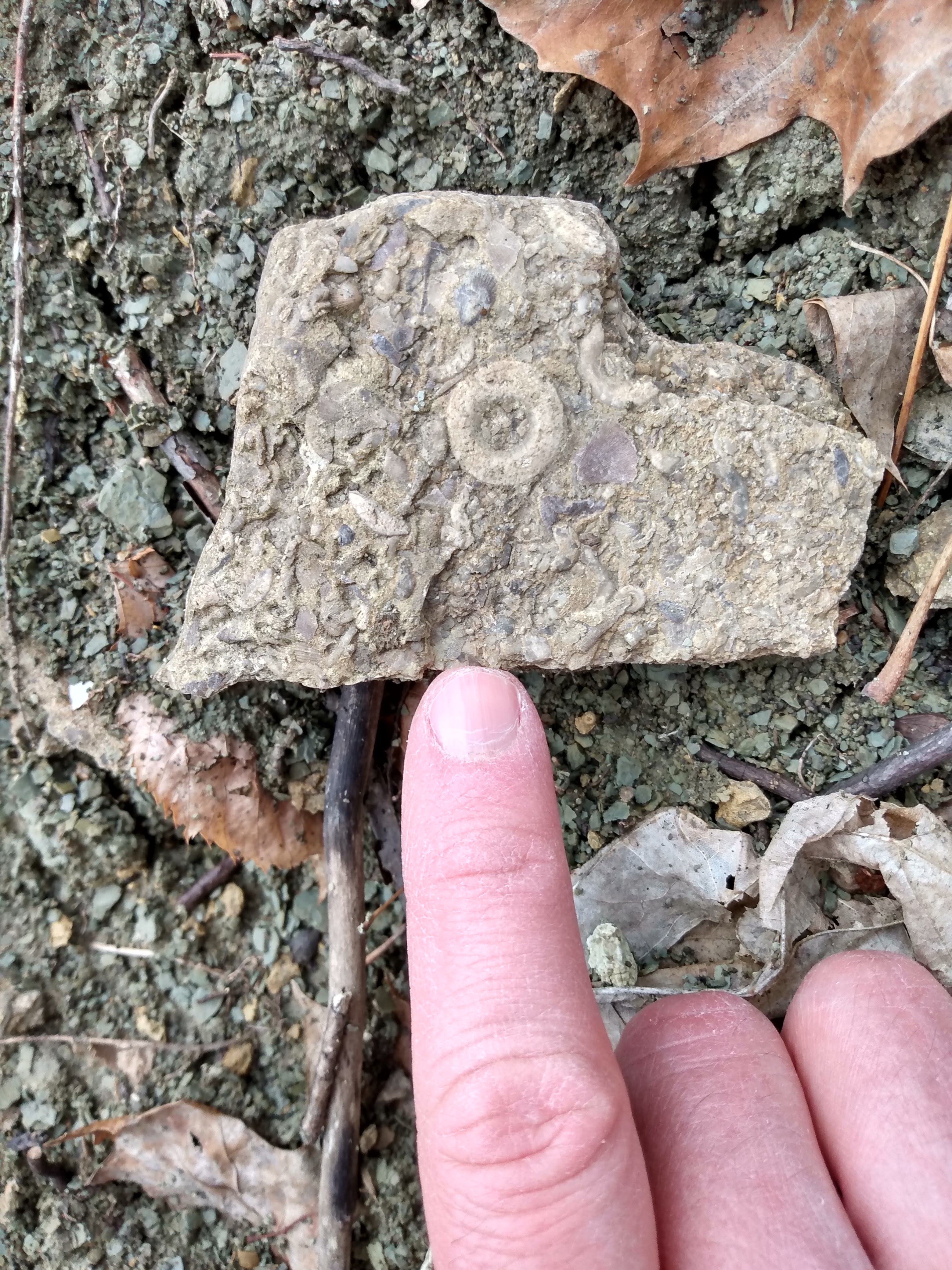
Only yesterday, less than a week after returning from the above trip, I was visiting a couple of Decorah Shale sites and came across the above specimen. I happened to be caught short of a traditional scale bar, so you will have to take my word that the fingernail of the above finger is 1.1 cm (0.43 in) across at its widest point. Therefore, that columnal is 1.5 cm (0.59 in) across, which is pretty darn big for anything in the Decorah except for certain trilobites. In fact, it made me wonder if the stone might be a ringer transported from another formation, by glacier, river, or what-have-you. (Not impossible at all; here's a neat report on all kinds of exotic rocks and fossils found in Mississippi gravel, including Lake Superior agates and Sioux Quartzite; closer to home, a piece of an Upper Cretaceous ammonite was once found at the Brickyard, as related in Cobban and Merewether 1983:19.) However, the chunk shows no evidence of transport, and lithologically it looks the same as any piece of thin limestone eroded out of the Decorah. Were it not for the great honking columnal, I wouldn't have thought twice about its legitimacy. (I wouldn't even have thought once!) My guess is that this particular specimen originated from higher in the formation than the stuff I usually see, or that great honking crinoids were a very minor part of the Decorah fauna and this just happens to be my first encounter.

References

Cobban, W. A., and E. A. Merewether. 1983. Stratigraphy and paleontology of mid-Cretaceous rocks in Minnesota and contiguous areas. U.S. Geological Survey, Washington, D.C. Professional Paper 1253.

Sunday, April 10, 2022

Mitchell Caverns

Back in the fall of 2021, I made a work visit to Mojave National Preserve, located logically enough within the Mojave Desert of southern California. While there, I had the opportunity to tour Mitchell Caverns. Mitchell Caverns is in the unusual position of being part of a state land parcel (Mitchell Caverns Natural Preserve or State Natural Preserve, depending on the source), entirely surrounded by another parcel of state land (Providence Mountains State Recreation Area), which is itself surrounded by a National Park Service unit (Mojave National Preserve). For good measure, the cave system is also a National Natural Landmark. It's parks all the way down in the Providence Mountains. (To be fair, the natural preserve designation is kind of a map artifact; it's not really distinct from the state recreation area.)

Sunday, September 5, 2021

Bryozoan Overload

Sometimes you look at a slab, and you notice one special thing about it. "That's a nice Isotelus hypostome." "Neat strophs." "Look at that Phycodes!" In this case, it's "Gee, that's a lot of bryozoans!"

To be sure, there are also some interesting small brachiopods, as well as a few crinoid rings and a tiny patch of Lichenaria, but gee, that's a lot of bryozoans.

(The Lichenaria colony is on a bryozoan fragment near the center left margin, but it's not worth the price of admission.)

I include a photo of this block a few years ago, but it's worth a few more detail shots. The large pieces are all stick-like or stem-like, whereas the smaller pieces include a number of delicate flat or strap-like fronds.

Branching straps plus a few different brachiopods.

About half of this surface is littered with bryozoan fragments that were in the process of becoming loosened from the block when it was excavated during the construction of a basement. Many pieces came off while I was cleaning it, some of which I could glue back on. (Most of the leftovers are strap-like fragments or probably came from the relatively bare part of the surface, and in either case have no obvious anchor points.) Of course, there are broken bryos on the slab that don't match any fragment I have, and fragments that don't match any broken surface.

Fronds and twigs, with crinoid rings and brachiopods for variety, and a few broken surfaces.

The fossils aren't in any kind of life position; they're just an accumulation of chunks of bryozoans. Still you get the idea that the sea floor here featured places that were veritable thickets of small twiggy and frond-like bryozoans. To all you time travelers: probably not recommended for bare feet.

It's bryozoans almost all the way through, as well.

Sunday, August 30, 2020

Ammonicrinus

Nothing too heavy today; I just wanted to draw your attention to a very unusual crinoid, Ammonicrinus from the Early and Middle Devonian of Europe and north Africa. While we're used to the idea that crinoids are either stalked things with spindly arms, or free-floating things with spindly arms, not all of them stuck to this body plan. Some of them evolved an enrolled body plan, such as Myelodactylus, which as a fossil looks a bit like a curled-up millipede. Some of them went even farther, like the subject of today's post (and see Bohatý 2011 for much more information).

Yes, this is a crinoid, just... different. Figure 1 in Bohatý (2011). CC-BY-4.0.

Ammonicrinus came in three great flavors: stalked and with a shielded but exposed crown ("exposed roller-type", seen only in the early history of the genus); stalked and with an entirely enrolled crown, most of the animal laying on the seafloor ("encased roller-type"); and barely stalked with an entirely enrolled crown, perched on a brachiopod shell ("settler type"). For the remarkable "encased roller-type", the base was a holdfast attached to something, which was followed by several large, bead-like columnals. Then the columnals began to widen and flatten into broad concave-convex structures, shaped something like brackets in cross-section. These bracket-shaped columnals then turned into a much narrower section which connected to a stocky crown. The crown and the thinner columnals were wrapped up within the broader bracket-shaped segments, with just enough space on either side to pass water through. For good measure, the segments were also decorated with long, articulated, echinoid-like spines (Bohatý 2011).

An early Ammonicrinus, of the "exposed roller-type". Figure 6 in Bohatý (2011). CC-BY-4.0.

What could have possessed the ammonicrinids to go in this direction? One possibility is that everything is tied to making an end-run around other crinoids. Typical crinoids would filter higher in the water column; Ammonicrinus could have the lower levels all to itself. The drawbacks are that the crinoid would be more exposed to predation from benthos (it's hard to believe that anything would willingly eat a crinoid, but there's no accounting for taste), and would be more vulnerable to fouling from the muddy bottom. Ammonicrinus addressed the issue of predation by protecting its crown via enrolling; the spines would have also offered protection. The spines would have also helped to brace the animal against the unstable bottom environment. To keep water flowing and to clear itself of sediment, it could rock the enrolled part of the skeleton, which would force water through the crown (Bohatý 2011).

An Ammonicrinus doing its thing, rocking to promote a current. Figure 14C in Bohatý (2011). CC-BY-4.0.

References

Bohatý, J. 2011. Revision of the flexible crinoid genus Ammonicrinus and a new hypothesis on its life mode. Acta Palaeontologica Polonica 56(3):615–639.

Sunday, May 10, 2020

Revisiting Shadow Falls Park

I like to periodically recheck various sites along the Mississippi corridor, to see how the elements are treating them, if there have been any major rock falls, damage from downed trees, changes in usage, etc. One of the places I get to more frequently than others is Shadow Falls Park. It has an informal reputation for collecting and is a place with soil on steep slopes (plus access is good and I like going there).

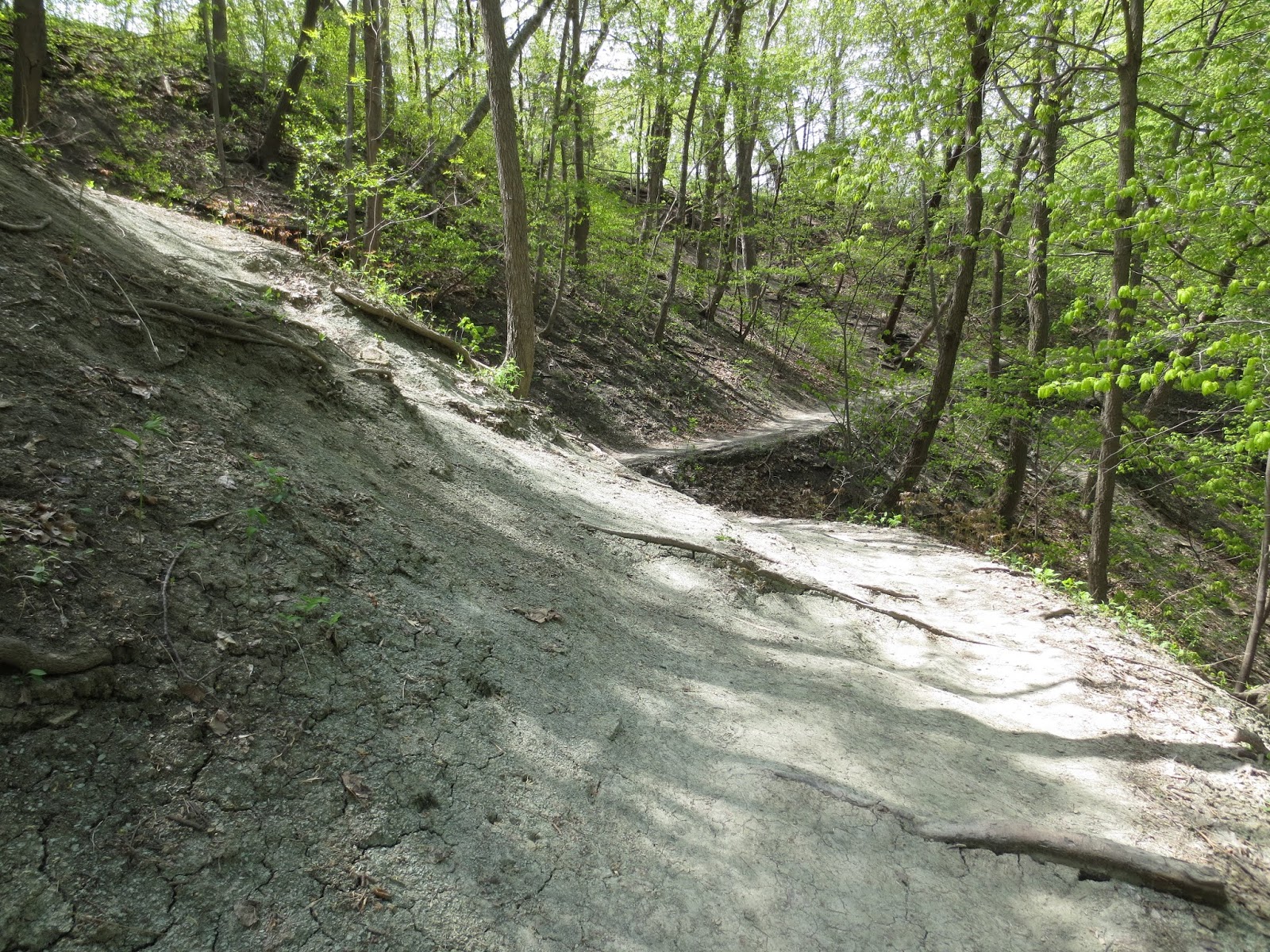
Here's the trail on the south side of the valley past the falls (which are essentially just to the right and a little below the vantage point of this photo).

Erosion may not be immediately evident if you don't have something to measure the loss of sediment, but in places with tree roots near the surface on the slopes it's easy to see how running water and gravity have done their work.

Almost a staircase of roots.

The usual array of lower Decorah fossils was present, in small chunks of rock and loose. It seemed to be a particularly good day for observing strophomenids (in the hash plates, primarily; they tend to break up otherwise). One example in the photo below is probably Rafinesquina, based on the thinness of the valve. This genus is named after Rafinesque, who we met last week and had a much more substantial career than getting into arguments about sloths. Another nice piece observed was a Bumastoides pygidium.

A. Probable Rafinesquina valve. B. Bumastoides pygidium

In one area I observed two pieces of a larger specimen of Rauffella palmipes. This is all catch-and-release, of course!

Two fragments of a large Rauffella palmipes.

Shadow Falls includes not only the falls, but a long valley oriented east-west with its head near but not quite reaching Cretin Avenue. I haven't spent much time in the valley above the falls because the area right above the falls tends to turn into a muddy swamp, but it's been a dry spring. The creek feeding the falls is in a very deep valley for its size, but would have been somewhat bigger in the days before sewers and roads.

The creek valley above Shadow Falls...

...opens up into this near its head.

There are several large fossiliferous blocks along the creek that include crinoid columnals notably larger in diameter than the run-of-the-mill lower Decorah columnals (note that the photo in the linked post is biased to larger, more photogenic columnals). The obvious guess is that they were brought to the area by glaciers and represent a different part of the stratigraphic column, say the upper Decorah or one of the overlying Ordovician formations that have been stripped from the area.

Large columnals

Sunday, February 18, 2018

Identifying invertebrate fossils

Pop quiz! (don't worry, it's not for credit)

Romance *and* brachiopods

Here we have an assortment of fossils, tastefully arranged in a holiday-appropriate setting. They're all the typical local Ordovician stuff, but many Paleozoic shallow marine formations will have a lot of the same general things. What are they, and how can you tell?

Sunday, December 17, 2017

Decorah crinoids revisited

Here in the Land of 10 Billion Crinoid Columnals, it's nice to be reminded that we do occasionally find a little more of the beast. I touched on the background of the metro crinoids in the crinoid post a couple of years ago. To quickly summarize: for whatever reason the paleontologists of the Minnesota Geological and Natural History Survey did not include echinoderms in the great monograph summarizing their work, although there were clearly plans to describe some crinoids, and Edward Oscar Ulrich did get to describe Cremacrinus punctatus; Frederick Sardeson described portions of the crinoid fauna in the first few decades of the 20th century; and the whole shebang was done up by Brower and Veinus in 1978. Their work was based around the University of Minnesota collections, largely collected by Sardeson. In his several decades of collecting, he amassed about 50 crinoid crowns and cups and several thousand plates (Brower and Veinus 1978), so if you're wondering why you haven't found any, it's because he got them all first. Here are a few highlights of the collection.

Sunday, October 22, 2017

Sunday morning Decorah fossils

I've recently made a small collection of Decorah Shale pieces from spoil piles at a construction site. Most of them will go to other people and groups for use in education, but while I've got them I'm certainly going to take the opportunity to photograph them. Incidentally, construction can be a good source of fossils in the Twin Cities, if you don't mind disruption of the original stratigraphic context (which tends to happen anyway with the Decorah around here). Of course, as always, you'll want to ask for permission, and it's advisable to make collections when someone is working there, so you aren't mistaken for a trespasser or other nefarious sort.

Sunday, July 10, 2016

Dystactophycus, the crinoid swirl

A few weeks ago, a friend brought in an odd object to the Science Museum, which he had collected from an excavation in the vicinity. The object is a carbonate rock featuring concentric ridges that seem to be radial around a central depression. On the off-chance that it was some kind of exotic trace or trace-like pseudofossil, and that it had been illustrated, I went across the hall, pulled the volume of the Treatise on Invertebrate Paleontology that covers traces, and was pleasantly rewarded in the pseudofossil section with an illustration of something called Dystactophycus. The illustrated specimen was even from the Cincinnatian, which is practically as good as the Platteville/Decorah, being just a couple of million years younger. Of course, when something comes this quickly I'm honor-bound to be suspicious, but in this case the actual existence of something like Dystactophycus is more interesting than the question of whether or not I was right. (I do get back to the question of identity in the last paragraph.)

Dystactophycus, as currently understood, is one of those things that makes perfect sense once you've heard of it, but otherwise would probably never occur to you. It is composed of concentric markings on a conical structure. The initial describers (Miller and Dyer 1878) interpreted it as a seaweed, because the year was 1878 and the campaign to wrap peoples' minds around invertebrate trace fossils was far from being over. In short order, it was dismissed as an impression of a concentrically ringed bryozoan (Monticulipora by way of Lichenalia concentrica, both then considered corals) (James 1885, 1895–1896). More recently, Dystactophycus has been attributed to crinoids (Osgood 1970; Meyer and Davis 2009). As Osgood described it, the earlier researchers had the thing upside down: instead of an upward-pointing cone, the center was a low depression. The stem was partially buried by mud and the rest of it was spun around by swirling currents, causing its arms to sweep out an area that became the depression and quite naturally leave concentric markings. At some point, the crinoid detached, and the depression filled in the absence of the sweeping action. Although kind of like a trace fossil, these markings are not trace fossils because they are not evidence of biological activity. Think of them more like an Ordovician equivalent to marks left by a log on a river bottom (tool marks, in the parlance). (If you'd like to see a true crinoid trace, check this out!)

The specimen in question (I didn't have a scale handy, so my fingertips will have to do). Although similar in some ways to Dystactophycus, I don't think it's an example.

So, do I think that the specimen in hand is an example of Dystactophycus? Although it is superficially similar to the description, there are a couple of characteristics that lead me to say "no". The major issue is that the specimen is not a simple cone shape. Instead, after rising from the center, it slopes again (so kind of a doughnut shape), and the concentric lines are not confined to the cone but continue on the back side. In addition, the markings are not so much grooves and ridges but concentric terraces. My guess instead is some sort of abiotic sedimentary deformation.

References:

James, J. F. 1885. Fucoids of the Cincinnati Group. Journal of the Cincinnati Museum of Natural History 7(4):151–166.

James, J. F. 1895–1896. Manual of the paleontology of the Cincinnati Group, Part VII. Journal of the Cincinnati Museum of Natural History 18(3–4):115–140.

Meyer, D. L., and R. A. Davis. 2009. A Sea Without Fish. Indiana University Press, Bloomington and Indianapolis.

Miller, S. A., and C. B. Dyer. 1878. Contributions to Paleontology 2.

Osgood, R. G., Jr. 1970. Trace fossils of the Cincinnati area. [regrettably, the plates are not included] Palaeontographica Americana 6(41):280–444.

Thursday, March 24, 2016

Mostly bryos and burrows

It's still a little early to be out and about in the metro rocks and expect good luck (for one thing, the Decorah is still in winter-spring-transition mud mode) or consistent weather, but we're getting close, and sooner than usual. Here's one seasonal photo and then a few interesting pieces I hadn't featured before. These are all photos of Decorah Shale fossils from the St. Paul side of the river.

Lower Decorah a couple of weeks ago, after having been relatively warm and dry for several days. These two fragments were covered with half-burrows (imagine a tubular burrow split along its long axis), and several other pieces from the same area and probably a similar stratigraphic level had the same kind of abundant half-burrows.

Sunday, July 26, 2015

Crinoids

For the fossil enthusiast in Minnesota, there are few groups with a bigger gap between "what they show in the books" and "what you actually find" than crinoids. The ideal of a crinoid fossil is a long segmented stem or stalk connected to a cup-like structure crowned by a group of delicate feathery arms. The Digital Atlas of Ordovician Life and the UGA Stratigraphy Lab's pages on Cincinnatian fossils have many images of these ideal crinoid fossils, if you're feeling like living vicariously. The reality in Minnesota is a bit more like this:

Of course, they are not always found loose, but you get the idea.