Showing posts with label echinoderms. Show all posts

Sunday, June 1, 2025

The Find

A weekend or so back I traveled down to Whitewater State Park to participate in their Fossil Field Trip event. As part of this, visitors go to a site off of the park where they can hunt for fossils (participants can keep two). It was very well presented and attended! The site is in the Cummingsville Formation, which is the limestone that follows the Decorah Shale. (Actually, it's a bit more complicated than that: much of the Cummingsville Formation in Olmsted County is roughly the offshore equivalent of the more nearshore Decorah of the Twin Cities, so where we were is probably equivalent to a horizon in the upper half of the Decorah quarry walls at the Brickyard.) Unlike the distinctive green-gray Decorah, the Cummingsville presents as a tan unit. It's a shaly limestone at the site, so it doesn't quite have the strength of a pure limestone, but it does better than the Decorah.

Weathering Cummingsville at the site.

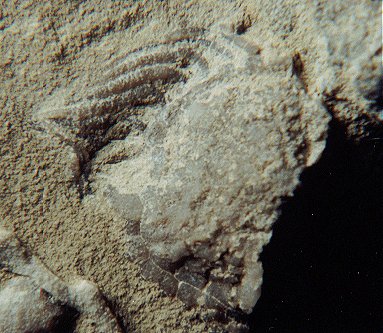
The Cummingsville is not as fossiliferous as the Decorah, even accounting for my different search image, and the site is a known fossil site, so the going was slow at the beginning. Then I found this:

Well, I did do a little prep work and applied water before taking this picture, and the rock is about palm-sized all told, but you get the idea.

I'd been hoping to find a receptaculitid, because those are common in the Cummingsville and I haven't found one, but this was something better. Even in an unprepared state it was obviously an echinoderm based on the plates, but what kind? A crinoid calyx? Something else?

If you know what the arrows are pointing to...

The prep work exposed the little vent-like features, meaning it was some kind of rhombiferan cystoid. The cleaning also made it more obvious where the plates met, which can be kind of confusing when there are all these ridges to mislead the eye.

A handy diagram! The dotted lines are where the plate edges become obscure or are lost.

If you don't know what it is, check this out:

Figure 1 from Parsley (1970), with red lines and dots added by me. Original image CC BY-NC-SA 3.0.

Yup, this is a Pleurocystites, or at least a good-sized chunk of one. Either P. squamosus (Parsley 1970) or P. strimplei (Brower 1999) would be appropriate for the Cummingsville; there's not really enough there to tell between them, but I'm not complaining! It's fun to be in the right place at the right time with the right knowledge and experience.

References

Brower, J. C. 1999. A new pleurocystitid rhombiferan echinoderm from the Middle Ordovician Galena Group of northern Iowa and southern Minnesota. Journal of Paleontology 73(1): 129–153. 

Mossler, J. H. 2008. Paleozoic stratigraphic nomenclature for Minnesota. Minnesota Geological Survey, St. Paul, Minnesota. Report of Investigations 65.

Parsley, R. L. 1970. Revision of the North American Pleurocystitidae (Rhombifera-Cystoidea). Bulletins of American Paleontology 58(260): 135–213. 

Sunday, January 7, 2024

Cottage Grove cystoid

I recently paid a return visit to the site in Cottage Grove where I'd previously spotted a few blocks with brachiopods/etc. of the typical Platteville persuasion. While there, a few true outcrops were visible under the snow-free conditions of the so-called winter of December 2023, confirming that the Platteville is indeed at the surface and not just present as lag or buried under a bad toupee of soil and glacial debris. More significant was one of the blocks. See if you can spot what drew my attention:

Any ideas?

How about if we go in closer on the area of interest?

If you answered something along the lines of "the thing near the center that looks kind of like a truncated letter K", you've won! I snapped a couple of pictures thinking it might be echinoderm in origin and moved on. Later, upon reviewing the photos, the rectangular bit below it caught my eye; that definitely looked echinoderm. In fact, there is only one kind of thing it could belong to, as proclaimed by the chevron arrangement of slots on it surface. This is a plate from a rhombiferan cystoid bearing a pore rhomb in a pectinirhomb configuration. ("Of course!" you shout.) (Okay, so I looked up the anatomical terminology). Basically, the slots are vents for the animal's water circulation system.

This rock was obviously a good candidate for further study and photography, so I took some more photos with the hope of doing some taxonomy. Further inspection revealed a couple sharply ridged features similar to the "K", but more weathered.

There's a pretty well-developed one in the upper right, and one that is more poorly exposed near the left side.

When I first noticed the "K", I thought it might be ridges on a crinoid plate, but local crinoid plates don't usually have such sharp ridges. Instead, it turns out that there is a Platteville cystoid that does, Coronocystis durandensis. Coincidentally, this particular cystoid also has pore rhombs that are a good match for the pore rhomb plate on this rock (see photos in Kolata 2021).

Here close-up and with a tiny drip of water applied. There is also a gray rectangular ridge visible near the right border that I suspect to be another plate, but it's not as well-exposed.

I hesitate to make a firm identification from the available material, but it certainly appears that we have Coronocystis or something very similar. Coronocystis is interpreted as a stalked rhombiferan cystoid, unlike its free-thrashing cousin Pleurocystities (which does pore rhombs differently and has softer ridges). I interpret the block as from the Mifflin Member of the Platteville, but I suppose it could be higher. Whatever the exact identification at the genus or species level, this is clearly a rhombiferan cystoid, and the first I've ever seen in the field (and I'm pretty sure the first record from Cottage Grove). Plus, the several bits suggest a disarticulated but fairly associated specimen.

References

Kolata, D. R. 2021. Fossils of the Upper Ordovician Platteville Formation in the upper Midwest USA: an overview. Illinois State Geological Survey, Prairie Research Institute, University of Illinois at Urbana-Champaign, Champaign, Illinois. Bulletin 108.

Sunday, August 30, 2020

Ammonicrinus

Nothing too heavy today; I just wanted to draw your attention to a very unusual crinoid, Ammonicrinus from the Early and Middle Devonian of Europe and north Africa. While we're used to the idea that crinoids are either stalked things with spindly arms, or free-floating things with spindly arms, not all of them stuck to this body plan. Some of them evolved an enrolled body plan, such as Myelodactylus, which as a fossil looks a bit like a curled-up millipede. Some of them went even farther, like the subject of today's post (and see Bohatý 2011 for much more information).

Yes, this is a crinoid, just... different. Figure 1 in Bohatý (2011). CC-BY-4.0.

Ammonicrinus came in three great flavors: stalked and with a shielded but exposed crown ("exposed roller-type", seen only in the early history of the genus); stalked and with an entirely enrolled crown, most of the animal laying on the seafloor ("encased roller-type"); and barely stalked with an entirely enrolled crown, perched on a brachiopod shell ("settler type"). For the remarkable "encased roller-type", the base was a holdfast attached to something, which was followed by several large, bead-like columnals. Then the columnals began to widen and flatten into broad concave-convex structures, shaped something like brackets in cross-section. These bracket-shaped columnals then turned into a much narrower section which connected to a stocky crown. The crown and the thinner columnals were wrapped up within the broader bracket-shaped segments, with just enough space on either side to pass water through. For good measure, the segments were also decorated with long, articulated, echinoid-like spines (Bohatý 2011).

An early Ammonicrinus, of the "exposed roller-type". Figure 6 in Bohatý (2011). CC-BY-4.0.

What could have possessed the ammonicrinids to go in this direction? One possibility is that everything is tied to making an end-run around other crinoids. Typical crinoids would filter higher in the water column; Ammonicrinus could have the lower levels all to itself. The drawbacks are that the crinoid would be more exposed to predation from benthos (it's hard to believe that anything would willingly eat a crinoid, but there's no accounting for taste), and would be more vulnerable to fouling from the muddy bottom. Ammonicrinus addressed the issue of predation by protecting its crown via enrolling; the spines would have also offered protection. The spines would have also helped to brace the animal against the unstable bottom environment. To keep water flowing and to clear itself of sediment, it could rock the enrolled part of the skeleton, which would force water through the crown (Bohatý 2011).

An Ammonicrinus doing its thing, rocking to promote a current. Figure 14C in Bohatý (2011). CC-BY-4.0.

References

Bohatý, J. 2011. Revision of the flexible crinoid genus Ammonicrinus and a new hypothesis on its life mode. Acta Palaeontologica Polonica 56(3):615–639.

Sunday, April 22, 2018

Foerstediscus splendens, a Minnesotan in Washington

Because I was in northern Virginia, I thought I'd visit the National Museum of Natural History. While nosing around the Ocean Hall, I ran into another Minnesotan: the holotype specimen of the edrioasteroid Foerstediscus splendens (Bassler 1936). I couldn't get right up to due to the glass, so the photos aren't the clearest and there's no scale, but it's still a fine specimen, and somewhat larger than I expected following my experience with the minuscule Pyrgocystis (for reference, it's described as 3 cm across, a little more than an inch).

Points to you if you too noted "Middle Ordovician"; with redefinition and redating of the Ordovician, "Late Ordovician" would be more accurate.

Here's a closer view of the specimen. "S. 4079" is the Smithsonian's number; it was originally a University of Minnesota specimen, UMPC 4742a, but it was donated to the Smithsonian (Rice 1990). From my own experience with the UMPC fossils, I think all of the edrioasteroids they had on hand by approximately the mid-1930s went to the Smithsonian at Bassler's request, with the specimens I photographed coming with Sardeson's collections a few years later.

"Edrioasteroid" means "seated star", which is reasonably self-explanatory.

Edrioasteroids are among the rarest fossils from the Decorah and Platteville formations of Minnesota, with their other competition in that category being other echinoderms such as sea stars and cystoids. Seeing as how these fossils are very rare here except in certain places such as the former Johnson Street Quarry, the obvious scenario is that non-crinoid echinoderms only thrived under certain conditions that are poorly represented in the known outcrops of the Platteville and Decorah. (Alternatively, they *were* more common than we know, but they decomposed so completely to their constituent plates that they've been unrecognizable; be that as it may, though, the Platteville/Decorah echinoderm diversity doesn't seem to be as high as in other formations of similar age in the central US.)

Foerstediscus splendens was collected from the Ford Plant (Bassler 1936). Work on the Ford Plant, Ford Bridge, and Ford Dam (Lock and Dam No. 1) in the 1920s made that area a great place for collecting, as discussed in this post. Clinton R. Stauffer named 56 species of microfossils from collections at the bridge (Stauffer 1933, 1935), and August Foerste named the nautiloid Metaspyroceras perlineatum (Foerste 1932) from the vicinity of the plant and dam. F. splendens was found by Irving G. Reimana from the top of the Rhinidictya bed of the Decorah Shale (Bassler 1936), otherwise known as Bed 4 (Sloan 1987), or, a little more informally, the lower third of the Decorah Shale above the Carimona Member. (One of these days I ought to outline the bed divisions.) In more practical terms, Bed 4 is the Decorah you see at Shadow Falls, so the top of Bed 4 would be somewhere at or a little higher than the highest part of the ravine. Strangely, Stauffer and Thiel (1941) attributed Foerstediscus to the underlying Carimona Member, or Bed 3, despite Stauffer presumably being the one who gave Bassler the stratigraphic information in the first place.

Looking east from Minnehaha Park in June 2013, toward the defunct Ford Plant (across Lock and Dam No. 1, aka the Ford Dam).

The closure and dismantling of the Ford Plant over the past few years provide an unusual opportunity to look at current events in a geological frame of mind. The Ford Plant was a fixture of southwestern St. Paul for decades (and it happened to be there because there was a young river gorge carved by a post-glacial waterfall that could be harnessed for hydroelectric power, and because there was once a pure sandy beach that could be turned into auto glass). Its day is now over, though, and soon its former grounds will be rebuilt into something entirely different. Ten thousand years ago, mammoths and giant beavers roamed its grounds. Seventy million years ago it was probably a coastal plain near a sea filled with ammonites and marine reptiles. 454 million years ago edrioasteroids, nautiloids, and other marine invertebrates lived and died in a shallow tropical sea that had submerged the pure sandy beach. Underneath all of it are volcanic rocks more than a billion years old that fill a scar from Michigan to Kansas. Every part of history is made up of what came before it, and shapes what comes after it.

References

Bassler, R. S. 1936. New species of American Edrioasteroidea. Smithsonian Miscellaneous Collections 95(6).

Foerste, A. F. 1932. Black River and other cephalopods from Minnesota, Wisconsin, Michigan and Ontario (Part 1). Denison University Scientific Laboratories Journal 27:47–137.

Rice, W. F. 1990. Catalog of paleontological type specimens in the Geological Museum, University of Minnesota. Minnesota Geological Survey, St. Paul, Minnesota. Information Circular 33.

Sloan, R. E. 1987. History of study of the Middle and Late Ordovician rocks of the Upper Mississippi Valley. Pages 3–6 in R. E. Sloan, editor. Middle and Late Ordovician lithostratigraphy and biostratigraphy of the Upper Mississippi Valley. Minnesota Geological Survey, St. Paul, Minnesota. Report of Investigations 35.

Stauffer, C. R. 1933. Middle Ordovician Polychaeta from Minnesota. Geological Society of America Bulletin 44(6):1173–1218.

Stauffer, C. R. 1935. The conodont fauna of the Decorah Shale (Ordovician). Journal of Paleontology 9(7):596–620.

Stauffer, C. R., and G. A. Thiel. 1941. The Paleozoic and related rocks of southeastern Minnesota. Minnesota Geological Survey, St. Paul, Minnesota. Bulletin 29.

Sunday, December 17, 2017

Decorah crinoids revisited

Here in the Land of 10 Billion Crinoid Columnals, it's nice to be reminded that we do occasionally find a little more of the beast. I touched on the background of the metro crinoids in the crinoid post a couple of years ago. To quickly summarize: for whatever reason the paleontologists of the Minnesota Geological and Natural History Survey did not include echinoderms in the great monograph summarizing their work, although there were clearly plans to describe some crinoids, and Edward Oscar Ulrich did get to describe Cremacrinus punctatus; Frederick Sardeson described portions of the crinoid fauna in the first few decades of the 20th century; and the whole shebang was done up by Brower and Veinus in 1978. Their work was based around the University of Minnesota collections, largely collected by Sardeson. In his several decades of collecting, he amassed about 50 crinoid crowns and cups and several thousand plates (Brower and Veinus 1978), so if you're wondering why you haven't found any, it's because he got them all first. Here are a few highlights of the collection.

Sunday, June 5, 2016

Oklahomacystis

Something I'd hoped to find at Chickasaw National Recreation Area was an example of Oklahomacystis. The Bromide Formation is one of the great rock units for echinoderm diversity, and Oklahomacystis is one of the classic forms. Unfortunately, we didn't end up getting into the Bromide in the recreation area, although it should be there, so it will have to wait for another time. I did see plenty of Oklahomacystis in the collections of the Sam Noble Museum, as well as one slab featuring a group of them at the Travertine Nature Center in the recreation area. Here are some photos of the slab:

Oklahomacystis tribrachiatus

Other photos of the same slab are on the Internet, but my photos may be the only ones without the glass, so they've got that going for them. The scale is important, because for some reason, when taken without it, the fossils look to be about the size of dates, when they are actually more like the size of the first joint of a finger. The fossils represent the body, or "theca".

Mysteriously larger

These are visually unusual fossils, looking something like a pine cone, or a pineapple, or a cluster of berries, or a grenade. A close look shows that their surfaces are covered by shared circular arrangements of six (usually) wedge shapes, kind of like Trivial Pursuit pies that share wedges with other pies. If you're familiar with the kinds of words that are frequently used in scientific names, you may have already guessed that we're dealing with an echinoderm. If you guessed "paracrinoid", congratulations, either you are really good with echinoderms or you already know something about Oklahoma's fossils.* A paracrinoid is one of the numerous varieties of stalked echinoderms that flourished for a relatively brief span of time during the Paleozoic and then went extinct. The name suggests affinities with crinoids, but it should be noted that sometimes they are classified more distantly, with relatives to blastoids ("sea buds") or as their own group distinct from either crinoids or blastoids. Like those two groups, a complete paracrinoid would have also featured a stalk attaching it to the seafloor. Presumably Oklahomacystis would have had a fairly simple feeding apparatus compared to crinoids, like the similar paracrinoids Amygdalocystites or Comarocystites (which looks quite a bit different because its thecal plates are strongly concave, giving it that "puckered hexagon" look that was such a craze in the Ordovician). Oklahomacystis had recumbent arms which are part of the thecal structure; as the species name "tribrachiatus" indicates, there are three of these (tri + brachi, meaning arm, which of course we know from Brachiosaurus, the "arm lizard". Snuck in a dinosaur!). Like the other two genera mentioned above, Oklahomacystis's filter feeding apparatus would have consisted of pinnules attached to the arms. If you'd like more technical information on paracrinoids, there's a monograph on the subject available here (no. 288; it just happens to name Oklahomacystis as well).

(*Oklahomacystis is sometimes identified as a cystoid echinoderm, as under the "Bromide Formation" page at Wikipedia. I hinted at this a little bit in a previous post, but in the past people have occasionally had recourse to shovel various enigmatic extinct echinoderms into the cystoids. I'd just stick with paracrinoids here.)

I'll be at an event for Interstate State Park next weekend, so expect some Cambrian in the next post. After that, I'll try to do something dinosaurian; otherwise they'll take away my card!

Thursday, April 21, 2016

And the state fossil of Minnesota is...

...nothing. Despite the map on "List of U.S. state fossils" [note, 2018/2/22: this has since been fixed], Minnesota does not have an official state fossil. There was a push to draft the giant beaver into this position, but the rodent fell short. The immediate political reason for its failure can be grasped from its scientific name: Castoroides ohioensis. Should the state fossil of Minnesota refer to another state? Certainly not!

Sunday, August 9, 2015

All of the other echinoderms

If you thought that echinoderms have a variety of seemingly unrelated body plans today (sea stars, crinoids, sea urchins, sea cucumbers...), you should have seen them during the Paleozoic, when several now-extinct classes populated the oceans. The group with probably the most recognition are the blastoids, or sea buds, which had stalks like crinoids but with a nut-like structure instead of a cup-like structure as the business end. The rocks of the Twin Cities area are not known to have produced blastoids, but they have produced rare examples of four other groups not including the crinoids we saw before. They are: asteroids (sea stars), rhombiferan cystoids, edrioasteroids, and stylophorans (a.k.a. carpoids, a.k.a. homalozoans). Three of these groups are extinct, and it doesn't take much to guess which. This diversity of echinoderms is not particularly unusual; Cincinnatian rocks have all the same classes as well as brittle stars and cyclocystoids (extinct and known mostly from their ring-like outer structures), and the Bromide Formation of Oklahoma, of comparable age, outdoes the Minnesota rocks handily. But for the luck of the cosmic draw, any of these extinct groups might be around today.

Sunday, July 26, 2015

Crinoids

For the fossil enthusiast in Minnesota, there are few groups with a bigger gap between "what they show in the books" and "what you actually find" than crinoids. The ideal of a crinoid fossil is a long segmented stem or stalk connected to a cup-like structure crowned by a group of delicate feathery arms. The Digital Atlas of Ordovician Life and the UGA Stratigraphy Lab's pages on Cincinnatian fossils have many images of these ideal crinoid fossils, if you're feeling like living vicariously. The reality in Minnesota is a bit more like this:

Of course, they are not always found loose, but you get the idea.