Showing posts with label mosasaurs. Show all posts

Saturday, October 11, 2025

Compact Thescelosaurus Year Ten

Twelve months have rolled along since our previous check on The Compact Thescelosaurus, now clocking in at a decade of existence. With Triassic and Jurassic pseudosuchians for the previous two years, the obvious addition was Cretaceous pseudosuchians, of which there were more than the previous two additions combined. The Cretaceous section wasn't quite so dominated by one group like the Jurassic was by thalattosuchians, but it was a great time to be a notosuchian.

Like this one, Simosuchus clarki. I took this photo when the traveling exhibit visited the Science Museum 11 years ago; Wikipedia is running a photo of the same mount from another stop on the itinerary.

Sunday, October 13, 2024

Compact Thescelosaurus Year Nine

October and National Fossil Day have rolled around again (check out the fall 2024 Park Paleontology News, too!), so it's time to take a look at the previous year's changes to The Compact Thescelosaurus and welcome some new content. First, the new stuff: I'm sure you'll be shocked to find out I've followed up Triassic pseudosuchians with... Jurassic pseudosuchians. I'm rearranging the pseudosuchian content a bit, to have the non-crocodylomorphs on one sheet and the crocodylomorphs on another. This was done to forestall the deployment of an unwieldy number of "subdivision" columns. Provided I get far enough along, something similar might have to happen with the new sheet around Crocodylia or so. Anyway, the main takeaways I got out of Jurassic pseudosuchians are 1) there's been a lot of work on thalattosuchians over the past couple of decades, and 2) I've discovered I'm not very fond of thalattosuchians and certainly don't mind that they conk out midway through the Cretaceous.

Hey, it's the Science Museum "Goniopholis" again! (Most Jurassic pseudosuchians are thalattosuchians, but North America is largely bereft of the darlings, so we make do with crocs like these.)

Sunday, October 8, 2023

Compact Thescelosaurus Year Eight

It's that time again, for National Fossil Day (October 11 this year), a new sheet for The Compact Thescelosaurus, and the annual summary of what was added to the spreadsheet in the past 12 months. In addition to National Fossil Day events this month, the latest issue of Park Paleontology News is up for viewing. Also in breaking NPS paleontology news: additional dating of the fossil human tracks at White Sands National Park, and a previously overlooked record of a tyrannosaur tooth at Yellowstone National Park. [Update, 2023/10/10: And a tritylodont bonebed at Glen Canyon National Recreation Area was just announced; goes well with this new paper on a massive track block from the recreation area, too.]

Here at Equatorial Minnesota, we've passed 400 entries this year. Later this year, December 15 will mark 10 years of posting. (Also, anyone know why this nautiloid post would have spiked in interest?) The Compact Thescelosaurus has been around for 8 of those years, and it's traditional to add a new sheet. For this year, first I considered all of Pseudosuchia (except for the aetosaurs, covered already), but decided against it due to the number of species. I then looked at doing just Mesozoic pseudosuchians before being discouraged by whatever it is Thalattosuchia has been doing over the past 200 years. So, for now it's just Triassic forms, with the intent to expand over time.

Prestosuchus threatening an Eoraptor in the "Ultimate Dinosaurs" exhibition at the Science Museum of Minnesota, May 2014.

Sunday, October 9, 2022

Compact Thescelosaurus Year Seven

Here we are at the second weekend of October, which means it's time for three things: National Fossil Day; a new sheet for The Compact Thescelosaurus; and our annual roundup of what's been added to the spreadsheet. National Fossil Day falls on Wednesday, October 12 this year, although events occur throughout the month (especially the weekends before and after), so check your nearest museum or National Park System unit for events! Our fall Park Paleontology newsletter is also up for viewing (including more fun with packrats).

Sunday, October 10, 2021

Compact Thescelosaurus Year Six

The time has come again for the annual review of The Compact Thescelosaurus. This year's new page is on aetosaurs and their close relatives, with the classification diagram page updated. (Don't forget, Wednesday the 13th is also National Fossil Day!)

Aetosaur Desmatosuchus spurensis is one of the subjects of the NPS Prehistoric Life Coloring Book. Coincidentally, an aetosaur also featured in the 2014 National Fossil Day artwork.

Sunday, October 11, 2020

Compact Thescelosaurus Year Five

It's time for the annual review of The Compact Thescelosaurus. As is traditional, there's a new sheet, which this year covers mosasaurs, as you might have guessed from the image. The classification diagram page has been updated as well. (Don't forget, Wednesday the 14th is also National Fossil Day!)

Mosasaurus conodon, hanging out at the Science Museum.

Sunday, July 5, 2020

Fossil Marine Reptiles of the National Park Service

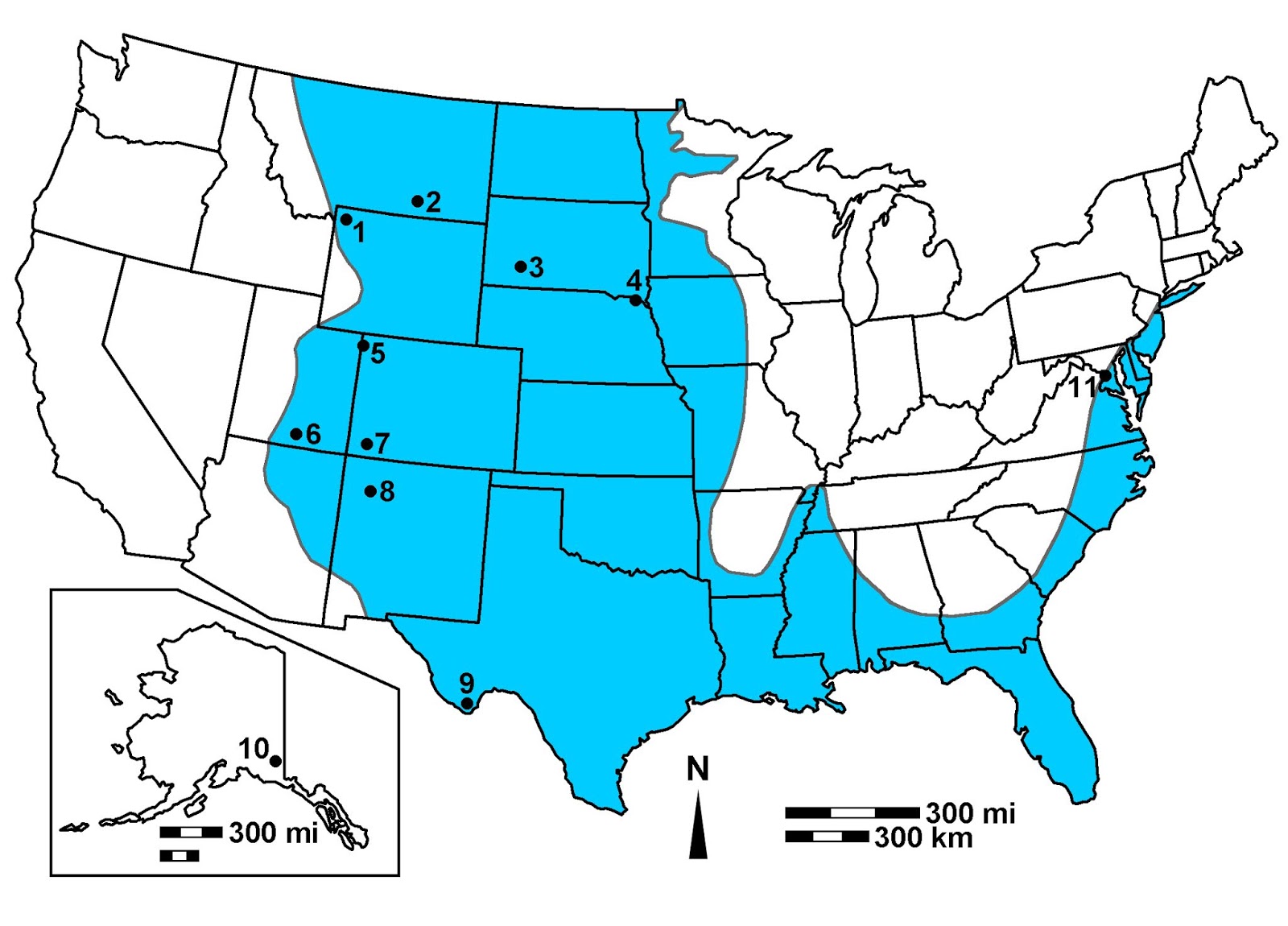
For my annual post summarizing a type of fossils from National Park Service lands, this time around we're going with Mesozoic marine reptiles: ichthyosaurs, plesiosaurs, and mosasaurs. As you might guess, most of the examples come from the rocks of the Western Interior Seaway. This time around, we're only dealing with eleven parks, so there's space for going into more detail. We'll start off with the traditional map, which includes a lovely blue overlay to give you an idea of the extent of shallow seas at their Cretaceous peak:

The outline of the seaway is roughly after Robinson Roberts and Kirschbaum (1995), with a more substantial Mississippi Embayment added and a bit more on the Atlantic Coastal Plain, which I let peter out in New England. No attempt has been made to reconstruct the marine extent on the Pacific coast. Also, Minnesota was improvised after Sloan (1964), due to Robinson Roberts and Kirschbaum (1995) having a text box over the state. Sites mentioned in the post are: 1. Yellowstone National Park; 2. Little Bighorn Battlefield National Monument; 3. Badlands NP; 4. Missouri National Recreational River; 5. Dinosaur NM; 6. Glen Canyon National Recreation Area; 7. Mesa Verde NP; 8. Chaco Culture National Historic Park; 9. Big Bend NP; 10. Wrangell-St. Elias NP and Preserve; 11. Fort Washington Park.

(Also, if you're interested in cave fossils, check out our recently finalized paleontological inventory for Carlsbad Caverns NP!)