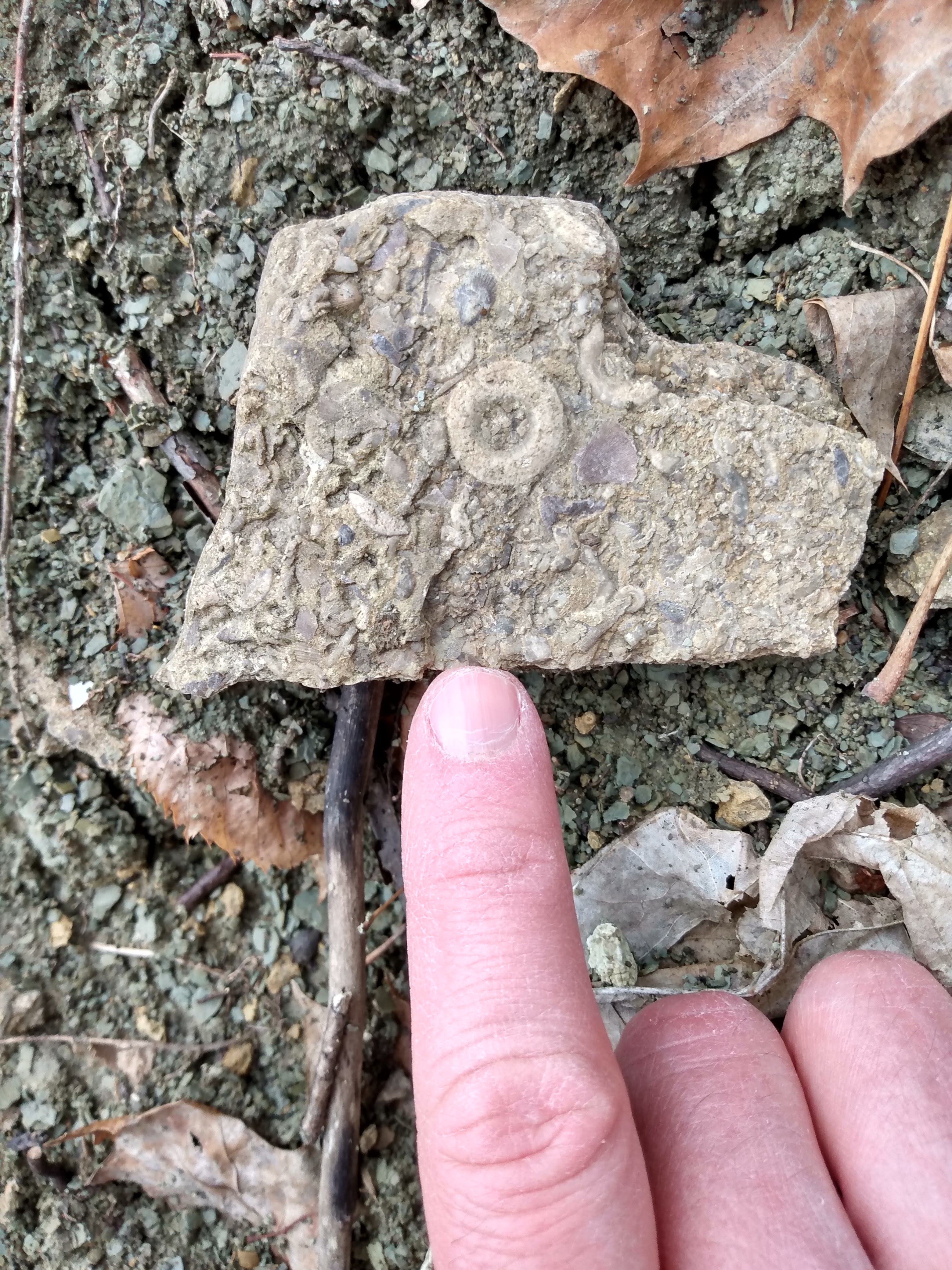
Showing posts with label Pennsylvanian. Show all posts

Thursday, August 31, 2023

Fossil Collections of the Ancestral Puebloans

Although the ancient biological origin of fossils has only been widely appreciated in the past couple hundred years, people have collected fossils for various reasons for millennia. One of my favorite instances is recorded by Roman biographer Suetonius, who noted that Augustus had a collection of bones of "sea and land monsters" at Capri. (By the way, if you're also a sucker for ancient history as written by ancient historians, "The Twelve Caesars" is a great book.)

One of the things I've come across working with National Park Service paleontology is that the Ancestral Puebloans, represented by numerous locations in the NPS, had a notable interest in fossils. This is something that took a while for me to realize because most of the evidence is in the archeological literature and as a paleontologist, I didn't know to look in it. On the flip side, the archeologists generally didn't make a big deal of finding run-of-the-mill fossils among the artifacts at their sites; for them, fossils were just one class of objects among many. I haven't made an exhaustive survey, but a couple of sites stand out.

Pecos Pueblo is the namesake feature of the complex Pecos National Historical Park. The pueblo was excavated between 1915 and 1925 by Alfred Vincent Kidder of the Robert S. Peabody Museum of Archaeology (Phillips Academy, Andover, Massachusetts). Kidder (1932) reported finding "many hundreds" of fossils at Pecos Pueblo. They were predominantly marine fossils from "the limestone formations underlying the red sandstones of the valley", which appears to correspond to the Pennsylvanian-age Alamitos Formation of the Madera Group. Among these were corals, brachiopods ("bivalves" of the photo caption), snails, and crinoids. Not all were marine; among them was a partial rhino tooth, and there were also many pieces of petrified wood, including colorful Chinle wood and brown or gray wood typical of the area southwest of Santa Fe, possibly selected for its unusual cleavage and the "clear, resonant tone which it gives when tapped". Kidder observed that the majority of the fossils were found in rubbish and suggested they were collected as curios, but I have to wonder. It takes some effort to collect hundreds of fossils (although admittedly Pecos Pueblo was inhabited for a long time).

Pecos Pueblo is hardly a patch on Pueblo Bonito of Chaco Culture National Historical Park, though. Pepper (1920) documented fossils in 18 rooms, not counting artifacts made of petrified wood. Most had just a few, but Room 12 is something else. Room 12 has a floor area less than 10 square meters (108 square feet; a bit less than 3.7 by 2.7 m or 12 ft by 9 ft), and when excavated contained a 1.5 m (5 ft) thick layer including the following:

  • 1,000+ small fossil shells
  • 300 fragments of crinoid stems
  • 140+ water-worn pebbles
  • 125+ chalcedony concretions
  • 125+ fragments of contemporary Pacific shells
  • 50 to 75 specimens of crystals or other rocks and minerals of beauty or interesting form

This is the largest intentional accumulation of fossils predating the rise of museums that I've come across. Furthermore, unlike Pecos Pueblo, a significant chunk of the paleontological collection could not have been collected more or less "in the backyard". Judd (1954) provided taxonomic identifications of some of the fossils from a re-excavation. Chaco Canyon is over Campanian (Late Cretaceous) bedrock. The taxa identified from Room 12 include several Pennsylvanian-age brachiopod species known from central New Mexico, a Cenomanian ammonite (Metoicoceras whitei) with its nearest occurrences in the Black Mesa area of Arizona, and a snail (Gyrodes compressa/Euspira compressa) known from Upper Cretaceous rocks of the Pacific coast of California. This is a gathering of fossils that took some effort.

What exactly were the inhabitants of Pueblo Bonito doing with 1,300+ fossils? Agostini and Notterpek (2020) suggest that the fossil shells, together with the water-worn pebbles and concretions, were symbolic of water and a "past watery world". The canyon itself would also be symbolic of the action of water. It's an interesting idea, although again I do marvel at the sheer number of fossils. The scientific romantic in me wonders if there was someone there who just found fossils and minerals interesting, maybe even had them arranged in some pleasing setup (even sorted by morphology), and perhaps cultivated the collection of rare and unfamiliar objects. Or, maybe concentrating all of those fossils in one small place amplified their power. Or, maybe it was something like a museum, or at least a place to display and contemplate these objects. But what do I know?

References

Agostini, M. R., and I. Notterpek. 2020. Cosmological expressions and medicine stones in the Ancestral Pueblo world. KIVA 86:(4):4030–427. doi: https://doi.org/10.1080/00231940.2020.1832406.

Judd, N. M. 1954. The material culture of Pueblo Bonito. Smithsonian Miscellaneous Collections 124.

Kidder, A. V. 1932. The artifacts of Pecos. Yale University Press, New Haven, Connecticut.

Pepper, G. H. 1920. Pueblo Bonito [large file]. Anthropological Papers of the American Museum of Natural History 27.

G. Suetonius Tranquillus. 121. The twelve Caesars. Penguin Books, London, England. 1989 reprint of 1957 translation by Robert Graves.

Monday, April 10, 2023

The Conulariid Interior

Today we check in with one of the more unusual members of Paleozoic seafloor communities: Conulariida. The "four-sided herringboned ice cream cones" still hold many mysteries (including the mystery of the whereabouts of George Sinclair's collection; I'd still be interested in knowing more about that!). One of the major mysteries has been what exactly the soft parts of the animal looked like; if we knew that, we'd know a lot more about how conulariids are related to other animals, how they fed, how they looked, etc. It's generally assumed they are some kind of cnidarian (along with corals, jellyfish, sea anemones, and so on). Wikipedia has them potentially aligned with Staurozoa, which today is represented by stalked jellyfish (worth looking up if you've never heard of stalked jellyfish).

A cnidarian identity would imply stinging tentacles, but these have never been firmly identified. Soft parts in general are not particularly well-known for conulariids, which makes sense because preserving the soft parts of cnidarians is not something that just happens as a matter of course. (We could use a late Paleozoic amber-producing coastal forest that was flooded by a storm that dredged up all kinds of marine organisms.) There were some potential finds in the 1980s, as discussed in Babcock and Feldman (1986a) and Sendino et al. (2023) (see Figure 30 in Babcock and Feldman 1986b for internal casts and x-ray image of a conulariid's putative guts). Recently, Sendino et al. (2023) have applied X-ray micro-Computed Tomography (μCT) to a collection of well-preserved Pennsylvanian-age conulariids from the Wewoka Formation of Oklahoma and the Finis Shale Member of the Grand Formation of Texas.

What can μCT see in a conulariid? First off, it can see the concealed end of one conulariid partially within another conulariid. This is a good sign as a sanity check because we can confirm it can discern something that obviously should be there. With that encouraging information in mind, what else is there?

Figure 4 in Sendino et al. (2023); it's always good to see what you *ought* to see. CC BY 4.0.

Sendino et al. (2023) found "longitudinal bundles" in many of their specimens, i.e., oriented apex–aperture. The authors interpreted these as muscles for closing the flaps of the aperture. (This tells us a few things about the muscular and nervous systems of conulariids.) In some examples there was also an internal structure they interpreted as a possible gastric cavity. In other specimens, the internal sediment was clearly replaced, for example by sand, or contained other fossil material such as forams or a tiny drilled brachiopod. The internal sediment of some specimens appears to have been disrupted by later burrowing. A number of the conulariids also show scars from external attacks (conulariids seem to have been easy targets). The article, which is freely available, is heavily illustrated with μCT images, followed up by a series of supplementary files of large images.

And this is their basic interpretation (Figure 13). CC BY 4.0.

In other business: I'll be giving a talk for the Geological Society of Minnesota on Monday, May 8: "Snorkeling at Shadow Falls: Fossils of Minnesota". Non-members are welcome!

References

Babcock, L. E., and R. M. Feldmann. 1986a. Devonian and Mississippian conulariids of North America. part A. General description and Conularia. Annals of the Carnegie Museum 55:349–410.

Babcock, L. E., and R. M. Feldmann. 1986b. Devonian and Mississippian conulariids of North America. part B. Paraconularia, Reticulaconularia, new genus, and organisms rejected from Conulariida. Annals of the Carnegie Museum 55:411–479.

Sendino, C., B. Clark, A. C. Morandini, T. Salge, M. Lowe, and W. Rushlau. 2023. Internal conulariid structures unveiled using µCT. PalZ (2023). doi:https://doi.org/10.1007/s12542-023-00649-7.

Saturday, April 30, 2022

Synchronicity of Large Crinoids

I was recently out of town for work, and one of the things I saw was Middle Pennsylvanian-age building stone with stem segments from large crinoids:

Big ol' crinoids

It's like bony fingers strewn on the ground

You'd think with all this stem, there'd be a calyx somewhere, but no dice

At a shade over 1 cm (about 0.4 in) in diameter, the columnals are quite a bit bigger than garden-variety columnals, but still are well shy of world champ columnals, which reportedly exceed 2.5 cm (1 in); certainly much bigger than anything in Minnesota, right?

Yes! Time for the ironic photo!

Only yesterday, less than a week after returning from the above trip, I was visiting a couple of Decorah Shale sites and came across the above specimen. I happened to be caught short of a traditional scale bar, so you will have to take my word that the fingernail of the above finger is 1.1 cm (0.43 in) across at its widest point. Therefore, that columnal is 1.5 cm (0.59 in) across, which is pretty darn big for anything in the Decorah except for certain trilobites. In fact, it made me wonder if the stone might be a ringer transported from another formation, by glacier, river, or what-have-you. (Not impossible at all; here's a neat report on all kinds of exotic rocks and fossils found in Mississippi gravel, including Lake Superior agates and Sioux Quartzite; closer to home, a piece of an Upper Cretaceous ammonite was once found at the Brickyard, as related in Cobban and Merewether 1983:19.) However, the chunk shows no evidence of transport, and lithologically it looks the same as any piece of thin limestone eroded out of the Decorah. Were it not for the great honking columnal, I wouldn't have thought twice about its legitimacy. (I wouldn't even have thought once!) My guess is that this particular specimen originated from higher in the formation than the stuff I usually see, or that great honking crinoids were a very minor part of the Decorah fauna and this just happens to be my first encounter.

References

Cobban, W. A., and E. A. Merewether. 1983. Stratigraphy and paleontology of mid-Cretaceous rocks in Minnesota and contiguous areas. U.S. Geological Survey, Washington, D.C. Professional Paper 1253.

Sunday, April 10, 2022

Mitchell Caverns

Back in the fall of 2021, I made a work visit to Mojave National Preserve, located logically enough within the Mojave Desert of southern California. While there, I had the opportunity to tour Mitchell Caverns. Mitchell Caverns is in the unusual position of being part of a state land parcel (Mitchell Caverns Natural Preserve or State Natural Preserve, depending on the source), entirely surrounded by another parcel of state land (Providence Mountains State Recreation Area), which is itself surrounded by a National Park Service unit (Mojave National Preserve). For good measure, the cave system is also a National Natural Landmark. It's parks all the way down in the Providence Mountains. (To be fair, the natural preserve designation is kind of a map artifact; it's not really distinct from the state recreation area.)

Sunday, November 12, 2017

The first fossils described from Dinosaur National Monument

The first fossils described from Dinosaur National Monument (to the best of my knowledge) were not dinosaurian. They weren't vertebrate. They weren't from the Morrison Formation. They weren't from the Jurassic, or even the Mesozoic. You may not realize it, but the monument has a geologic record extending from the Neoproterozoic to the Quaternary (see for example Untermann and Untermann 1954, Gregson et al. 2010, or Santuci and Kirkland 2010). For this bit of history, we're also going back in geologic time.

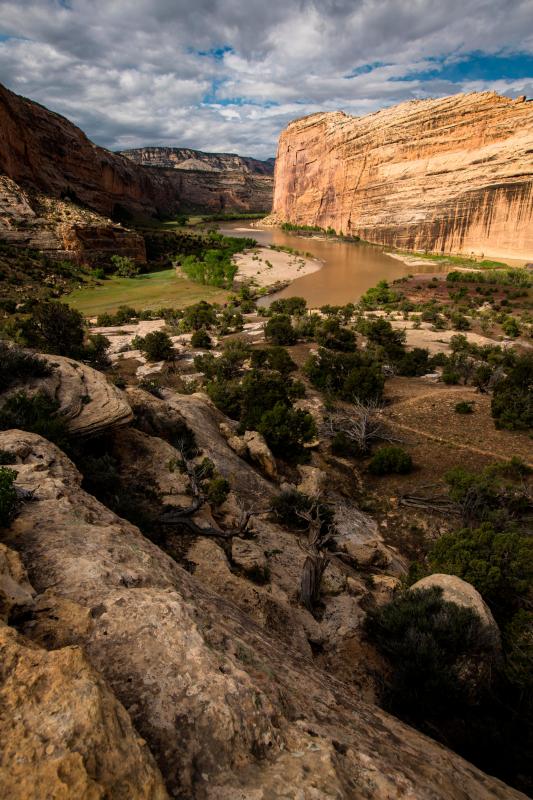
Echo Park, at the confluence of the Green and Yampa rivers (NPS/Jacob W. Frank). Why this landmark? Read on!