Showing posts with label trilobites. Show all posts

Thursday, October 30, 2025

Hyoliths VII: The New Blood

Have you ever been working on some mundane task when you suddenly wondered about the latest news from the world of hyoliths? Taking a walk, or merging onto a busy highway, or applying shampoo in the shower? All right, probably not, but if so, we're here for you!

Appropriately for this time of year, we have some news of hyoliths meeting or escaping grisly demises. (Or not, but that's taphonomy for you.) Kraft et al. (2023) published on an exceptionally well-preserved specimen of the Middle Ordovician central European trilobite Bohemolichas incola, including gut contents. The hyoliths are only a small part (quite literally!) of the story, which is well worth checking out if you have any interest in trilobites. The small trilobite (on the order of 35 mm or 1.4 inches long) apparently ate every darn thing it could fit in its mouth that wasn't putting up too much of a fight, including tiny hyoliths, ostracodes, stylophoran echinoderms, and chunks of shells.

The trilobite in question (Figure 1 from Kraft et al. 2023; scale bar 10 mm or 0.4 inches). Hyolith bits are in purple, including one recognizable shell under the trilobite's pygidium (tail segment). CC BY 4.0.

Paleozoic examples of the bilobed trace fossil Rusophycus are often attributed to resting trilobites, and one of the things you can do when you're not moving is pick up a snack. Lee et al. (2025), in a description of Cambrian Rusophycus from China, included an example where the trace was associated with hyolith shells. Unlike classic Rusophycus, thought to occur at the seafloor surface, this example was interpreted as a burrow. Also unlike classic trilobite predation trails, in this case the food had a hard shell. The trace-maker is thought to have been scavenging for hyoliths that had been transported from elsewhere.

Returning to the Ordovician of central Europe, we find a hyolith that was not eaten, although not from lack of trying. Fatka et al. (2023) reported a specimen of Elegantilites custos with healed damage in the form of scratches on its operculum. The culprit in this case is thought to have been an echinoderm, possibly an ophiuroid (brittle star) trying to get in.

Perhaps you'd prefer to think of your hyoliths more in terms of a grand and proud lineage, rather than delicious treats for every passing trilobite and brittle star. If so, Liu et al. (2024) have an analysis of Cambrian hyoliths for you. Using all valid Cambrian genera (N=115), they considered a set of 20 morphological characteristics over time and space. Overall hyolith taxonomic diversity peaked in Series 2 of the Cambrian (roughly speaking, the time when trilobites appeared and therefore kind of like the old "Early Cambrian"). They then keeled over sharply and were at lower levels for much of the rest of the Cambrian, locally reviving to a certain extent in the Early Ordovician. Their decline may have been due to an ocean anoxic event (the Sinsk Event) around 513 to 508 million years ago. The two major wings of hyoliths, the hyolithids (the kind with helens and complex opercula; filter feeders?) and orthothecids (the kind without helens and with simple opercula; deposit feeders?), did not follow the same curves: the orthothecids peaked sooner and felt the bite sooner, whereas the hyolithids didn't really get started until Series 2 and actually peaked just after it before suffering their drop. Morphological diversity was greatest in Series 2, although granted hyoliths had a somewhat limited repertoire.

The curve of Cambrian hyoliths. Figure 1 in Liu et al. (2024). CC BY 4.0.

References

Fatka, O., M. Valent, and P. Budil. 2023. The first healed injury in a hyolith operculum. The Science of Nature 110(50). https://doi.org/10.1007/s00114-023-01879-0.

Kraft, P., V. Vaškaninová, M. Mergl, P. Budil, O. Fatka, and P. E. Ahlberg. 2023. Uniquely preserved gut contents illuminate trilobite palaeophysiology. Nature 622: 545–551. https://doi.org/10.1038/s41586-023-06567-7.

Lee, D.-C., M.‑K. Oh, Y. Zhang, X.‑L. Zhang, J.‑H. Lee, K. Liang, and W. Li. 2025. Two new probable feeding traces of Rusophycus from the Cambrian of China: tracemaker’s behavior and formation mode. Geosciences Journal 29: 1–17. https://doi.org/10.1007/s12303-025-00007-6.

Liu, F., T. P. Topper, L. C. Strotz, Y. Liang, Y. Hu, C. B. Skovsted, and Z. Zhang. 2024. Morphological disparity and evolutionary patterns of Cambrian hyoliths. Papers in Palaeontology 10(2). https://doi.org/10.1002/spp2.1554.

Tuesday, April 30, 2024

Uŋčí Makhá Park 2024: another winter, more echinoderms

Two years after opening, Uŋčí Makhá Park can be considered a paleontological gem in the Twin Cities. With its Magnolia Member bedding planes, side cuts through the Magnolia and Carimona, easy access, and lack of vehicle traffic, it's nigh-on perfect for getting in touch with St. Paul as it was about 454–453 million years ago. It's kind of like our own Carnegie Quarry wall, except it's tiny marine invertebrates rather than dinosaurs, it probably wasn't planned, and you can walk right out over it. It's always fun to get to spend time there for work, and like last year, I got the opportunity to assist with a training session for Mississippi National River & Recreation Area seasonals there. Then, of course, I just had to make a quick return trip later to follow up on some things we'd seen.

Sunday, August 13, 2023

Zittelloceras

While on a walk earlier this year, I spotted a Decorah block that I decided to pick up for photography. The initial attraction was the abundance of snails, which are a reliable indicator that pieces of our fossil arthropod friends are also present (if there's only one practical thing you take away from this blog, it's "when you're in the Decorah and see snails, look for trilobites"). This was indeed the case:

Here's the whole block, which rewards a click to embiggen. There is a nice Clathrospira and a lophospire just right of the scale bar, and many smaller snails scattered throughout. You may also pick out the trilobite pygidia.

Here's a pygidium, pointed toward the top of the photo.

A nice pygidium plus a number of other things, including some crinoid columnals, bryozoan fragments, other trilobite bits, and, near the top, a whorl of a snail.

There was also something else: a dark object several millimeters long and broad. It appeared to be a thin-walled flattened tubular object, with a distinct series of ornamented transverse ridges. The ridges showed an alternating pattern of strongly projecting and more subtle, like perforations. Both had little scooped frilling, the same kind of shape as a doodle of stereotypical ocean waves.

The object in question is near center. You may have noticed it in the first photo. The light-colored band near the center is some light prep to see if I could get the matrix out from the groove.

I'd never seen this combination of features before, but I could knock out a lot of things quickly. In fact, I knocked out just about everything, which was a problem. Given the probability I had discovered a completely new phylum is pretty low, all things considered, I figured I'd probably missed something. So, I pulled out my copy of "A Sea Without Fish" (Meyer and Davis 2009) to see if some similar exotica had been found in the well-studied Cincinnatian, as it's only a few million years younger. Then I got excited looking at the figure and description of the machaeridian worm Lepidocoleus. Machaeridia is an extinct group of Paleozoic armored annelid worms, with segments of calcitic plates and a heart-shaped cross-section.

This view, under different lighting, shows the ridges and frills to good effect.

Before I got too excited, I decided to put it up on the Fossil Forum, to see what others might think. The first suggestion was Phragmolites, which was reasonable enough but didn't fit my experience with that snail. The chunk wasn't curved enough, the dark coloration and thin wall were unlike the examples of Phragmolites I'd seen, and the ornamentation of the ridges wasn't a good fit. Then someone came up with the nautiloid Zittelloceras, and provided photos of a form with almost the exact same pattern of frilled ridges found in the Platteville.

An end-on view shows the cross-section, with the thin walls and central crushing.

So, it looks like rather than a worm, it's a nautiloid. Zittelloceras is one of the "arched" nautiloids, not coiled and not a full-on orthocone. Several species are present in the Platteville per Catalani (1987), but none are listed in the Decorah. This is not a particular problem, as the genus is present in younger strata as well, and the Decorah's cephalopod record lags the Platteville. (Note that Zittelloceras is frequently misspelled "Zitteloceras", with one "l", but a look at the original publication, Hyatt 1884, shows the two-l spelling is correct.) I'm sure there are worms out there to be found in the Decorah, but I'll settle for this record of an ornate nautiloid.

Here's one more angle for the road.

References

Catalani, J. A. 1987. Biostratigraphy of the Middle and Late Ordovician cephalopods of the Upper Mississippi Valley area. Pages 187–189 in R. E. Sloan, editor. Middle and Late Ordovician lithostratigraphy and biostratigraphy of the Upper Mississippi Valley. Minnesota Geological Survey, St. Paul, Minnesota. Report of Investigations 35.

Hyatt, A. 1884. Genera of fossil cephalopods. Proceedings of the Boston Society of Natural History 22:253–338. [some history: The paper is based on a talk presented by Hyatt April 4, 1883, a day before his birthday. There is a note on the first page that there was going to be a monograph in the Memoirs of the Museum of Comparative Zoology, but this did not happen. At any rate it's hard to think of an 80-page paper being "preliminary" to anything!]

Meyer, D. L., and R. A. Davis. 2009. A sea without fish: life in the Ordovician sea of the Cincinnati region. Indiana University Press, Bloomington and Indianapolis, Indiana.

Sunday, June 4, 2023

Uŋčí Makhá Park Revisited, Part 2: Further Fossils

We're now up to the fourth entry in a completely unexpected series on the Platteville–Decorah rocks and fossils of Uŋčí Makhá Park. We've already seen the common fossils from the site, so for this go-round I'm focusing on rarities.

Sunday, April 11, 2021

Paleozoic Taxa of the St. Croix Valley

Back when I was working on the Saint Croix National Scenic Riverway project, I'd compiled a spreadsheet of all of the fossil genera and species that had been reported from the rocks exposed along the valley. There had been some talk of spinning it off as a separate thing, but that never happened, so I played with the idea of posting it here. I then forgot about it until recently looking through the backlog of half-formed ideas. The spreadsheet itself was all ready to go, so I figured "why not?"

It's pretty simple; a column of numbers so it can be sorted back to the original organization when I'm working, a column for the genus/species, a column for the broad classification, twelve columns for the formations (go here for a refresher; the names are abbreviated for space, but each one has a note providing the full name), a column for references (defined on the "References" tab), and a column for additional notes. If a given species is present in a particular formation, the corresponding cell is marked "Y" and filled blue; if there's some question, the cell is marked "?" and filled yellow. If it's not present, there's a dash and no color fill. To check it out, you can enter here. I would not be surprised if there has been some oversplitting, if for no other reason than the challenges of preservation (we're dealing with a lot of natural molds and casts of partial trilobites in sandstone; fragility and preservation fidelity leave something to be desired).

It's worth mentioning that there is a document that covers some of the same ground, Raasch (1950). In one sense it's more narrowly focused, on Cambrian trilobite biostratigraphy, but in another it's more diffuse, with a larger area of interest.

References

Raasch, G. O. 1950. Zonal range of Croixan trilobite genera in the upper Mississippi Valley. Cambrian Subcommittee Memorandum No. V. Illinois State Geological Survey, Urbana, Illinois.

Sunday, May 10, 2020

Revisiting Shadow Falls Park

I like to periodically recheck various sites along the Mississippi corridor, to see how the elements are treating them, if there have been any major rock falls, damage from downed trees, changes in usage, etc. One of the places I get to more frequently than others is Shadow Falls Park. It has an informal reputation for collecting and is a place with soil on steep slopes (plus access is good and I like going there).

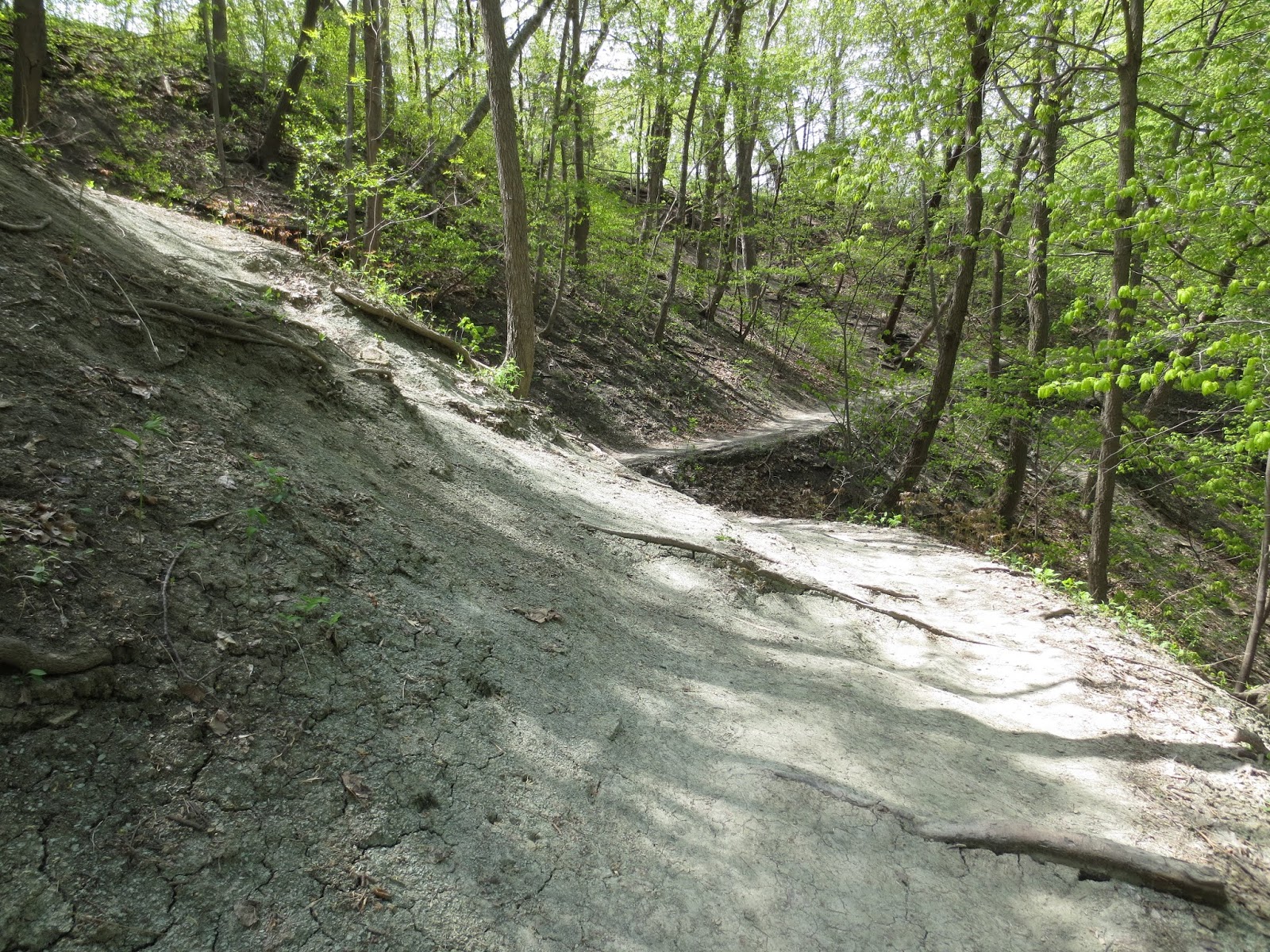
Here's the trail on the south side of the valley past the falls (which are essentially just to the right and a little below the vantage point of this photo).

Erosion may not be immediately evident if you don't have something to measure the loss of sediment, but in places with tree roots near the surface on the slopes it's easy to see how running water and gravity have done their work.

Almost a staircase of roots.

The usual array of lower Decorah fossils was present, in small chunks of rock and loose. It seemed to be a particularly good day for observing strophomenids (in the hash plates, primarily; they tend to break up otherwise). One example in the photo below is probably Rafinesquina, based on the thinness of the valve. This genus is named after Rafinesque, who we met last week and had a much more substantial career than getting into arguments about sloths. Another nice piece observed was a Bumastoides pygidium.

A. Probable Rafinesquina valve. B. Bumastoides pygidium

In one area I observed two pieces of a larger specimen of Rauffella palmipes. This is all catch-and-release, of course!

Two fragments of a large Rauffella palmipes.

Shadow Falls includes not only the falls, but a long valley oriented east-west with its head near but not quite reaching Cretin Avenue. I haven't spent much time in the valley above the falls because the area right above the falls tends to turn into a muddy swamp, but it's been a dry spring. The creek feeding the falls is in a very deep valley for its size, but would have been somewhat bigger in the days before sewers and roads.

The creek valley above Shadow Falls...

...opens up into this near its head.

There are several large fossiliferous blocks along the creek that include crinoid columnals notably larger in diameter than the run-of-the-mill lower Decorah columnals (note that the photo in the linked post is biased to larger, more photogenic columnals). The obvious guess is that they were brought to the area by glaciers and represent a different part of the stratigraphic column, say the upper Decorah or one of the overlying Ordovician formations that have been stripped from the area.

Large columnals

Sunday, May 19, 2019

Trilobites and strange fate

For reasons that will become abundantly clear in a few months, I've been immersed in the paleontology and geology of Grand Canyon National Park for work. We've been doing a lot of projects in that general area over the past few years (Glen Canyon National Recreation Area, Lake Mead National Recreation Area, Tule Springs Fossil Beds National Monument, Walnut Canyon National Monument [check out the public report], Wupatki National Monument, and Zion National Park), and it's only fitting that we take on Grand Canyon. This particular story includes both Grand Canyon and Lake Mead.

Boulder Dam Recreation Area, later renamed Lake Mead National Recreation Area, was established in the 1930s to administer the reservoir Lake Mead that was filling behind Hoover Dam, at the time known as Boulder Dam. As originally conceived, the recreation area extended quite a bit farther east, into what is now part of western Grand Canyon National Park. This is because at the time it was planned that another dam, the Bridge Canyon Dam, was going to be constructed in that area, and the recreation area was sized to accommodate the anticipated reservoir. Obviously, unless you are a reader who has stumbled in from another timeline, no such dam was ever built, and in 1975 the park boundaries were reconfigured, with most of eastern Lake Mead NRA (Grand Wash Cliffs area and east) being transferred to Grand Canyon National Park.

This area, as a matter of fact, looking due south into the western end of the park (photo taken from small plane, hence the plane structures and the whole "up in the air" thing).

Anyway, we were still back in the 1930s. The NPS had a few people on staff in the 1930s who specialized in geology, such as H. Donald Curry at Death Valley and Edwin McKee at Grand Canyon. Working at Boulder Dam Recreation Area was Ed Schenk, who had the challenge of contending with a field area that was steadily shrinking by the day as the reservoir filled. A substantial portion of his work at Lake Mead remains unpublished, but his research on the Cambrian escaped that fate (Schenk and Wheeler 1942). His counterpart at Grand Canyon, McKee, was also working on the Cambrian, and published a rather more famous work a few years later (McKee and Resser 1945). You may not recognize the citation, but if you've studied geology at the college level you may well have run into material that's been derived from this publication, in which McKee described the facies changes of the Cambrian formations in terms of marine advances and retreats: very briefly (and simply), there's the nearshore Tapeats Sandstone, the shallow marine Bright Angel Shale, and the deeper marine Muav Limestone.

As part of his work, Schenk collected fossils from about four dozen localities in and around the recreation area. About a quarter of the collections were from Cambrian rocks, all in that area which is now in western Grand Canyon NP. These collections included a fairly typical assortment of mid-Cambrian life, such as trilobites, brachiopods, and hyoliths. Several of these collections were cited in Schenk and Wheeler (1942). It is not immediately obvious, but the same collections are also cited in McKee and Resser (1945), with a few re-identifications. I only realized it when I thought to check because Schenk was noted as a collector in McKee and Resser (1945). Charles Resser, whom we met briefly earlier, also provided identifications for Schenk's paper. Essentially, the two papers were being worked on contemporaneously with contact between the groups of authors, and Schenk's shorter publication beat McKee's work into press by a couple of years (M&R '45 would also have been affected by wartime circumstances and Resser's passing in 1943).

If you're super-curious about these things, the collections definitely mentioned in both S&W and M&R are as follows, using M&R's stratigraphy ("F-" collections are Schenk's):
Peach Springs Member, Muav Limestone: fauna 73 = F-40
Bright Angel Shale tongue: fauna 74 = F-47
Spencer Canyon Member, Muav
Bright Angel Shale tongue
Sanup Plateau Member, Muav
Bright Angel Shale tongue: fauna 75 = F-37
Rampart Cave Member, Muav: fauna 76 = F-39
Flour Sack Member, Bright Angel Shale: faunas 46, 47 = F-16, F-17
Bright Angel Shale tongue
Tincanebits Tongue, Muav
Bright Angel Shale upper slope units: fauna 48 = F-44; fauna 49 = F.C. 761
Bright Angel Shale red-brown cliff unit?
Bright Angel Shale lower slope units: fauna 8 = F-15

Resser named several taxa from the F-# collections, and the holotypes for these taxa were sent to the USNM. These include Albertella schenki from F-44 (McKee and Resser #48; holotype USNM 108583), Lingulella mckeei from F-17 (M&R #47; USNM 108561a), Acrocephalops? arizonaensis from F-16 (M&R #46; USNM 108624), Kootenia simplex from F-37 (M&R #75; USNM 108591a), Kootenia schenki from F-40 (M&R #73; USNM 108586a), and Solenopleurella porcata from F-40 (M&R #73; USNM 108586a and 108626a). If you check the online USNM database, specimens with photos have the F-numbers on their slabs, showing their origin.

We come now to strange fate. Around 1960, with Schenk having long since left the NPS, staff at Lake Mead sent his old collections to the USGS for taxonomic identification. The USGS used to have a system where field geologists could send material for identification, usually to determine the relative age of rock units for mapping and resource projects. The resulting files were called "Examine & Report" (E&R) files. I've seen the files for the Lake Mead project, which took a while to complete for various reasons. Trilobite specialist A.R. "Pete" Palmer was sent the Cambrian samples for identification. Naturally enough, given the rock units involved, he used McKee and Resser (1945) for reference, as he remarked in the memo. Given that most of the fossils in McKee and Resser (1945) were only mentioned in lists, and type and figured specimens that might have given away the tale were retained from the collections by the Smithsonian, there was very little way of knowing that this exercise was actually about using McKee and Resser (1945) to identify fossils from some of the collections in McKee and Resser (1945).

References

McKee, E. D., and C. E. Resser. 1945. Cambrian history of the Grand Canyon region. Carnegie Institution of Washington Publication 563.

Palmer, A. R. 1963/10/17. O-60-55. USGS internal memo to M. B. Ingham (E&R file).

Schenk, E. T., and H. E. Wheeler. 1942. Cambrian sequence in western Grand Canyon, Arizona. Journal of Geology 50(7):822–899.

Sunday, August 12, 2018

Lower Decorah trilobites

Following last week with Strophomena, and having figured out what seems to be a good method of photographing small specimens, I thought I'd try my hand at photo-documenting and identifying some trilobites. The sample set is mostly limited to the lower third to lower half of the Decorah Shale of St. Paul, and the most relevant publications for these trilobites are DeMott (1987) and Rice and Hedbloom (1987); Midwest Paleo also has a fine photo-atlas and list. I'm reasonably satisfied that my identifications at the family or subfamily level are accurate. Genus, I'm not so keen on. Species, I didn't even dare; I would be just parroting.

Sunday, February 18, 2018

Identifying invertebrate fossils

Pop quiz! (don't worry, it's not for credit)

Romance *and* brachiopods

Here we have an assortment of fossils, tastefully arranged in a holiday-appropriate setting. They're all the typical local Ordovician stuff, but many Paleozoic shallow marine formations will have a lot of the same general things. What are they, and how can you tell?

Sunday, October 22, 2017

Sunday morning Decorah fossils

I've recently made a small collection of Decorah Shale pieces from spoil piles at a construction site. Most of them will go to other people and groups for use in education, but while I've got them I'm certainly going to take the opportunity to photograph them. Incidentally, construction can be a good source of fossils in the Twin Cities, if you don't mind disruption of the original stratigraphic context (which tends to happen anyway with the Decorah around here). Of course, as always, you'll want to ask for permission, and it's advisable to make collections when someone is working there, so you aren't mistaken for a trespasser or other nefarious sort.

Sunday, June 25, 2017

Dikelocephalus minnesotensis

Investigating the rocks of Saint Croix National Scenic Riverway (SACN) is a tougher nut than working in MNRRA. Most of the area where rocks are exposed in MNRRA is part of some kind of park (city, state, regional, county, etc.) and generally accessible to the public. Much of the area with outcrops on the St. Croix is private land, and many of the key localities in the literature are now overgrown, destroyed by construction, or are roadcuts next to busy highways. Determining where you are in the strat column is also more difficult. In MNRRA, it's hard to get mixed up if you can tell sandstone from limestone/dolomite and shale. In SACN, you're dealing with several quartz-rich medium to coarse sandstones that tend to look the same, with some intervening shaly, dolomitic, or finer-grained sandy formations, and in the literature practically every single investigator had their own preferred system of names right up until the 1960s. Finally, in MNRRA there are abundant and diverse fossils in the Platteville and Decorah, while in SACN the special of the day is the BLT (burrows, lophophorates [brachiopods and hyoliths], and trilobites) with a side order of mystery snails, and you have to work for everything but the B.

The sweet siren song of the Franconian trilobite.

Sunday, June 18, 2017

When brachiopods ruled the Earth

...well, maybe that's an overstatement, but it's a catchier title than "When brachiopods were dominant marine fauna in parts of cratonic North America", right? Our story today goes back to the latter part of the Cambrian, 500 million years ago or so. The Cambrian Explosion had come and gone, the confetti and stray napkins had been disposed of by various wormy things, and in the absence of thumbs to twiddle, there was nothing much to do until the Ordovician Radiation. Many forms of life got bored of waiting and went extinct, or otherwise died out from less frivolous causes, leaving behind a kind of "blah" marine fauna dominated by brachiopods, trilobites, and conodonts. This stretch of time has been called the "Late Cambrian plateau" or, more ominously, a "dead interval".

"We are your masters now! Ha ha!"

Thursday, March 24, 2016

Mostly bryos and burrows

It's still a little early to be out and about in the metro rocks and expect good luck (for one thing, the Decorah is still in winter-spring-transition mud mode) or consistent weather, but we're getting close, and sooner than usual. Here's one seasonal photo and then a few interesting pieces I hadn't featured before. These are all photos of Decorah Shale fossils from the St. Paul side of the river.

Lower Decorah a couple of weeks ago, after having been relatively warm and dry for several days. These two fragments were covered with half-burrows (imagine a tubular burrow split along its long axis), and several other pieces from the same area and probably a similar stratigraphic level had the same kind of abundant half-burrows.

Sunday, June 21, 2015

Trilobites

To start it off, this being Father's Day as I write, I shamelessly link to my father's Flickr photostream.  He's got photos of landscapes and landmarks of places in Hawaii, Arizona, Utah, Washington D.C., South Dakota, Virginia, Idaho, Alaska, and Minnesota. I recommend the eagles on Grey Cloud Island.

Where were we? Yes, the majestic trilobite, the three-lobed former denizen of the deep, the oval with antennae, bearer of the first compound eye, shameless vandal of pristine Paleozoic sediment. Trilobites are one of the most famous types of extinct organism, perhaps not on par with certain vertebrates, but certainly the most renowned fossil invertebrates. (In second place, with plenty of daylight intervening, are ammonites. In last place, maybe edrioblastoids? Some kind of echinoderm, probably.) You can find online information on practically any aspect of trilobites you may want to know about, often lovingly illustrated with photos. You'll probably end up at Trilobite.info sooner rather than later. The American Museum of Natural History also has a good guide, with photos of several of the species mentioned below. Wikipedia and the Kansas Geological Survey have detailed entries, and more photo guides particularly relevant to our slice of time can be found at the Atlas of Ordovician Life, the Dry Dredgers, fossilid.info, and University of Georgia pages on the Cincinnatian and Nashville.