Showing posts with label Mesozoic. Show all posts

Sunday, November 30, 2025

A Visual Paleontological Inventory of Utah’s National Park Service Areas

Allow me to indulge in a bit of puffery and congratulations...

Let's go back a couple of years ago. We in the NPS Paleontology Program knew that the new edition of the Utah Geological Association's "Geology of Utah's Parks and Monuments" was not going to have an update of the overall park paleontology chapter. (Which is fair enough, since it was 35 pages in the previous update and was not getting shorter. The new volume is still well worth seeing, though, especially if you haven't seen the earlier editions.) We also were working with Tut Tran, then putting the finishing touches on the paleontological inventory report for Bryce Canyon National Park. These touches included some clever biostratigraphic figures of a kind we'd never used before. Thus was an idea born: Tut would prepare a standalone article featuring similar figures for the rest of Utah, with contributions from various luminaries in NPS and Utah paleontology. This article, "A Visual Paleontological Inventory of Utah’s National Park Service Areas", is now available for your edification and reading pleasure. Congrats, everyone!

Utah has 13 National Park Service units: five parks (Arches, Bryce Canyon, Canyonlands, Capitol Reef, and Zion), six monuments (Cedar Breaks, Dinosaur, Hovenweep, Natural Bridges, Rainbow Bridge, and Timpanogos Cave), one national recreation area (Glen Canyon), and one national historical park (Golden Spike). (There are a few other units in the state designated as "National", such as Grand Staircase-Escalante National Monument and Flaming Gorge National Recreation Area, but they are under different agencies.) This is omitting a few NPS trails (California, Mormon Pioneer, Old Spanish, and Pony Express) and the Virgin Wild and Scenic River, which are complicated to deal with because they don't have formal boundaries the same way the other types of units do; one day I'd like to go over rivers and trails thoroughly, but that's for another day. Anyway, the 13 units give Utah one of the best state-wide paleontological records in the NPS, up there with Alaska and California. Each one of them has something, although certainly some have more than others. The five national parks, Dinosaur NM, and Glen Canyon NRA are the most abundantly supplied and feature the longest records.

Figure 2, comparing the stratigraphic records of Utah's NPS units. Click to embiggen. CC BY 3.0 US.

These seven units are fairly similar stratigraphically and in fossil content, with the exceptions of Bryce Canyon (getting started when most of the others are tapering off) and to a certain extent Dinosaur (longer record and some different formations due to distance from the other units). The classic assortment of rocks generally includes the Permian, Triassic (Moenkopi and Chinle), Jurassic (Glen Canyon Group, San Rafael Group, and Morrison Formation), and part of the Cretaceous (Cedar Mountain Formation and Naturita, the old Dakota Sandstone). Arches, Canyonlands, Capitol Reef, and Glen Canyon in particular are geological and paleontological siblings. There are some older and some younger formations, but generally the sweet spot is between about 300 and 100 million years ago.

You might think, based on Dinosaur's reputation, that the Morrison Formation is the big producer, but as it turns out that's not the case. The Lower and Middle Jurassic rocks that make up so much of the scenic vistas, although not big bone producers, are perhaps the most iconic fossil producers with their fossil tracks. (Which is fitting for a park, because just like you can't put a vista in a box and take it somewhere else, fossil tracks are best appreciated where they are found.) The Chinle and Moenkopi are also good but a bit overlooked (Utah's Chinle having the excuse of being in the shadow of Arizona and New Mexico). Another interval that is very productive is the late Quaternary: several units have cave/rock shelter assemblages, usually thanks to packrats, with the assistance of other animals. Glen Canyon in particular is noted for dung caves, including Bechan Cave ("big feces" in Navajo) and its supply of mammoth dung. The Cretaceous is coming into its own with work at Bryce Canyon, Dinosaur, and Glen Canyon; in fact, work on the Cretaceous made our article outdated almost the day it was published, thanks to Pahasapasaurus gillettei from the Tropic Shale of Glen Canyon (Schmeisser McKean 2025). We were able to get October's Athenar bermani in there in the proof stage, but the plesiosaur managed to wait just long enough. (Darn it.)

This article is not a rewrite of the NPS paleontology chapters in the old UGA volumes. It sets out to do different things and is much more visual in focus, rather than textual. (It even has its own nifty cover image, done by artist Benji Paysnoe in the spirit of the great "Vertebrate Paleontology of Utah" volume.) The main things you will find in this that you won't find in the older chapters are Tut's outstanding diagrams and a grand 62-page appendix listing fossil taxa from each park unit by formation, with citations. Between the nine authors, I think we were able to put together a pretty darn comprehensive appendix, although doubtless we missed something. (If you spot something, let us know, so it can be included if we get the opportunity to do an update.) Me, of course, I'm hoping for more Paleozoic invertebrates, but I'm not turning up my nose at anything!

Figure 39, a sample diagram (Rainbow Bridge NM). You should go to the article to see what's been found at the big parks! CC BY 3.0 US.

We're all excited for this to be out, and we hope you find it useful as well, as a unique look at the paleontological riches of Utah's NPS units.

References

Schmeisser McKean, R. L. 2025. A new species of Pahasapasaurus (Plesiosauria: Polycotylidae) from the Upper Cretaceous Tropic Shale (lower Turonian) of southern Utah, U.S.A. Cretaceous Research 106269. doi: https://doi.org/10.1016/j.cretres.2025.106269.

Tran, T., A. R. C. Milner, J. S. Tweet, D. D. DeBlieux, R. Hunt-Foster, A. B. Shaffer, J. I. Kirkland, E. Warner-Cowgill, and V. L. Santucci. 2025. A visual paleontological inventory of Utah’s National Park Service areas. Geology of the Intermountain West 12: 221–292. doi: https://doi.org/10.31711/giw.v12.pp221-292.

Saturday, July 5, 2025

Odds and Ends

Several items worth a brief comment...

Minnesota state fossil

By Minnesota law, Castoroides ohioensis, the "giant beaver", became Minnesota's state fossil on July 1, 2025. C. ohioensis is a rare case of a write-in winning (the original slate of candidates did not include it). Call me a lot of things (crazy, no fun, pessimistic about human nature), but I have a hard time believing the giant beaver won based on its merits as a fossil found in Minnesota, as opposed to a bunch of people on the Internet thinking it would be funny for Minnesota's state fossil to be a giant beaver. Which, I suppose, is a reasonable response to the idea of state symbols in general and state fossils in particular.

Enigmacursor

Speaking of pessimism, no sooner are all previous names for Morrison Formation "hypsils" declared dubious than a paper by the same authors comes out naming... a new Morrison Formation "hypsil". (Not the first time this kind of thing has taken place, but usually the declaration of invalidity and the new name come in the same paper.) Anyway, the new one is Enigmacursor mollyborthwickae, based on a partial skeleton from Colorado featuring vertebrae, ribs, and most of the girdles and limbs. It's not one of the more famous (well, "famous", but bear with me) unnamed Morrison specimens like BYU ESM 163R or "Barbara" but instead was recovered a few years ago. (Some days it feels like famous unnamed specimens *never* get described, but I digress.) Given the matter of chimeric specimens discussed in the Nanosaurus paper, a quarry map would have been a nice inclusion. E. mollyborthwickae looks and phylogenetically acts about the way you'd expect out of a Morrison "hypsil". I wouldn't expect that it actually *is* the closest relative to Yandusaurus hongheensis among all dinosaurs known to date (for one thing, that's putting a lot of faith in Yandusaurus, one of those dinosaurs that seems more complete and better known than it is), but that's about where Morrison "hypsils" always turn up.

Tyrannosaurus

Meanwhile, on the reincarnation of the Dinosaur Mailing List, the Dinosaur Mailing Group, the hot topic has been Tyrannosaurus and nanotyrants. Some things never change, after all. It's not a spontaneous irruption, but driven by Gregory Paul's new review of latest Cretaceous western North American tyrannosaurs. This follows on the paper a couple of years ago proposing to split T. rex into three species. Paul further revises Tyrannosaurus in this paper, supporting not only the removal of Nanotyrannus lancensis, but also Stygivenator molnari. (If you remember using the word "aublysodont" seriously, you know what's up, and there's an excellent chance you're also at least 40.) These two species are interpreted as having crossed over from Appalachia (the eastern half of North America) with the dwindling of the Western Interior Seaway, which is a fascinating idea worth further consideration.

Will it settle anything? I don't expect it to. At this point it feels like everyone is well beyond being burned out on the topic and is firmly set in their ways. It doesn't help that Nanotyrannus, along with spinosaurs and exaggerated dinosaur sizes, is one of the most obnoxious long-running issues among dinosaur enthusiasts, providing further incentive to stay the heck away. It's a pity, though, because there's something something weirdly Alioramus-y going on with some of these specimens, and all we ever do is circle around the same couple of points we always have.

Probably 25 years ago or more I posted something on the DML about a taxonomic discussion, and another member suggested we'd be better off not using the names at all and just using specimen numbers. I thought it was crazy at the time since they're a lot harder to keep track of, but with time I'm definitely coming around to the idea.

Lithodendron

The second issue of Lithodendron, Petrified Forest National Park's journal, has just come out. Contributions to this issue include a report of a large silesaurid (and coelophysoid) from the park, and the printing of a previously unpublished stratigraphic study of the park from 1940 (always good to see formerly overlooked research get published!).

Cenozoic Life and Mesozoic Life in the National Parks coloring books

Finally, some uncomplicated fun: We've recently produced coloring books of Cenozoic and Mesozoic life in the National Parks to go with the Prehistoric Life in the National Parks coloring book from a few years back. They feature a mix of artwork from the original coloring book plus newer pages. The links above will take you to the data store pages for the two books, which can be downloaded freely as pdfs. Parks with notable Cenozoic or Mesozoic fossils may also have physical copies available.

References

Maidment, S. C. R., and P. M. Barrett. 2025. Enigmacursor mollyborthwickae, a neornithischian dinosaur from the Upper Jurassic Morrison Formation of the western USA. Royal Society Open Science 12(6):242195. doi: https://doi.org/10.1098/rsos.242195

Paul, G. S. 2025. A presentation of the current data on the exceptionally diverse non-tyrannosaurid eutyrannosaur and tyrannosaurini genera and species of western North America during the End Cretaceous North American Interchange. Mesozoic 2(2): 85–138. https://doi.org/10.11646/mesozoic.2.2.1

Sunday, October 11, 2020

Compact Thescelosaurus Year Five

It's time for the annual review of The Compact Thescelosaurus. As is traditional, there's a new sheet, which this year covers mosasaurs, as you might have guessed from the image. The classification diagram page has been updated as well. (Don't forget, Wednesday the 14th is also National Fossil Day!)

Mosasaurus conodon, hanging out at the Science Museum.

Sunday, July 5, 2020

Fossil Marine Reptiles of the National Park Service

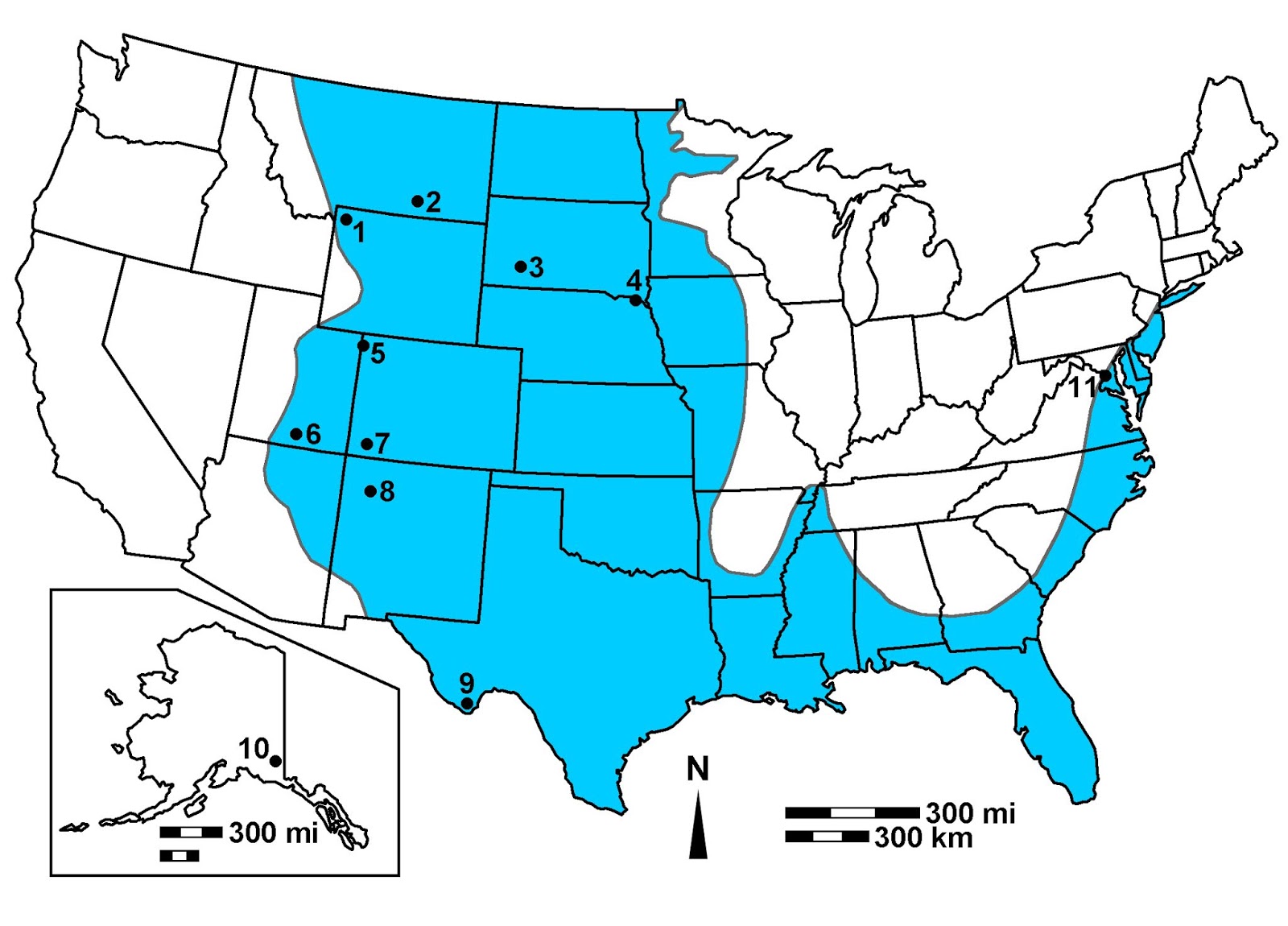
For my annual post summarizing a type of fossils from National Park Service lands, this time around we're going with Mesozoic marine reptiles: ichthyosaurs, plesiosaurs, and mosasaurs. As you might guess, most of the examples come from the rocks of the Western Interior Seaway. This time around, we're only dealing with eleven parks, so there's space for going into more detail. We'll start off with the traditional map, which includes a lovely blue overlay to give you an idea of the extent of shallow seas at their Cretaceous peak:

The outline of the seaway is roughly after Robinson Roberts and Kirschbaum (1995), with a more substantial Mississippi Embayment added and a bit more on the Atlantic Coastal Plain, which I let peter out in New England. No attempt has been made to reconstruct the marine extent on the Pacific coast. Also, Minnesota was improvised after Sloan (1964), due to Robinson Roberts and Kirschbaum (1995) having a text box over the state. Sites mentioned in the post are: 1. Yellowstone National Park; 2. Little Bighorn Battlefield National Monument; 3. Badlands NP; 4. Missouri National Recreational River; 5. Dinosaur NM; 6. Glen Canyon National Recreation Area; 7. Mesa Verde NP; 8. Chaco Culture National Historic Park; 9. Big Bend NP; 10. Wrangell-St. Elias NP and Preserve; 11. Fort Washington Park.

(Also, if you're interested in cave fossils, check out our recently finalized paleontological inventory for Carlsbad Caverns NP!)

Sunday, October 13, 2019

Compact Thescelosaurus Year Four

It's time for the annual update to The Compact Thescelosaurus, now entering its fifth year. This time, ichthyosaurs join the group, which is really stretching it for me, but hopefully it's not entirely in vain. Ichthyosaurs fared a bit better than plesiosaurs in that *only* 91 of the 224 species (40.6%) included are of questionable validity, rather than 173 of 318 (54.4%). (Only.) My go-to work was McGowan and Motani 2003 on Ichthyopterygia (Handbook of Paleoherpetology 8), just to figure out what was there. Ichthyosaurus itself, like Plesiosaurus, accumulated an awe-inspiring retinue of species over the years, but it's not alone. A couple of areas of ichthyosaur taxonomy are pretty volatile at the moment as massively specious genera are re-evaluated, so expect revision. (Also expect the usual formatting bugs and obvious corrections that come with a new sheet.)

Sure, like you don't know what an ichthyosaur looks like. This was found at Wikimedia Commons, but originally came from a short item by William Diller Matthew in the American Museum Journal for January 1908.

Sunday, July 2, 2017

National Park Service dinosaurs

Here we are, three and a half years into this thing, and I haven't done a summary of National Park Service dinosaurs (non-avian variety)? No better time than the Fourth of July!

Time for another giant caption! This map shows the National Park Service units where non-avian dinosaur bones or tracks have been found in situ, or are historically associated with a park. 1. Yellowstone National Park; 2. Bighorn Canyon National Recreation Area; 3. Dinosaur National Monument; 4. Capitol Reef NP; 5. Arches NP; 6. Canyonlands NP; 7. Bryce Canyon NP; 8. Zion NP; 9. Glen Canyon NRA; 10. Rainbow Bridge NM; 11. Pipe Spring NM; 12. Petrified Forest NP; 13. Colorado NM; 14. Curecanti NRA; 15. Mesa Verde NP; 16. Chaco Culture National Historical Park; 17. Yukon-Charley Rivers National Preserve; 18. Denali NP & Preserve; 19. Wrangell-St. Elias NP & Preserve; 20. Katmai NP & Preserve (possibly); 21. Aniakchak NM & Preserve; 22. Big Bend NP; 23. Lewis and Clark National Historic Trail; 24. Springfield Armory National Historic Site.

Sunday, May 28, 2017

NPS Paleontology Roundup

In honor of the return of the Park Paleontology newsletter, I thought I'd do a roundup of some recent articles that discuss fossils from NPS lands. First, though, a word about the newsletter itself. The original incarnation was published from 1998 to 2004, and its archives can be accessed here [note, 2017/06/27: no longer available]. It was intended for brief communications about various topics relevant to NPS paleontology, from new finds, to new staff, to new legislation. The new edition follows in that tradition, with articles on a new exhibit at Big Bend National Park, type specimens from NPS units (yet again, sorry), Emily Thorpe's work at Salinas Pueblo Missions National Monument, which I plugged last post, John Day Fossil Beds National Monument's new Chief Paleontologist Nick Famoso, dinosaur tracks at Rio Grande Wild and Scenic River, and the history of the newsletter itself. If you're curious, yes, the number of fossil species named/possibly named/etc. from NPS units is now at 4,922, thanks in part to the subject of the heading immediately after the jump.

The part and counterpart of University of Minnesota Paleontology Collections 4090, holotype of graptolite Dictyonema minnesotense Ruedemann 1933, collected from the St. Lawrence Formation at a no-longer extant site in Afton, Minnesota, now within Saint Croix National Scenic Riverway.

Sunday, May 7, 2017

Sauropods, three-for-one

Three new sauropod species were published this week, although technically speaking all three are based on fossils that have been mentioned in the literature previously. This is just how things work in paleontology. Even if you know you have something new, it may be years or even decades for a description to surface. The three sauropods of the week cover three continents, two epochs, and three lineages. In a slight upset none of them are South American titanosaurs. Instead, they are diplodocid Galeamopus pabsti from the Upper Jurassic Morrison Formation of the United States, titanosaur Tengrisaurus starkovi from the Lower Cretaceous Murtoi Formation of Russia, and brachiosaurid Vouivria damparisensis from the Upper Jurassic Calcaires de Clerval Formation of France.

Sunday, April 16, 2017

Mea culpa and Moabosaurus

I apologize for having been light on the whole "Minnesota" and "invertebrates" part of the blog for this year. Having been doing this for a few years now, the low-hanging fruit is picked, and of course the winter is not the best time to be out and about in the rocks, even if "winter" came with quotation marks instead of snow this year. I'm currently on a short trip to Reston, Virginia, to do some work at the USGS, but I thought I'd at least try to put in something relevant for those topics. Then, of course, there’s a sauropod.

Sunday, December 11, 2016

Fossil Crocs of the Science Museum

Although the dinosaurs get the most press, the Science Museum of Minnesota's paleontology department has a strongly diversified portfolio of ancient reptiles. In particular, champsosaurs and crocodyliforms (modern crocodilians and their closest extinct relatives) are well-represented in the collections and on exhibit. The Science Museum features mounts of four fossil crocs, each one filling different places in their ecosystems: an apex terrestrial/freshwater croc (Borealosuchus formidabilis), a large estuarine croc with elongate jaws living alongside whales (Gavialosuchus carolinensis), a medium-sized terrestrial/freshwater croc from a dinosaur-dominated setting ("Goniopholis"), and a house-pet-sized terrestrial/freshwater generalist (Wannaganosuchus brachymanus). This diversity shouldn't be too surprising. Crocodylomorphs, with around 225 million years of time on their hands, have done quite a bit of experimentation, including truly marine thalattosuchians and small, terrestrial, occasionally dinosaur-like "sphenosuchians".

Thursday, April 28, 2016

Death Valley National Park geology, Part III: Mesozoic through Paleogene

We made it out of the Precambrian. We made it out of the Paleozoic. We aren't nearly out of Death Valley, though. There's still about 250 million years to go, during which the valley was converted from marine property to land, became gently toasted by massive subterranean plutons, and was eventually pulled apart into the modern topography over about 15-20 million years of nonstop faulting, with volcanic eruptions and inland lakes thrown in for variety.