This year it works out that I'm a little early for the annual "Fossil [Group] of the National Park Service", and we continue our tour of mammal groups with a bit of a grab-bag. As with the marine reptiles, there is not one single group of marine mammals. Rather, several different groups became adapted to the oceans. There are the cetaceans, including whales, dolphins, and porpoises (and yes, dolphins and porpoises are small whales, but you know what I mean). There are the pinnipeds, including animals such as seals, sea lions, and walruses (and yes, there are two distinct groups of pinnipeds called seals, true seals without ears and eared seals that are closer to sea lions; it wouldn't be an Equatorial Minnesota post without mentioning at least a couple of caveats and technicalities, after all). Finally, we also have sirenians (dugongs and manatees) and desmostylians (extinct, kind of hippo-like things), two herbivorous groups that may or may not have been related.
Tuesday, June 30, 2026

Sunday, July 20, 2025
Fossil Ursids of the National Park Service
Here we are, a little later than usual for the annual "Fossil [Group] of the National Park Service" but present nonetheless. I decided to get in another group of carnivorans, this time the bears (Ursidae). If you've been here for the cats and dogs, you can probably guess the basic shape of things: a few records earlier in the Cenozoic, then a big slug in the Pleistocene into the Holocene, with many of the records representing living species. That is indeed how it goes with the bears as well, with a couple of quirks: the bear record goes back as far as the dog record, into the Chadronian (Late Eocene), but is never as diverse as the records for either cats or dogs. Essentially you get a couple of genera or species in a formation, and that's about it. Bears, it seems, have never felt the need to be profuse about the business of being bears. It's not quite "one-bear-fits-all", but bears favor generalism, and there's only room for so many species of generalists in one place and time.
Sunday, July 7, 2024
Fossil Canids of the National Park Service
We've been taking a tour of Mammalia for the past two annual "Fossil [Group] of the National Park Service", and this year we'll make it three in a row with man's best friends, the Canidae. The dog record starts up in the Eocene with the hesperocyonines, who held court through the Oligocene but then petered out in the Miocene. Turning up in the Oligocene are the borophagines, or "bone-crushing dogs," and the canines, which include wolves, foxes, domestic dogs, and close relatives. Borophagines, as the nickname suggests, had robust jaws and teeth, which doesn't mean they should be typecast as slavering hypercarnivorous brutes (canids in general have been pretty flexible about diet over their history). They drop out of the record at about the end of the Pliocene, leaving the field clear for the canines, which had been a fairly minor component of the canid radiation until about the Late Miocene. If you're interested in paleontological nitty-gritty on these two groups, check out Wang et al. (1999) on borophagines and Tedford et al. (2009) on canines. Canids, incidentally, are a North American invention, and unlike some other groups that originated in North America (camels, horses, rhinos), they have never gone extinct on the continent.
Tuesday, July 4, 2023
Fossil Lagomorphs of the National Park Service
It's time for the annual focus on the paleontology of a particular group in National Park Service lands. This year we turn from the felines to one of their prey items, the lagomorphs (rabbits, hares, and pikas). So, why bunnies and pikas? To be honest, most of us have probably never given more than a moment's thought to the fossil record of lagomorphs, and that moment probably involved one of three thoughts: a nodding recognition that fossil rabbits et al. must exist; goofy speculation ("prehistoric saber-toothed rabbits"); or providing some ancient carnivore an appropriate lunch for a drawing or story. Well, you know me: I love topics nobody else is talking about. (I get in fewer arguments that way.) Also, I come from a household that appreciates small mammals for what they are. In return, they seem to feel comfortable hanging around. (A Tamiasciurus hudsonicus deciding your yard is part of its territory provides entertainment value all winter; the little psychos will take on anything.) For the past couple of months a young rabbit has been a frequent visitor, so this is my tip of the cap.
Sunday, July 3, 2022
Fossil Felids of the National Park Service
For this year's annual focus on a fossil group in National Park System units, I am going to pay my Internet cat tax and present a quick look at the fossil felids of the parks. If you're not familiar with the history of Felidae, it may come as a surprise that cats are a relatively recent innovation. They have only a few tens of millions of years under their collective belts, and didn't arrive in North America until
Pseudaelurus in the early Miocene. (Note: barbourofelids and nimravids may give off saber-toothed cat vibes, but they aren't Felidae.)
It turns out that there are 24 NPS units with cat body or trace fossils. All of the records, unsurprisingly, are early Miocene in age or younger. The great majority are Quaternary (concerning the question of when to cut off the paleontological record, caves don't discriminate if you happen to be 11,000 years old rather than 12,000 years old, and neither do we): only seven of the 24 park units have pre-Q cats. These are Big Bend National Park, Death Valley NP, Hagerman Fossil Beds National Monument, John Day Fossil Beds NM, Lake Mead National Recreation Area, Mojave National Preserve, and Niobrara National Scenic River.
 |
| These maps are so much easier to make now that I have one file with all of the parks as points, and I can just turn them on and off. 1. John Day Fossil Beds National Monument; 2. Oregon Caves NM; 3. Lava Beds NM; 4. Hagerman Fossil Beds NM; 5. Yellowstone National Park; 6. Great Basin NP; 7. Death Valley NP; 8. Tule Springs Fossil Beds NM; 9. Lake Mead National Recreation Area; 10. Mojave National Preserve; 11. Joshua Tree NP; 12. Grand Canyon NP; 13. Chaco Culture National Historical Park; 14. White Sands NP; 15. Carlsbad Caverns NP; 16. Guadalupe Mountains NP; 17. Big Bend NP; 18. Amistad NRA; 19. Waco Mammoth NM; 20. Niobrara National Scenic River; 21. Ozark National Scenic Riverways; 22. Chickamauga & Chattanooga National Military Park; 23. Potomac Heritage National Scenic Trail; 24. Valley Forge NHP. |
Geographically the sites are concentrated in the southwestern US; in fact, 15 of the sites are in Arizona, California, Nevada, New Mexico, or Texas. This seems to say something about cat biogeography, given these are mostly Quaternary sites and the NPS has a pretty good Quaternary record in terms of geographic spread. I wouldn't base a thesis on it or anything, though.
It's not stated on the map, but the Quaternary record is heavy on caves; a dozen of the records are from caves or rock shelters. These included significant records at Carlsbad Caverns NP, Grand Canyon NP, Guadalupe Mountains NP, Potomac Heritage NST (Cumberland Bone Cave), and Valley Forge NHP (Port Kennedy Bone Cave).
Most of the records are body fossils, but at least three have cat trace fossils: tracks at Death Valley NP and White Sands NP, and tracks and cave scratches at Chickamauga & Chattanooga NMP. One of these sites has yielded a track type specimen, Felipeda scrivneri Sarjeant et al. (2002) from Death Valley NP. There are also eight fossil felid species named from body fossils discovered within or potentially within NPS areas (all named before the units were established):
- Felis lacustris Gazin (1933) from Hagerman (now Puma lacustris)
- Machairodus? hesperus Gazin (1933) from Hagerman (now Megantereon hesperus)
- Felis augustus Leidy (1872) possibly from Niobrara (now Panthera onca [augusta], and Pleistocene instead of Miocene in age)
- Felis (Pseudaelurus) intrepidus Leidy (1858) possibly from Niobrara (now Pseudaelurus intrepidus)
- Crocuta inexpectata Cope (1895) from Valley Forge (now Miracinonyx inexpectatus)
- Lynx calcaratus Cope (1899) from Valley Forge (now considered a synonym of Lynx rufus)
- Smilodon gracilis Cope (1880) from Valley Forge
- Uncia mercerii Cope (1895) from Valley Forge (now considered a synonym of Smilodon gracilis)
Attaining consensus on cat taxonomy and nomenclature can be like, well, herding cats. It doesn't help that it can be difficult to tell cats apart; see a record of "Panthera onca" at Carlsbad Caverns NP becoming Panthera atrox (Kottkamp et al. 2022), and "Puma concolor" fossils at Grand Canyon NP becoming Miracinonyx trumani (Hodnett et al. 2022; take the skull for a spin here). Nevertheless, the Quaternary sample can be divided among seven species or species groups. Three are extinct:
- American cheetah (Miracinonyx inexpectatus and M. trumani): found at Carlsbad, Grand Canyon, Potomac Heritage, and Valley Forge
- American lion (Panthera atrox): found at Carlsbad, Potomac Heritage, and Tule Springs
- Saber-toothed cats (Smilodon spp.): found at Potomac Heritage, Tule Springs, Valley Forge, and Waco Mammoth
Two are still around but not this far north:
-
Jaguar (Panthera onca): found at Lava Beds, Oregon Caves, Ozark,
Potomac Heritage, and Valley Forge (these are all pretty far north for something we associate with tropical jungles!)
- Jaguarundi (Herpailurus yagouaroundi): found at Valley Forge
Finally, two are still found in the United States:
- Bobcat (Lynx rufus, with allowance for Lynx sp.): Amistad, Carlsbad Caverns, Chaco Culture*, Great Basin*, Grand Canyon, Guadalupe Mountains, Joshua Tree*, Lava Beds, Tule Springs, Valley Forge, and Yellowstone* (*=Holocene only)
- Cougar/mountain lion/puma (Puma concolor): Carlsbad Caverns, Chaco Culture*, Guadalupe Mountains, and Tule Springs
The most species-rich sites are:
- Carlsbad Caverns NP (American cheetah, American lion, bobcat, cougar)
- Hagerman Fossil Beds NM (American cheetah, Homotherium sp. [a saber-toothed cat], Lynx rexroadensis, Megantereon hesperus [or cultridens; another saber-toothed cat], Puma lacustris)
- Tule Springs Fossil Beds NM (American lion, bobcat, cougar, saber-toothed cat)
- Valley Forge NHP (American cheetah, bobcat, jaguar, jaguarundi, saber-toothed cat)
Of these four, the Hagerman assemblage is Pliocene, the Valley Forge assemblage is middle Pleistocene, and the other two are late Pleistocene. In the Pleistocene, at least, a robust cat assemblage may include a big lion-type cat, a saber-toothed cat, a smaller big cat (but apparently not cougars and jaguars at the same place), and a bobcat-sized cat.
Felids are relatively uncommon compared to the other big terrestrial carnivorans. Fossil dogs and bears are more widely distributed in NPS units than cats. Furthermore, all but one NPS assemblage that has cats also has dogs, bears, or both (the exception being the Pliocene tracks of Death Valley NP). These groups, though, are for another time...
References
Cope, E. D. 1880. On the extinct cats of America. American Naturalist 14(12):833–858.
Cope, E. D. 1895. The fossil Vertebrata from the fissure at Port Kennedy. Proceedings of the Academy of Natural Sciences of Philadelphia 47:446–450.
Cope, E. D. 1899. Vertebrate remains from Port Kennedy bone deposit. Journal of the Academy of Natural Sciences of Philadelphia, 2nd series, 11(3):193–286.
Gazin, C. L. 1933. New felids from the upper Pliocene of Idaho. Journal of Mammalogy 14:251–356.
Hodnett, J. P., R. White, M. Carpenter, J. Mead, and V. L. Santucci. 2022. Miracinonyx trumani (Carnivora; Felidae) from the Rancholabrean of the Grand Canyon, Arizona and its implications on the ecology of the “American cheetah.” New Mexico Museum of Natural History Bulletin 88:157–186.
Kottkamp, S., V. L. Santucci, J. S. Tweet, R. D. Horrocks, and G. S. Morgan. 2022. Pleistocene vertebrates from Carlsbad Caverns National Park, New Mexico. New Mexico Museum of Natural History and Science Bulletin 88:267–290.
Leidy, J. 1858. Notice of remains of extinct Vertebrata, from the valley of the Niobrara River, collected during the exploring expedition of 1857, in Nebraska, under the command of Lieut. G. K. Warren, U.S. Top. Eng., by Dr. F. V. Hayden, Geologist to the expedition. Proceedings of the Academy of Natural Sciences of Philadelphia 10:20–29.
Leidy, J. 1872. Remarks on some extinct vertebrates. Proceedings of the Academy of Natural Sciences of Philadelphia 24:38–40.
Sarjeant, W. A. S., R. E. Reynolds, and M. M. Kissell-Jones. 2002. Fossil creodont and carnivore footprints from California, Nevada, and Wyoming. Pages 37–50 in R. E. Reynolds, editor. Between the Basins: Exploring the western Mojave and southern Basin and Range Province. California State University, Fullerton, California.
Sunday, July 28, 2019
Fossil Horses of the National Park Service
 |
| Another in the long line of long captions. There is some question about the location or antiquity of the records for 30, 31, and 32, so they are marked with gray question marks. 1. John Day Fossil Beds National Monument; 2. Nez Perce National Historical Park; 3. Hagerman Fossil Beds NM; 4. Yellowstone National Park; 5. Fossil Butte NM; 6. Great Basin NP; 7. Golden Gate National Recreation Area; 8. Death Valley NP; 9. Tule Springs Fossil Beds NM; 10. Mojave National Preserve; 11. Lake Mead NRA; 12. Glen Canyon NRA; 13. Grand Canyon NP; 14. Santa Monica Mountains NRA; 15. Joshua Tree NP; 16. Bering Land Bridge NPRES; 17. Kobuk Valley NP; 18. Wind Cave NP; 19. Badlands NP; 20. Agate Fossil Beds NM; 21. Niobrara National Scenic River; 22. Carlsbad Caverns NP; 23. Guadalupe Mountains NP; 24. Big Bend NP; 25. Waco Mammoth NM; 26. Padre Island National Seashore; 27. Mammoth Cave NP; 28. Potomac Heritage National Scenic Trail; 29. Valley Forge NHP; 30. Chesapeake and Ohio Canal NHP; 31. Piscataway Park; 32. George Washington Birthplace NM; 33. Cumberland Island NS; 34. Big Cypress NPRES. |
Sunday, July 7, 2019
What I Did While I Was Out, part 2
 |
| This is a pretty representative view from the central part of Santa Rosa Island, featuring grassy and brushy vegetation over a lot of up-and-down topography. |
Sunday, April 29, 2018
Tracking sloths and people at White Sands National Monument
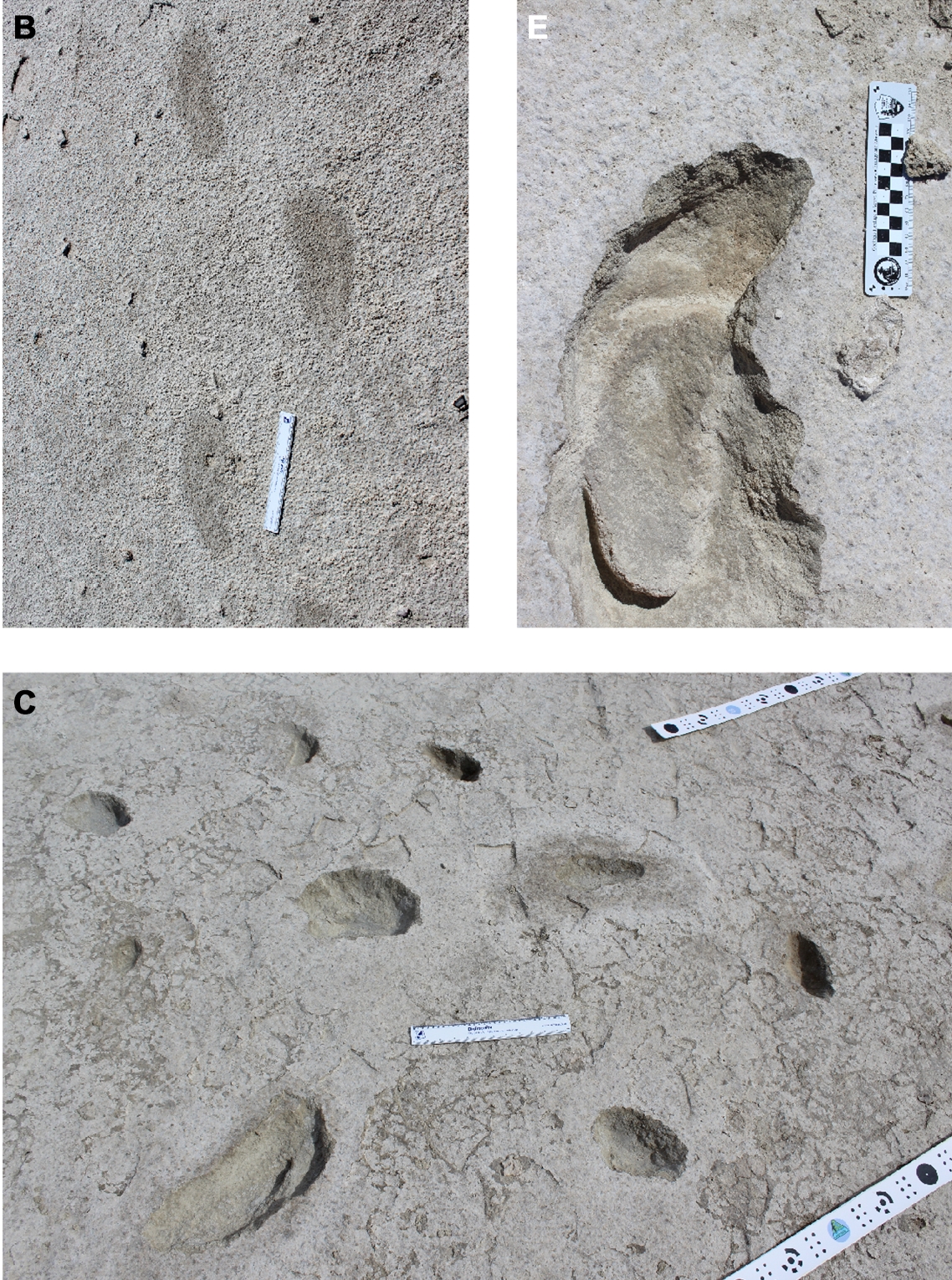 |
| Part of Figure 2 from Bustos et al. (2018). Part B has some faint sloth tracks (when poorly preserved, it can be difficult to distinguish similarly sized human and sloth tracks). Part C shows a "flailing circle" where a sloth appears to have swung its arms at a human. Part E shows a human track inside a much larger sloth track. |
Sunday, May 28, 2017
NPS Paleontology Roundup
 |
| The part and counterpart of University of Minnesota Paleontology Collections 4090, holotype of graptolite Dictyonema minnesotense Ruedemann 1933, collected from the St. Lawrence Formation at a no-longer extant site in Afton, Minnesota, now within Saint Croix National Scenic Riverway. |
Sunday, December 11, 2016
Fossil Crocs of the Science Museum
Saturday, May 7, 2016
Death Valley National Park geology, Part IV: Neogene and Quaternary
 |
| Very low-level photo across the salt flats of Badwater |
...And finally we reach the top of the stratigraphic column at Death Valley National Park (DEVA). For convenience, here are the links to Parts I, II, and III. A lot of geologists just love the most recent 23 or so million years of Death Valley geology. For one thing, it gives people fantastic fodder for arguments about when various events happened, their extent, and even the basic mechanisms. DEVA features not only the pull-apart tectonics of the Basin and Range, but also lateral movements on strike-slip faults. As a result, there are depositional basins of a wide range of sizes. Terminology is a bit of a nightmare. The Wiki page on Death Valley geology isn't bad, but its strat column isn't a patch on the glorious Cenozoic complexity lurking in the park.
Thursday, April 28, 2016
Death Valley National Park geology, Part III: Mesozoic through Paleogene
Sunday, December 27, 2015
North American camels: not the run-of-the-mill Christmas camels
Sunday, December 13, 2015
The three wells of Fort Monroe, and why they didn't pan out
 |
| Fort Monroe, during the early stages of the Civil War. Not pictured: somebody contemplating where to sink a well, never dreaming that by the time they stopped in 1869, the war would be long over, the current President would be assassinated, his replacement would be impeached, and the well would only turn up salt water. (image found at NPS monument site). |
For understandable reasons, it is useful for a fort to have a secure water supply. Logically enough, the staff at Fort Monroe decided to address theirs by drilling an artesian well. Thus it was that in 1845, work began on a well. Drilling continued until July 1846, at which time a pipe broke at 189 ft (58 m). In terms of getting water, this effort was unsuccessful, but for those of us interested in geology and paleontology, the attempt was a rousing success. The pioneering American microscopist Jacob Whitman Bailey identified a number of fossils, particularly from a unit of fine-grained greenish gray sand 48 to 108 ft (15 to 33 m) down). Identifiable material included coal, foraminifera, stratigraphically useful bivalves and scaphopods, and echinoid spines (Fontaine 1882). The mollusks are typical of the Yorktown Formation, now known to be Pliocene.
By the time of the Civil War, the fort (which remained in Union hands throughout) was still reliant on a cistern. Another attempt to sink a well was begun in 1864, within the walls of the fort (Woolman 1899). This time they reached 907 ft (276 m) (Rogers 1882) before running out of money in September 1869 (Fontaine 1882). Again, a number of marine fossils were found in the sediments, this time also including abundant diatoms, shark teeth, and whale bones (Rogers 1882). Also, like the first well, there was a distinct lack of potable groundwater. The only significant water was struck at 599 ft (183 m), and it was reportedly very saline (Sanford 1913).
There is no sense in doing things halfway, so in 1902 a third attempt was made. This time, they didn't stop until they penetrated crystalline bedrock at 2,254 ft (687 m) (Darton 1902). In eastern Virginia, there aren't a lot of places to view long columns of strata, so this and the 1864 well have attracted a fair amount of interest, popping up from time to time in the literature (e.g. Richards 1945, 1947; Cederstrom 1945, 1957; Powars 2000). Interestingly, Darton (1902) thought there was quite a bit of Cretaceous coastal plain sediments below the fossil-bearing Cenozoic marine sediments, but Cederstrom (1945, 1957) thought it was Cenozoic all the way down. In the end, the well has been quite informative for geologists. In terms of water? The third and final attempt was just as fruitless as the others. When water was tested, it proved to be saline (Sanford 1913).
Now for the punchline: they never turned up potable groundwater for the simple reason that they couldn't. What they had no way of knowing at the time was that during the Eocene, approximately 35 million years ago, an object from space blasted into North America about where the tip of the Delmarva Peninsula is today. Fort Monroe happens to be within the area directly affected by the impact. The sediments down to bedrock were rearranged in the blink of an eye and the preexisting aquifers were completely disrupted. In the impact zone, no matter how far down you go, you turn up salty water (Powars and Bruce 1999; Powars 2000).
References:
Cederstrom, D. J. 1945. Structural geology of southeastern Virginia. Bulletin of the American Association of Petroleum Geologists 29(1):71–95.
Cederstrom, D. J. 1957. Geology and ground-water resources of the York-James Peninsula, Virginia. U.S. Geological Survey, Washington, D.C. Water-Supply Paper 1361.
Darton, N. H. 1902. Norfolk folio, Virginia-North Carolina. U.S. Geological Survey, Washington, D.C. Folio of the Geologic Atlas 80.
Fontaine, W. M. 1882. The artesian well at Fort Monroe, Va. The Virginias 3(2):18–19.
Powars, D. S. 2000. The effects of the Chesapeake Bay impact crater on the geologic framework and the correlation of hydrogeologic units of southeastern Virginia, south of the James River. U.S. Geological Survey, Reston, Virginia. Professional Paper 1622.
Powars, D. S., and T. S. Bruce. 1999. The effects of the Chesapeake Bay impact crater on the geological framework and correlation of hydrogeologic units of the lower York-James Peninsula, Virginia. U.S. Geological Survey, Reston, Virginia. Professional Paper 1612.
Richards, H. G. 1945. Subsurface stratigraphy of Atlantic Coastal Plain between New Jersey and Georgia. Bulletin of the American Association of Petroleum Geologists 29(7):885–955.
Richards, H. G. 1947. Invertebrate fossils from deep wells along the Atlantic Coastal Plain. Journal of Paleontology 21(1):23–37.
Rogers, W. B. 1882. Infusorial deposit of Virginia in the Fort Monroe artesian well. The Virginias 3(10):151–152. Reprinted in Geology of the Virginias, 1884, pp. 733-736.
Sanford, S. 1913. The underground water resources of the coastal plain province of Virginia. Virginia Geological Survey, Charlottesville, Virginia. Bulletin 5.
Woolman, L. 1899. Artesian wells in New Jersey. Pages 59–144 in Annual report of the State Geologist for the year 1898. Geological Survey of New Jersey, Trenton, New Jersey.