Showing posts with label trace fossils. Show all posts

Thursday, October 30, 2025

Hyoliths VII: The New Blood

Have you ever been working on some mundane task when you suddenly wondered about the latest news from the world of hyoliths? Taking a walk, or merging onto a busy highway, or applying shampoo in the shower? All right, probably not, but if so, we're here for you!

Appropriately for this time of year, we have some news of hyoliths meeting or escaping grisly demises. (Or not, but that's taphonomy for you.) Kraft et al. (2023) published on an exceptionally well-preserved specimen of the Middle Ordovician central European trilobite Bohemolichas incola, including gut contents. The hyoliths are only a small part (quite literally!) of the story, which is well worth checking out if you have any interest in trilobites. The small trilobite (on the order of 35 mm or 1.4 inches long) apparently ate every darn thing it could fit in its mouth that wasn't putting up too much of a fight, including tiny hyoliths, ostracodes, stylophoran echinoderms, and chunks of shells.

The trilobite in question (Figure 1 from Kraft et al. 2023; scale bar 10 mm or 0.4 inches). Hyolith bits are in purple, including one recognizable shell under the trilobite's pygidium (tail segment). CC BY 4.0.

Paleozoic examples of the bilobed trace fossil Rusophycus are often attributed to resting trilobites, and one of the things you can do when you're not moving is pick up a snack. Lee et al. (2025), in a description of Cambrian Rusophycus from China, included an example where the trace was associated with hyolith shells. Unlike classic Rusophycus, thought to occur at the seafloor surface, this example was interpreted as a burrow. Also unlike classic trilobite predation trails, in this case the food had a hard shell. The trace-maker is thought to have been scavenging for hyoliths that had been transported from elsewhere.

Returning to the Ordovician of central Europe, we find a hyolith that was not eaten, although not from lack of trying. Fatka et al. (2023) reported a specimen of Elegantilites custos with healed damage in the form of scratches on its operculum. The culprit in this case is thought to have been an echinoderm, possibly an ophiuroid (brittle star) trying to get in.

Perhaps you'd prefer to think of your hyoliths more in terms of a grand and proud lineage, rather than delicious treats for every passing trilobite and brittle star. If so, Liu et al. (2024) have an analysis of Cambrian hyoliths for you. Using all valid Cambrian genera (N=115), they considered a set of 20 morphological characteristics over time and space. Overall hyolith taxonomic diversity peaked in Series 2 of the Cambrian (roughly speaking, the time when trilobites appeared and therefore kind of like the old "Early Cambrian"). They then keeled over sharply and were at lower levels for much of the rest of the Cambrian, locally reviving to a certain extent in the Early Ordovician. Their decline may have been due to an ocean anoxic event (the Sinsk Event) around 513 to 508 million years ago. The two major wings of hyoliths, the hyolithids (the kind with helens and complex opercula; filter feeders?) and orthothecids (the kind without helens and with simple opercula; deposit feeders?), did not follow the same curves: the orthothecids peaked sooner and felt the bite sooner, whereas the hyolithids didn't really get started until Series 2 and actually peaked just after it before suffering their drop. Morphological diversity was greatest in Series 2, although granted hyoliths had a somewhat limited repertoire.

The curve of Cambrian hyoliths. Figure 1 in Liu et al. (2024). CC BY 4.0.

References

Fatka, O., M. Valent, and P. Budil. 2023. The first healed injury in a hyolith operculum. The Science of Nature 110(50). https://doi.org/10.1007/s00114-023-01879-0.

Kraft, P., V. Vaškaninová, M. Mergl, P. Budil, O. Fatka, and P. E. Ahlberg. 2023. Uniquely preserved gut contents illuminate trilobite palaeophysiology. Nature 622: 545–551. https://doi.org/10.1038/s41586-023-06567-7.

Lee, D.-C., M.‑K. Oh, Y. Zhang, X.‑L. Zhang, J.‑H. Lee, K. Liang, and W. Li. 2025. Two new probable feeding traces of Rusophycus from the Cambrian of China: tracemaker’s behavior and formation mode. Geosciences Journal 29: 1–17. https://doi.org/10.1007/s12303-025-00007-6.

Liu, F., T. P. Topper, L. C. Strotz, Y. Liang, Y. Hu, C. B. Skovsted, and Z. Zhang. 2024. Morphological disparity and evolutionary patterns of Cambrian hyoliths. Papers in Palaeontology 10(2). https://doi.org/10.1002/spp2.1554.

Monday, October 7, 2024

Rockford, Part 2: Fossils (exclusive of brachiopods)

Before we get into the festivities, I've recently written an article for the online magazine Agate, about identifying common Paleozoic fossils of Minnesota. It's a compact summary that covers the most abundant groups, so if you're looking for something like that, go have a look!

In our previous post we had a look at the geology of the Fossil & Prairie Park Preserve of Floyd County, Iowa, also known as the Rockford site. For this post I'm going to briefly detail the fossils I collected, with the exception of the brachiopods, which will get a post of their own. For most of the non-brachiopods, I didn't get too far into the weeds on taxonomy, because many of the groups don't lend themselves to simple eye-checks for genera and species. Horn corals and bryozoans, for example, usually require thin sections, and crinoid columnals are generally only diagnostic of the presence of crinoids. I did, though, have recourse to Fenton and Fenton (1924) and other peoples' identifications to get some ideas.

Tuesday, April 30, 2024

Uŋčí Makhá Park 2024: another winter, more echinoderms

Two years after opening, Uŋčí Makhá Park can be considered a paleontological gem in the Twin Cities. With its Magnolia Member bedding planes, side cuts through the Magnolia and Carimona, easy access, and lack of vehicle traffic, it's nigh-on perfect for getting in touch with St. Paul as it was about 454–453 million years ago. It's kind of like our own Carnegie Quarry wall, except it's tiny marine invertebrates rather than dinosaurs, it probably wasn't planned, and you can walk right out over it. It's always fun to get to spend time there for work, and like last year, I got the opportunity to assist with a training session for Mississippi National River & Recreation Area seasonals there. Then, of course, I just had to make a quick return trip later to follow up on some things we'd seen.

Sunday, June 4, 2023

Uŋčí Makhá Park Revisited, Part 2: Further Fossils

We're now up to the fourth entry in a completely unexpected series on the Platteville–Decorah rocks and fossils of Uŋčí Makhá Park. We've already seen the common fossils from the site, so for this go-round I'm focusing on rarities.

Sunday, May 28, 2023

Uŋčí Makhá Park Revisited, Part 1: Freeze-Thaw

After I'd come across the new exposures at Uŋčí Makhá Park last fall, I was very curious about how a Minnesota winter and spring would treat them. After all, these were fresh, with no previous direct exposure to snow, ice, and freeze-thaw cycles. Would they rapidly degrade, or were they made of sterner material? Last week I had the opportunity to spend some quality time at the park, in preparation for and leading a training session for Mississippi National River & Recreation Area seasonals (and if any of the participants happen on this post, hello! I hope you had a good time!).

What were the results of this natural experiment? A few observations:

The Carimona Member of the Decorah (blue-gray upper interval), particularly the blocks used as landscaping, suffered appreciably more than the Magnolia Member of the Platteville (tan lower interval). I attribute this to the greater shale content of the Carimona.

This is a pretty illustrative comparison. The blue-gray block on the upper left is Carimona, and the tan block on the lower right is Magnolia. The Carimona block's upper surface is littered with small chips, while the only chips on the Magnolia block came from the Carimona block. (Note also the large burrow on the Magnolia block.)

More Carimona landscaping showing exfoliation.

This indicates that the Carimona blocks will weather faster than the Magnolia blocks; eventually, both lithologies will reach equilibrium with their new surroundings, but the "fucoidal" surfaces on the landscaping are going to go away faster than the shell beds.

Note the burrows popping off the surface in some places.

It wasn't all smooth sailing for the Magnolia, though. Although many blocks and beds seemed fine, others had definite signs of damage.

Here a thin bed is breaking up.

This isolated block appears to be shattered. (Colors are weird because when I took this photo, I'd forgotten to reset the lighting from tungsten bulbs.)

Unlike last fall, which was a time of drought, this spring we can also definitely see where the seeps are.

And they're concentrated at the bentonite layers in the Carimona.

Many fossils and features came through without particular damage, though. I included a photo of a bivalve in the fossil guide post. Here it is last week:

Dare I say that it's "happy as a clam"? (Ignore the color balance differences.)

With that out of the way, did we find other fossils I hadn't seen in the fall? Well, of course! Tune in next week for some less-typical fossils!

Monday, March 20, 2023

Brooksella: what are star cobbles?

Back in the far-off year of 2012, when I was helping to compile instances of paleontological type specimens found in National Park Service units, we had to make decisions about various edge cases. One of these was how to handle names for what later turned out to be pseudofossils. We decided to record the information as historically relevant but did not include the "taxa" in any counts. On this blog we've actually covered a couple of them already, "Lingula calumet" and "Paradoxoides barberi" from within or very near Pipestone National Monument. Another is "Brooksella canyonensis", a putative jellyfish from the Proterozoic Nankoweap Formation of Grand Canyon National Park. It was first reported as such in Van Gundy (1937) and then named, not entirely enthusiastically, in Bassler (1941). "B. canyonensis" has fared poorly as a jellyfish, but has had its supporters as an organic feature (e.g., Glaessner 1969; Kauffman and Steidtmann 1981; Kauffman and Fursich 1983; tentatively Ciampaglio et al. 2006). However, I favor an inorganic interpretation. Admittedly, there are several to choose from: gas-escape structures or compaction (Cloud 1968), "sand-volcano"-type fluid escape (Ford and Breed 1977; Ford 1990), and mud rolls (Fedonkin and Runnegar 1992).

"B. canyonensis" was not the first species in the genus Brooksella, though. Brooksella was named by Charles Walcott for "star cobbles" from the Coosa Valley of Alabama (Walcott 1896), now attributed to the middle Cambrian-age Conasauga Formation (Nolan et al. 2023). In fact, he named three taxa for different forms of cobbles: B. alternata, B. confusa, and Laotira cambria (Walcott 1896). Star cobbles got their name because at their best they look like the stereotypical twinkly pointed things you might doodle. Some of them even have five rays, although six is more typical and they are more lobed than pointed, so it's not a perfect match.

Brooksella (A–D, K) and Laotira (E–H, J) as illustrated by Walcott (1898) and reproduced as Figure 1 in Nolan et al. (2023) (which see for full caption). CC BY 4.0.

Walcott interpreted the objects as representing jellyfish, which are probably not the first thing you think of when fossils come to mind, but jellyfish fossils are in fact known elsewhere. In this case, though, the interpretation hasn't proved tremendously popular over time, and numerous alternatives have been proposed. These alternatives, though, generally involve some kind of organic origin, either as a true body fossils or a trace fossil of some sort. It's not hard to see why: they look like something that *ought* to be organic, even if the identity of that something is unclear. (Anyone who has gone out fossil hunting will probably recognize this feeling. Sometimes you're right, sometimes you're wrong.)

Nolan et al. (2023) have published a detailed reassessment of Alabama Brooksella. As part of it, they prepared a lovely supplemental figure of various hypotheses, with thumbnail evaluations (discussed at greater length in the text). (*Warning*: Hold off on clicking the link if you'd rather not get their solution immediately.) Studies of Brooksella from the past couple of decades have interpreted it as a trace fossil (either a feeding burrow or a coprolite) or a glass sponge (hexactinellid). Nolan et al. subjected star cobbles to about as many tests as can legally be done to rocks in their analysis of the various possibilities, and came to several conclusions, including:

  • Brooksella specimens do not have a sponge's anatomy. There aren't spicules, features previously interpreted as ostia (pores) bear a strong resemblance to pitting left behind when lichen are cleaned off, and lobes do not feature opening at their ends for radial canals (which were also not found).
  • The orientation of the specimens when found in situ was with the putative central osculum (excurrent vent) down in the sediment, which is an inconvenient place for an osculum. Furthermore, many examples did not even have an "osculum".
  • The specimens include internal voids and tubes, but these spaces do not correspond to the external form, unlike primary burrows (although this does not preclude the specimens having "captured" parts of burrows that were passing through). Furthermore, the internal features do not include common burrowing structures such as backfill.
  • The specimens have the same composition as silica concretions from the same rocks, and are very comparable overall, with the same kind of weathering rings, lichen pitting, and random internal voids and tubes.

Nolan et al. concluded that Brooksella is no different from the local concretions except for the lobes, and should therefore "be considered a pseudofossil until proven otherwise." A consequence of this conclusion is that Brooksella, not being a glass sponge, would not have been a source of silica for preservation of fossils in the Conasauga. (It's not stated, but it seems that it would have been a sink instead.) It further goes to show that you shouldn't trust strange things in the Cambrian.

Brooksella (A–E) and concretions (F–K) collected from the Conasauga Formation by Nolan et al. (scale bar 1 cm, or 0.4 in); Figure 5. CC BY 4.0.

References

Bassler, R. S. 1941. A supposed jellyfish from the pre-Cambrian of the Grand Canyon. Proceedings of the United States National Museum 89(3104):519–522.

Ciampaglio, C. N., L. E. Babcock, C. L. Wellman, A. R. York, and H. K. Brunswick. 2006. Phylogenetic affinities and taphonomy of Brooksella from the Cambrian of Georgia and Alabama, USA. Palaeoworld 15:256–265.

Cloud, P. E., Jr. 1968. Pre-metazoan evolution and the origins of the Metazoa. Pages 1–72 in E. T. Drake, editor. Evolution and environment. Yale University Press, New Haven, Connecticut.

Fedonkin, M. A., and B. N. Runnegar. 1992. Proterozoic metazoan trace fossils. Pages 389–395 in J. W. Schopf and C. Klein, editors. The Proterozoic biosphere: A multidisciplinary study. Cambridge University Press, Cambridge, United Kingdom.

Ford, T. D. 1990. Grand Canyon Supergroup: Nankoweap Formation, Chuar Group, and Sixtymile Formation. Pages 49–70 in S. S. Beus and M. Morales, editors. Grand Canyon geology. Oxford University Press, New York, New York.

Ford, T. D., and W. J. Breed. 1977. Chuaria circularis Walcott and other Precambrian fossils from the Grand Canyon. Journal of the Palaeontological Society of India 20:170–177.

Glaessner, M. F. 1969. Trace fossils from the Precambrian and basal Cambrian. Lethaia 2(4):369–393.

Kauffman, E. G., and F. Fursich. 1983. Brooksella canyonensis: A billion year old complex metazoan trace fossil from the Grand Canyon. Abstracts with Programs - Geological Society of America 15(6):608.

Kauffman, E. G., and J. R. Steidtmann. 1981. Are these the oldest metazoan trace fossils? Journal of Paleontology 55:923–947.

Nolan, M. R., S. E. Walker, T. Selly, and J. Schiffbauer. 2023. Is the middle Cambrian Brooksella a hexactinellid sponge, trace fossil or pseudofossil? PeerJ 11:e14796. doi:https://doi.org/10.7717/peerj.14796.

Van Gundy, C. E. 1937. Jellyfish from Grand Canyon Algonkian. Science 85(2204):314.
Walcott, C. D. 1896. Fossil jelly fishes from the Middle Cambrian Terrane. Proceedings of the United States National Museum 18:611–614.

Walcott, C. D. 1898. Fossil Medusæ. U.S. Geological Survey, Washington, D.C. Monograph 30.

Sunday, November 13, 2022

Quick Guide to Fossils at Uŋčí Makhá Park

So I went back to Uŋčí Makhá Park last weekend and spent a couple of hours taking photos of fossils, because it makes such an ideal place to see the upper Platteville fauna. After all, a winter of freezes and thaws may not leave these new exposures looking as nice as they do now. Here's a quick guide to what can be seen there. (Let's see how many photos I can squeeze into one post, and how many species I can misidentify!)

Determining where you are stratigraphically

First of all, I'd just like to reiterate the stratigraphy. Most of the vertical extent is in the Magnolia Member of the Platteville Formation, with the upper part composed of the Carimona Member of the Decorah Shale. I'm thinking more or less the entire extent of the Carimona is exposed, based on thickness; at any rate the next thing up would be the shaly part of the Decorah, and there isn't a trace of it to be seen. I'm suspicious because the difference is just so darn clear, but at this site there is an unmistakable color change between the two units: the Carimona is the upper blue-gray interval and the Magnolia is the light tan-gray interval below. The Deicke K-bentonite is the lower and thicker of the two bentonite gaps in the Carimona. (Note that the Carimona is sometimes supplemented or replaced by landscaping, but this is pretty obvious.) As you walk from south to north, the "floor" goes up stratigraphically, so it's not all one bedding plane but a gently rising series of planes, until by the exit you're close to the color change.

The color change is quite evident here. The Deicke K-bentonite is the cut-in about halfway up the blue-gray Carimona (above the scale bar in the center of the photo).

Here we've gone north, and the floor has risen. The Deicke is still the seam in the middle of the blue-gray rocks.

Sunday, May 10, 2020

Revisiting Shadow Falls Park

I like to periodically recheck various sites along the Mississippi corridor, to see how the elements are treating them, if there have been any major rock falls, damage from downed trees, changes in usage, etc. One of the places I get to more frequently than others is Shadow Falls Park. It has an informal reputation for collecting and is a place with soil on steep slopes (plus access is good and I like going there).

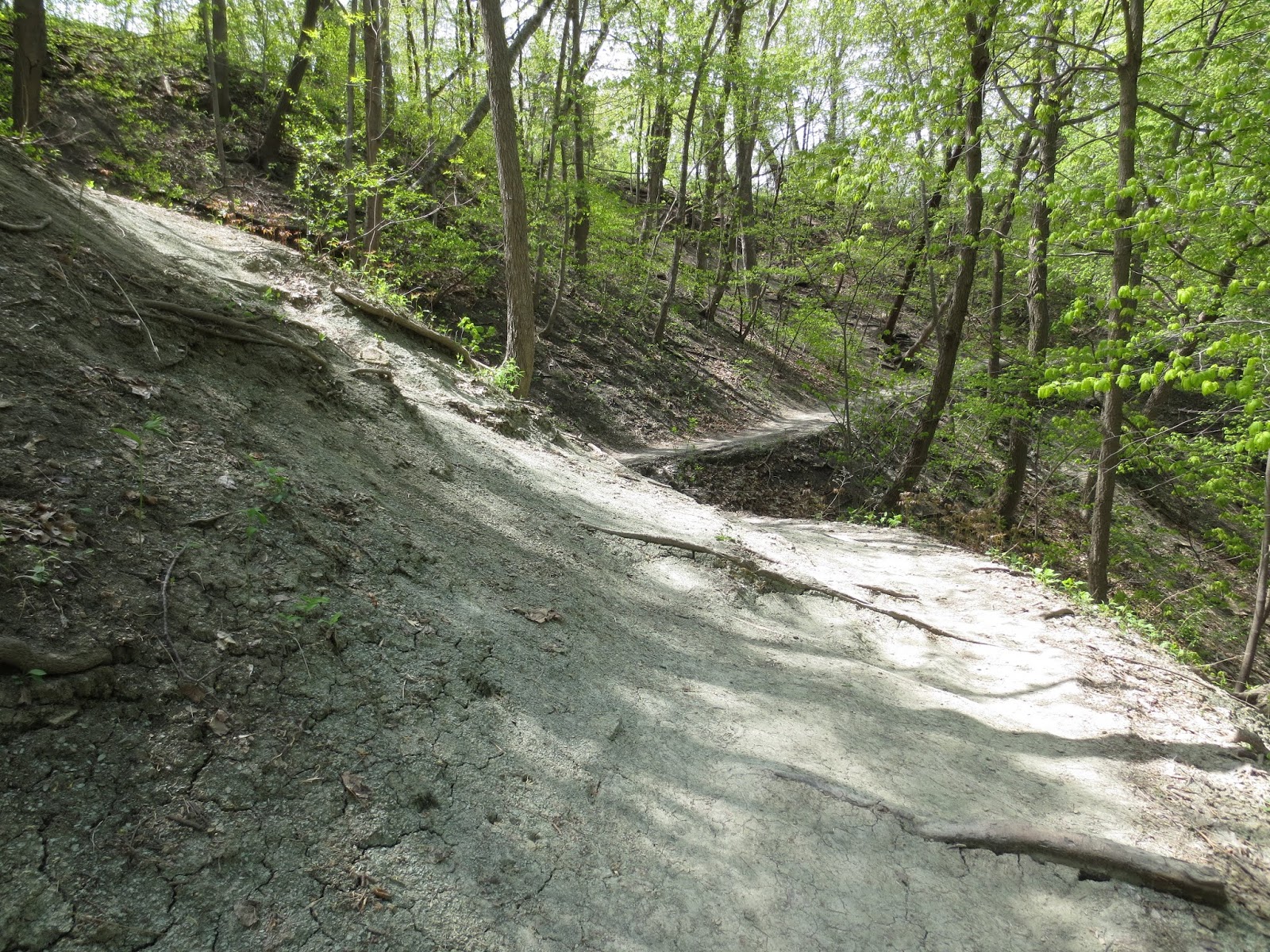
Here's the trail on the south side of the valley past the falls (which are essentially just to the right and a little below the vantage point of this photo).

Erosion may not be immediately evident if you don't have something to measure the loss of sediment, but in places with tree roots near the surface on the slopes it's easy to see how running water and gravity have done their work.

Almost a staircase of roots.

The usual array of lower Decorah fossils was present, in small chunks of rock and loose. It seemed to be a particularly good day for observing strophomenids (in the hash plates, primarily; they tend to break up otherwise). One example in the photo below is probably Rafinesquina, based on the thinness of the valve. This genus is named after Rafinesque, who we met last week and had a much more substantial career than getting into arguments about sloths. Another nice piece observed was a Bumastoides pygidium.

A. Probable Rafinesquina valve. B. Bumastoides pygidium

In one area I observed two pieces of a larger specimen of Rauffella palmipes. This is all catch-and-release, of course!

Two fragments of a large Rauffella palmipes.

Shadow Falls includes not only the falls, but a long valley oriented east-west with its head near but not quite reaching Cretin Avenue. I haven't spent much time in the valley above the falls because the area right above the falls tends to turn into a muddy swamp, but it's been a dry spring. The creek feeding the falls is in a very deep valley for its size, but would have been somewhat bigger in the days before sewers and roads.

The creek valley above Shadow Falls...

...opens up into this near its head.

There are several large fossiliferous blocks along the creek that include crinoid columnals notably larger in diameter than the run-of-the-mill lower Decorah columnals (note that the photo in the linked post is biased to larger, more photogenic columnals). The obvious guess is that they were brought to the area by glaciers and represent a different part of the stratigraphic column, say the upper Decorah or one of the overlying Ordovician formations that have been stripped from the area.

Large columnals

Sunday, March 8, 2020

Stromatolite Sunday

I happen to know a place along a shore where the riprap includes a small percentage of stromatolitic blocks, and given the nice weather on Saturday, I thought I'd stop by and take some pictures. I have not asked about the source, but I have a pretty good idea that the provenance is one or more quarries in the area working the Shakopee Formation (Prairie du Chien Group). The rocks look like the Shakopee Formation (including that which is exposed in outcrop nearby), and there are no fossils beyond stromatolites and burrows. Stromatolites can be subtle features, but not these examples. Not only is the layering very distinct, once you get used to the appearance of the stromatolitic blocks it is possible to reliably pick them out from the other blocks at a distance of a few meters/yards. The simplest way to describe it is that the non-stromatolitic blocks are sandier and thus reflect light differently. Here's a side of a stromatolitic block, as you might see it as you approach.

Since these are domes, way-up is toward the top of the photo.

You'll see what looks like numerous parallel series of stacked parentheses. Let's zoom in on them:

Note that the column near the center splits into two smaller columns going up.

Enhance!

There's been just enough weathering to make the layers stand out nicely.

The stacks aren't necessarily separate columns, because if you look closely you can see that layers can continue from stack to stack, but "column" is a handy quick descriptor. In life, the colony would have had a lumpy upper surface composed of a number of distinct but connected domes. We can see this in upper and lower surfaces of stromatolitic blocks.

The upper surfaces of stromatolite blocks (A) are lumpy, showing the tops of the small domes. Sometimes there is a nice bottom surface that's essentially a negative of the upper surface (B). (These are definitely hollows, but your eyes may interpret the photo as domes.) Bottom surfaces can be easier to appreciate than the sometimes subtle upper surfaces.

In this case, weathering has partially removed some of the uppermost layers, "dissecting" the tops of the domes.

This photo, taken along the edge between an upper surface and a side, shows how the stacks translate into domes.

I am completely comfortable interpreting these lumpy stacked colonies as Stauffer's Cryptozoon rosemontensis, which he named from the Shakopee Formation not too far away. Almost all of the stromatolitic blocks I saw fall under this category, but there were a couple of examples that did not have stacks, instead having large hemispherical structures. These are much more typical of a variety named Cryptozoon minnesotensis.

These two photos show a much different flavor of microbial colony immortalized as stromatolites. A shows multiple lobes, while most of B is one big dome. These are in the vein of Cryptozoon minnesotensis.

Some of the blocks are well-preserved, even though they are now exposed to the elements. Others are now weathering, breaking down either by spalling at the tops of the dome stacks or by the stacks themselves beginning to fall out. The difference may have to do with how much sand was incorporated into the colony.

This group of photos shows a heavily eroded block, with columns beginning to spall out. A gives the overall appearance. B is a close-up of several such columns. The pockmarks mark where sand grains have eroded from the layers. C shows a closer view of pockmarks.

The Prairie du Chien Group is not noted for its non-stromatolitic fossils, although I have seen some snails in the Shakopee elsewhere. These blocks did not change that overall impression. There were a couple of cases of burrows or things that look very much like burrows, though.

A couple of examples of burrows or burrow-like features. A has a long feature from the lower left to near the center, plus other shorter similar features. B has what looks like a web of burrows.

Sunday, December 8, 2019

St. Croix Cambrian trace fossils

Here's something simple: photos of Cambrian trace fossils in the St. Croix Valley. If you would like a refresher on the rocks in question, may I suggest this post? We've already seen some photos of Skolithos burrows in the Mazomanie, a sandstone unit. The finer-grained rocks have other kinds of trace fossils, which makes sense because they represent different environments than the Mazomanie. At the same places in Osceola where Skolithos are found in abundance in the Mazomanie, much different burrows are locally abundant in the overlying St. Lawrence Formation. In the upper part of this formation, where the beds are sandy and can be hard to tell from the Jordan Sandstone (Sardeson 1932), the burrows are much thicker and horizontal.

There are a few in these pieces of float, including just below the scale bar and in the block above and to the left of the central block. The squares in the bar are 1 cm, so the burrows are a bit larger, on the order of finger-sized.

Returning to the same area nearly two and a half years later, I came across these remnants of a disintegrated block. If you expand the photo, you'll see that the largest chunks are those with burrows.

Comparable burrows can be found lower in the formation, in more typical-looking gray-green blocks. I wasn't seeing body fossils, which are reputed to be there, but there were certainly plenty of trace fossils.

This is more like what the St. Lawrence is supposed to look like, and there's another horizontal burrow, a bit smaller than those in the photos above but pretty similar.

One of the finer-grained units intertonguing with the Mazomanie is the Tomah Member of the Lone Rock Formation, another part of the ex-Franconia Formation. The Tomah is the finest-grained part of the Lone Rock Formation and has a tendency to erode into angular chips, blocks, and chunks, usually hand-sized or smaller, often in pastel greens and oranges. Some of the beds are heavily marked by various kinds of trace fossils.

Several different sizes are apparent here.

This one's unusual for having eroded out as a substantial piece.

This chip has traces close to 1 mm in diameter near the top and a thicker trace several mm across near the center, with a "lobed" appearance that may be due to erosion.

The large straight burrow on this piece has a lumpy surface somewhat reminiscent of "corn cob" Ophiomorpha, but not as coarse.

A slice of pizza covered with grains of rice?

I could go on ad nauseum with trace fossil photos from the Tomah (you may already be there), so just one more for the road. As far as I know, nobody has published a detailed analysis of the trace fossils in the Tomah or St. Lawrence, although I can't rule out there being some dissertation or other piece of grey literature I haven't run across. There's certainly quite a lot of these fossils there, though!

This one is dominated by burrows a couple of mm in diameter. Note the long slender trace in the upper center

References

Sardeson, F. W. 1932. Fauna of the Jordan Sandstone. Pan-American Geologist 58(2):103–106.

Sunday, February 24, 2019

The many moods of Rauffella

Earlier in February, I attended a Geological Society of Minnesota fossil lab hosted by Jeff Thole and Macalester College. At some point someone brought out a fossil that they weren't familiar with; it looked a lot like the final photo in this post, a light-colored object that resembled loops of cord. What this person had was one of the most characteristic but least scientifically appreciated fossils of the Decorah Shale: the trace fossil Rauffella (specifically R. palmipes, as we'll get to later).

Sunday, April 29, 2018

Tracking sloths and people at White Sands National Monument

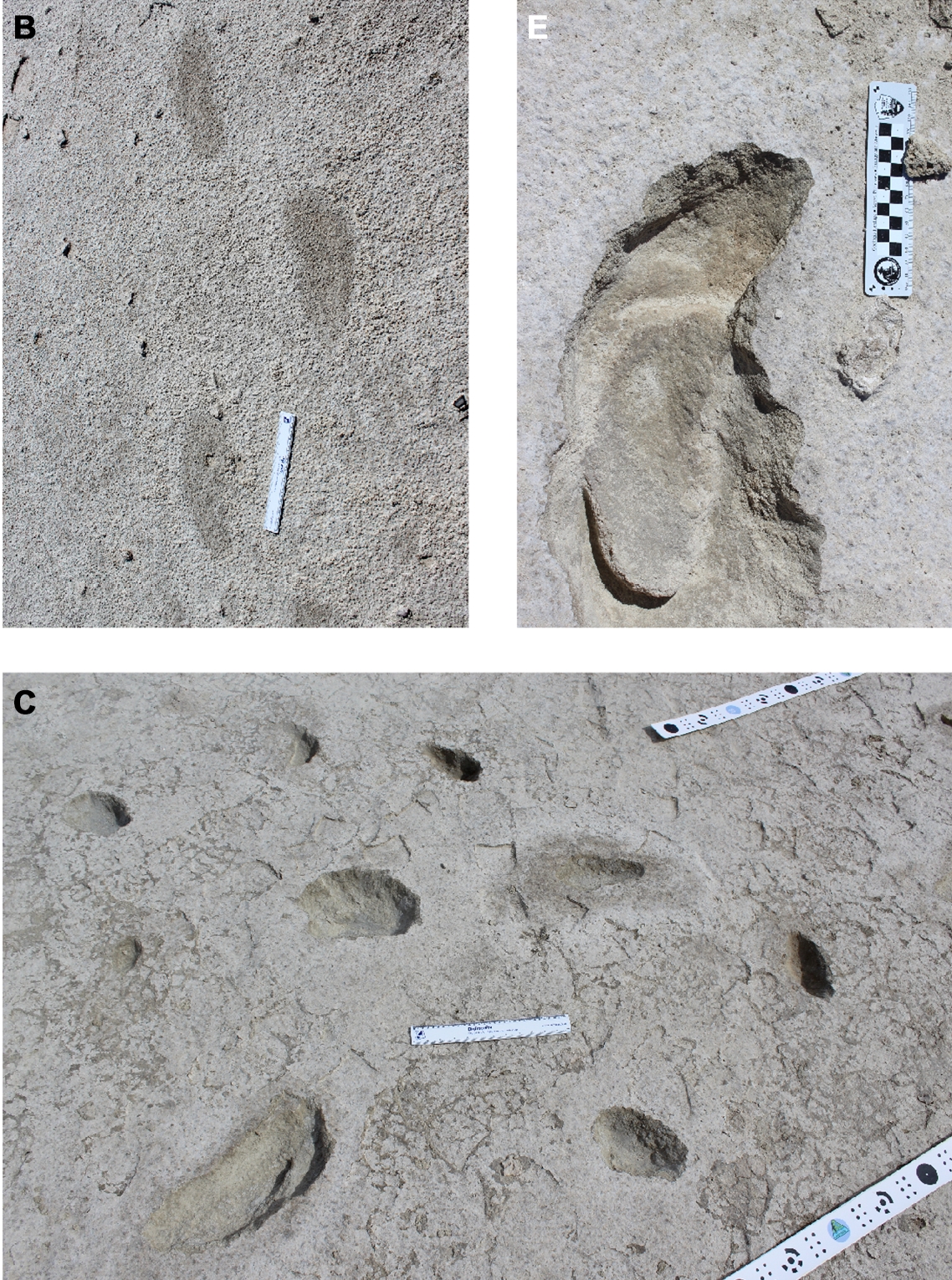
Earlier this week came some of the biggest news concerning National Park Service paleontology in quite some time: the discovery of tracks, including overlapping tracks, of extinct ground sloths and humans at White Sands National Monument, New Mexico. These finds were published in an article by Bustos et al. (2018), which can be accessed here (don't forget the supplement; less technical summary here). It's a pretty darn substantial way of showing humans and extinct sloths as contemporaries, and new evidence on the early history of humans in the Americas and the twilight of the Pleistocene megafauna. About the only ways you could make the tracks more notable would be to have them continue into the end of a hunt, or to have some dateable material that placed them significantly pre-Clovis.

Part of Figure 2 from Bustos et al. (2018). Part B has some faint sloth tracks (when poorly preserved, it can be difficult to distinguish similarly sized human and sloth tracks). Part C shows a "flailing circle" where a sloth appears to have swung its arms at a human. Part E shows a human track inside a much larger sloth track.

Sunday, April 8, 2018

Phycodes: bundles of burrows

I'm going out of the office again, so, like last year, I'm tossing up a few pictures of something I find interesting, in this case an invertebrate trace fossil called Phycodes (not to be confused with Phycodes the moth). I touched on Phycodes briefly a few years ago, using the image included below:

That pale gray color is characteristic of the Brickyard in Lilydale, for whatever reason(s).

The whole piece looks like this:

"Licrophycus ottawaensis" in older literature.

I collected it on a Geological Society of Minnesota visit back in 2006 and it has since become one of the pieces I like to take to events because it's a great teaching fossil. I ask people what it is and let them explain their choice if they want to, and then I identify it. I get a lot of plant-based guesses (which of course is what a lot of paleontologists and geologists thought this kind of structure was decades ago). What Phycodes really is is an invertebrate trace fossil recording the behavior of some kind of wormy animal probing in the mud for food and returning to a central point. This resulted in splayed bundles of burrows, giving the trace fossil a characteristic root-like or mop-like appearance. It doesn't have quite the oomph of a dinosaur bone, but it looks interesting, it's good for conversation, and worms are more familiar than, say, crinoids.

When space is an issue, I have a more compact specimen.

Phycodes turns up every so often in the Decorah. It's not as common as Rauffella (which has turned up in a half-dozen posts so far), but it certainly makes a striking fossil.

Suitable for framing: this chunk is almost entirely Phycodes, with little matrix, which also makes it more fragile than the first two specimens (too bad, because it's also the best). The individual tubes are a bit smaller in diameter than those of the first two as well.

The makers of Decorah Phycodes differed from the makers of Rauffella in a couple of notable ways: Phycodes-makers were smaller (a few mm in diameter versus finger thickness for many Rauffella) and apparently smoother (no surficial striations in Phycodes).

This piece is one of the group from the construction site last year. I'm not certain what kind of ichnofossil it is. It resembles Phycodes templus, but it's also kind of poorly preserved and it's not clear if the burrows are bundled, so it might not be Phycodes at all. (Another possibility is poorly preserved "Camarocladia".) Note the brassy ooids.

Sunday, February 18, 2018

Identifying invertebrate fossils

Pop quiz! (don't worry, it's not for credit)

Romance *and* brachiopods

Here we have an assortment of fossils, tastefully arranged in a holiday-appropriate setting. They're all the typical local Ordovician stuff, but many Paleozoic shallow marine formations will have a lot of the same general things. What are they, and how can you tell?

Sunday, July 10, 2016

Dystactophycus, the crinoid swirl

A few weeks ago, a friend brought in an odd object to the Science Museum, which he had collected from an excavation in the vicinity. The object is a carbonate rock featuring concentric ridges that seem to be radial around a central depression. On the off-chance that it was some kind of exotic trace or trace-like pseudofossil, and that it had been illustrated, I went across the hall, pulled the volume of the Treatise on Invertebrate Paleontology that covers traces, and was pleasantly rewarded in the pseudofossil section with an illustration of something called Dystactophycus. The illustrated specimen was even from the Cincinnatian, which is practically as good as the Platteville/Decorah, being just a couple of million years younger. Of course, when something comes this quickly I'm honor-bound to be suspicious, but in this case the actual existence of something like Dystactophycus is more interesting than the question of whether or not I was right. (I do get back to the question of identity in the last paragraph.)

Dystactophycus, as currently understood, is one of those things that makes perfect sense once you've heard of it, but otherwise would probably never occur to you. It is composed of concentric markings on a conical structure. The initial describers (Miller and Dyer 1878) interpreted it as a seaweed, because the year was 1878 and the campaign to wrap peoples' minds around invertebrate trace fossils was far from being over. In short order, it was dismissed as an impression of a concentrically ringed bryozoan (Monticulipora by way of Lichenalia concentrica, both then considered corals) (James 1885, 1895–1896). More recently, Dystactophycus has been attributed to crinoids (Osgood 1970; Meyer and Davis 2009). As Osgood described it, the earlier researchers had the thing upside down: instead of an upward-pointing cone, the center was a low depression. The stem was partially buried by mud and the rest of it was spun around by swirling currents, causing its arms to sweep out an area that became the depression and quite naturally leave concentric markings. At some point, the crinoid detached, and the depression filled in the absence of the sweeping action. Although kind of like a trace fossil, these markings are not trace fossils because they are not evidence of biological activity. Think of them more like an Ordovician equivalent to marks left by a log on a river bottom (tool marks, in the parlance). (If you'd like to see a true crinoid trace, check this out!)

The specimen in question (I didn't have a scale handy, so my fingertips will have to do). Although similar in some ways to Dystactophycus, I don't think it's an example.

So, do I think that the specimen in hand is an example of Dystactophycus? Although it is superficially similar to the description, there are a couple of characteristics that lead me to say "no". The major issue is that the specimen is not a simple cone shape. Instead, after rising from the center, it slopes again (so kind of a doughnut shape), and the concentric lines are not confined to the cone but continue on the back side. In addition, the markings are not so much grooves and ridges but concentric terraces. My guess instead is some sort of abiotic sedimentary deformation.

References:

James, J. F. 1885. Fucoids of the Cincinnati Group. Journal of the Cincinnati Museum of Natural History 7(4):151–166.

James, J. F. 1895–1896. Manual of the paleontology of the Cincinnati Group, Part VII. Journal of the Cincinnati Museum of Natural History 18(3–4):115–140.

Meyer, D. L., and R. A. Davis. 2009. A Sea Without Fish. Indiana University Press, Bloomington and Indianapolis.

Miller, S. A., and C. B. Dyer. 1878. Contributions to Paleontology 2.

Osgood, R. G., Jr. 1970. Trace fossils of the Cincinnati area. [regrettably, the plates are not included] Palaeontographica Americana 6(41):280–444.

Thursday, March 24, 2016

Mostly bryos and burrows

It's still a little early to be out and about in the metro rocks and expect good luck (for one thing, the Decorah is still in winter-spring-transition mud mode) or consistent weather, but we're getting close, and sooner than usual. Here's one seasonal photo and then a few interesting pieces I hadn't featured before. These are all photos of Decorah Shale fossils from the St. Paul side of the river.

Lower Decorah a couple of weeks ago, after having been relatively warm and dry for several days. These two fragments were covered with half-burrows (imagine a tubular burrow split along its long axis), and several other pieces from the same area and probably a similar stratigraphic level had the same kind of abundant half-burrows.

Sunday, August 10, 2014

Sponge detective: when faunal lists go bad

I set out to do something simple, really I did. All I wanted to write was an introduction to sponges and a quick description of the forms known from the Twin Cities region. I already had a list of appropriate species, and I knew that most of the original forms weren't actually sponges, which I thought would make things easier. "There's only a couple left, that's not too bad." Then I made the mistake of checking into those leftovers. It turns out that you can never assume a classification for early Paleozoic sponge-like things. There's always room for an argument. In paleontology, the answer to any question always includes "start digging," whether it be rocks or research, and, frankly, isn't some mystery more interesting than a list?

Sunday, January 12, 2014

Scolecodonts and other signs of worms

Clinton R. Stauffer had one of the most convenient field areas it is possible for a geologist to have. He worked for the University of Minnesota from 1914 to 1944, producing a number of papers on paleontology and stratigraphy; they include a study of the Paleozoic of Minnesota (Stauffer and Thiel 1941), a list of Pleistocene mammal finds from the state (Stauffer 1945; an update would be greatly appreciated!), and several descriptions of microfossils (Stauffer 1930, 1933, 1935a, 1935b). He did a fair amount of collecting for the university, and a fair amount of collecting within the university. "Aha," you may say if you are familiar with the geography; "the campus is split by the river, with prominent and accessible bluffs." This is quite correct, but he did not limit his on-campus collecting to the bluffs. For example, during the construction of Northrop Auditorium in 1927, he obtained rocks from the excavation for the heating shaft (Stauffer 1930), and described a number of conodonts and other fossils from this material (Stauffer 1930, 1933, 1935a). If he wanted comparable material from other locations, it was only a matter of miles to southwestern St. Paul/southeastern Minneapolis, where he worked extensively in the Ford Plant/Fort Bridge/Minnehaha Creek/Lock & Dam 1 area (this was convenient both in terms of location and time; the dam, auto plant, and bridge were all completed during this time frame, so there was a lot of disturbed ground and excavated rock to pick through). It wasn't all roses and brachiopods, though; those bluffs on campus are not a place for anyone who have a healthy respect for gravity and large heavy rocks. The combination of a narrow footpath and overhanging rock makes the area about the most hazardous I have seen for Twin Cities geology.

The bluffs south of the Washington Avenue Bridge. Not recommended.