In the previous two posts on the paleontology of Rockford, Iowa, we looked at the site itself and the majority of the fossils, leaving the brachiopods for now. I ended up identifying 13 brachiopod taxa to genus or species. They're written up in alphabetical order below, with a brief description of what I found to be the most important distinguishing characteristics for those of us who know a thing or two about brachiopods but are not conversant with fine anatomical details. I have to admit that the photos are a bit disappointing, which is in part because we're dealing with strongly three-dimensional objects. Pictures are great, but there are things that just don't quite make sense unless you're holding a fossil in your hand. I used Fenton and Fenton (1924) quite a bit, recognizing that the taxonomy is outdated (brachiopod taxonomy does not sit still). I also consulted online galleries of Rockford fossils, e.g., this, this, and this, and had recourse to Ma and Day (2000) for the spiriferids. All in all, I'm happy with the identifications in a broad sense, but inevitably there are a few individual specimens that I'm not sure about.
Sunday, October 27, 2024

Sunday, May 19, 2024
The Lives of the Strophs
As mentioned a few years ago, strophomenid brachiopods must have had a different lifestyle than your typical brachiopod. With no pedicle to attach to anything, they would have been loose on the seafloor. Their strongly concave-convex shell anatomy seem likely to have been inconvenient in several ways. If you place them convex-up, the opening between the valves is liable to be in the sediment, which doesn't help a filter-feeder. If you place them concave-up, the shell is liable to be flipped over if it is not partially sunk into the sediment, and even if it's clear, the narrow gape would make the intake prone to fouling. Clearly, though, they must have been doing something right, at least for a few million years in the Late Ordovician if the rocks in the Twin Cities have anything to say about it.
 |
| A stroph in the Magnolia Member of the Platteville. See, I can always find ways to use even more photos from Uŋčí Makhá Park! |
A new publication by Dattilo et al. (2024) offers a lifestyle reconstruction of the stroph Rafinesquina that may resolve these issues: in brief, rather than a narrow valve gape, these brachiopods may have lived with their valves wide-open.
 |
| Perhaps like this, as restored by Kyle Hartshorn for Figure 15, not unlike some modern brachiopods. CC BY 4.0. |
Dattilo et al. present several lines of evidence leading to the conclusions that Rafinesquina had a typical gape around 45 degrees and could potentially open wider. The major area of focus was the anatomy of the hinge, including both the hard structures and the inferred musculature. The assembly, as it turns out, is rather more complex than one might suspect just looking at Stroph #46893 in a random Platteville surface. (It's also rather more complex than can be explained in a couple of sentences, so fortunately there is the paper to refer to.)
 |
| Although to be fair, Stroph #46893 has its charms. |
The possibility of widely gaped strophs leads to some other potential implications. For instance, once the ability to make a respectable gape is admitted, there is also the possibility for mobility. A stroph buried by sediment could have used valve clapping to escape. (And if we're doing that, why not a bit of clap-swimming, like modern scallops?) Clapping is also a great way to quickly clear sediment from the feeding organs, and we may have evidence of this in the form of "moats" around some stroph fossils. A natural wide gape also helps explain how stroph internal anatomy worked: a stroph with a narrow gape has a cramped area for its lophophore to function in, while a stroph with a wide gape doesn't have to worry about this as much, as long as there's enough space to stow the lophophore when the valves are closed. Finally, a wide gape does not settle the concave-up or convex-up question, as the brachiopod can function in either mode. Dattilo et al. suggest that convex-up is more stable and protective for the stroph's soft parts.
References
Dattilo, B. F., R. L. Freeman, K. Hartshorn, D. Peterman, A. Morse, D. L. Meyer, L. G. Dougan, and J. W. Hagadorn. 2024. Paradox lost: wide gape in the Ordovician brachiopod Rafinesquina explains how unattached filter-feeding strophomenoids thrived on muddy substrates. Palaeontology 67(2): e12697. doi:https://doi.org/10.1111/pala.12697.
Tuesday, April 30, 2024
Uŋčí Makhá Park 2024: another winter, more echinoderms
Two years after opening, Uŋčí Makhá Park can be considered a paleontological gem in the Twin Cities. With its Magnolia Member bedding planes, side cuts through the Magnolia and Carimona, easy access, and lack of vehicle traffic, it's nigh-on perfect for getting in touch with St. Paul as it was about 454–453 million years ago. It's kind of like our own Carnegie Quarry wall, except it's tiny marine invertebrates rather than dinosaurs, it probably wasn't planned, and you can walk right out over it. It's always fun to get to spend time there for work, and like last year, I got the opportunity to assist with a training session for Mississippi National River & Recreation Area seasonals there. Then, of course, I just had to make a quick return trip later to follow up on some things we'd seen.
Thursday, August 31, 2023
Fossil Collections of the Ancestral Puebloans
Although the ancient biological origin of fossils has only been widely appreciated in the past couple hundred years, people have collected fossils for various reasons for millennia. One of my favorite instances is recorded by Roman biographer Suetonius, who noted that Augustus had a collection of bones of "sea and land monsters" at Capri. (By the way, if you're also a sucker for ancient history as written by ancient historians, "The Twelve Caesars" is a great book.)
One of the things I've come across working with National Park Service paleontology is that the Ancestral Puebloans, represented by numerous locations in the NPS, had a notable interest in fossils. This is something that took a while for me to realize because most of the evidence is in the archeological literature and as a paleontologist, I didn't know to look in it. On the flip side, the archeologists generally didn't make a big deal of finding run-of-the-mill fossils among the artifacts at their sites; for them, fossils were just one class of objects among many. I haven't made an exhaustive survey, but a couple of sites stand out.
Pecos Pueblo is the namesake feature of the complex Pecos National Historical Park. The pueblo was excavated between 1915 and 1925 by Alfred Vincent Kidder of the Robert S. Peabody Museum of Archaeology (Phillips Academy, Andover, Massachusetts). Kidder (1932) reported finding "many hundreds" of fossils at Pecos Pueblo. They were predominantly marine fossils from "the limestone formations underlying the red sandstones of the valley", which appears to correspond to the Pennsylvanian-age Alamitos Formation of the Madera Group. Among these were corals, brachiopods ("bivalves" of the photo caption), snails, and crinoids. Not all were marine; among them was a partial rhino tooth, and there were also many pieces of petrified wood, including colorful Chinle wood and brown or gray wood typical of the area southwest of Santa Fe, possibly selected for its unusual cleavage and the "clear, resonant tone which it gives when tapped". Kidder observed that the majority of the fossils were found in rubbish and suggested they were collected as curios, but I have to wonder. It takes some effort to collect hundreds of fossils (although admittedly Pecos Pueblo was inhabited for a long time).
Pecos Pueblo is hardly a patch on Pueblo Bonito of Chaco Culture National Historical Park, though. Pepper (1920) documented fossils in 18 rooms, not counting artifacts made of petrified wood. Most had just a few, but Room 12 is something else. Room 12 has a floor area less than 10 square meters (108 square feet; a bit less than 3.7 by 2.7 m or 12 ft by 9 ft), and when excavated contained a 1.5 m (5 ft) thick layer including the following:
- 1,000+ small fossil shells
- 300 fragments of crinoid stems
- 140+ water-worn pebbles
- 125+ chalcedony concretions
- 125+ fragments of contemporary Pacific shells
- 50 to 75 specimens of crystals or other rocks and minerals of beauty or interesting form
This is the largest intentional accumulation of fossils predating the rise of museums that I've come across. Furthermore, unlike Pecos Pueblo, a significant chunk of the paleontological collection could not have been collected more or less "in the backyard". Judd (1954) provided taxonomic identifications of some of the fossils from a re-excavation. Chaco Canyon is over Campanian (Late Cretaceous) bedrock. The taxa identified from Room 12 include several Pennsylvanian-age brachiopod species known from central New Mexico, a Cenomanian ammonite (Metoicoceras whitei) with its nearest occurrences in the Black Mesa area of Arizona, and a snail (Gyrodes compressa/Euspira compressa) known from Upper Cretaceous rocks of the Pacific coast of California. This is a gathering of fossils that took some effort.
What exactly were the inhabitants of Pueblo Bonito doing with 1,300+ fossils? Agostini and Notterpek (2020) suggest that the fossil shells, together with the water-worn pebbles and concretions, were symbolic of water and a "past watery world". The canyon itself would also be symbolic of the action of water. It's an interesting idea, although again I do marvel at the sheer number of fossils. The scientific romantic in me wonders if there was someone there who just found fossils and minerals interesting, maybe even had them arranged in some pleasing setup (even sorted by morphology), and perhaps cultivated the collection of rare and unfamiliar objects. Or, maybe concentrating all of those fossils in one small place amplified their power. Or, maybe it was something like a museum, or at least a place to display and contemplate these objects. But what do I know?
References
Agostini, M. R., and I. Notterpek. 2020. Cosmological expressions and medicine stones in the Ancestral Pueblo world. KIVA 86:(4):4030–427. doi: https://doi.org/10.1080/00231940.2020.1832406.
Judd, N. M. 1954. The material culture of Pueblo Bonito. Smithsonian Miscellaneous Collections 124.
Kidder, A. V. 1932. The artifacts of Pecos. Yale University Press, New Haven, Connecticut.
Pepper, G. H. 1920. Pueblo Bonito [large file]. Anthropological Papers of the American Museum of Natural History 27.
G. Suetonius Tranquillus. 121. The twelve Caesars. Penguin Books, London, England. 1989 reprint of 1957 translation by Robert Graves.
Sunday, June 4, 2023
Uŋčí Makhá Park Revisited, Part 2: Further Fossils
We're now up to the fourth entry in a completely unexpected series on the Platteville–Decorah rocks and fossils of Uŋčí Makhá Park. We've already seen the common fossils from the site, so for this go-round I'm focusing on rarities.
Sunday, May 7, 2023
Replacement of Fossils
You might think that getting a shell or bone or wood chunk safely buried is the tough part for fossilization, that once something's entombed in sediment it's all smooth sailing. Burial is certainly important, but it's not the end of the story. A lot of things can happen between deposition and exposure. Pore spaces are filled with new minerals. Existing minerals are replaced. Entire structures can be replaced, then lost. These changes all fall under diagenesis. What exactly happens depends on things like the physical and chemical structure of the object in question, temperature and pressure of burial, and the chemical composition of the fluids in the sediment. Denser fossils like teeth are less vulnerable to changes than more porous materials. The form of calcium carbonate known as aragonite is less stable than calcite. Many different minerals and mineraloids can get involved in the fun; for example, there are opalized fossils and pyritized fossils.

|
|
Bivalve mold and internal cast (steinkern). Not pictured: bivalve
shell. |
Because silica and carbonate minerals are so abundant at typical surface and near-surface temperatures and pressures, they are the minerals most frequently involved. In Minnesota, we generally get dolomitization. This is somewhat inconvenient, because dolomitization has a tendency to destroy fossils, and even when it doesn't, it usually leaves behind molds and casts that aren't as crisp as the original. It's a bit like replacing the Venus de Milo or Michelangelo's David with nothing but 2x4 Lego bricks; you'll notice a difference. Dolomitic replacement may give a fossil a quirky sparkly appearance thanks to the dolomite rhombs, but that's about the only plus. Pervasive dolomitization is why many fossils in the Platteville are gray with a sugary appearance: you're actually looking at a natural mold or cast of the original in dolomite.

|
|
Sometimes diagenesis gives you exotic, spectacular fossils, and
sometimes it gives you dolomite. |

|
|
Although once in a while you get something to write home about; this is a nautiloid in the Science Museum of Minnesota collections with its internal structures replaced. |
I was inspired to write a note about this topic by a different kind of replacement. Someone reviewing one of my work projects commented on a type of replacement seen in some of the fossils, consisting of circular mineralizations. They informed me this was a kind of silicification known as beekite. This immediately twigged my memory banks, because I'd also seen it in photos of fossils from other work projects. Like dolomitization, it's not exactly faithful reproduction, although it can be aesthetically pleasing.
 |
| A beekitized (beekitified?) lower Permian brachiopod, central Kansas. |
Saturday, December 31, 2022
Platteville fossils in Cottage Grove
Cottage Grove, Minnesota is not noted as a geological wonderland, although Cottage Grove Ravine Regional Park certainly has its charms if you are willing to put in a little shoe leather. There are also scattered outcrops of the St. Peter Sandstone. However, persistence may be rewarded. Back in November I came across a couple of small fossiliferous blocks in town.


The first thing to do was to figure out the stratigraphy. The rocks were not in situ, but they were not heavily worn, either; in other words, they hadn't fallen off a glacier. The rocks of the area included outcrops of the St. Peter, and initially I wondered if I'd stumbled on a stray carbonate lens in the upper part of the formation. A rather more likely identity, though, is as erosional lag from the Platteville. In fact, the rocks look not unlike the occasional poorly dolomitized intervals I've seen in the Mifflin, and the fossils are certainly appropriate.

|
|
A (relatively) large brachiopod shell, among numerous teeny-tiny crinoid
columnals and other fragments. |
They include a mix of the BBC (brachiopods, bryozoans, and crinoids). There is also one object that looks like a whorl of a small Phragmolites sticking out. A couple of notable features include the small size of the fossils, particularly the crinoids; and the density of small fossil fragments and elements.

|
|
A different relatively large brachiopod shell among numerous teeny-tiny
crinoid columnals and other fragments; note some nice bryozoan fragments
on the left. |
 |
| A hash of tiny fragments. |
 |
| See what looks like tire tread near the center? That's what reminds me of Phragmolites. |
Before we sign off for the year, I'd like to note that for some reason, over the past few weeks the "Fossil Felids of the National Park Service" post has been attracting a few dozen views a week. (Considering I don't do any external promotion and have reduced my social media presence from "negligible" to "zero", this is a lot!) I have no idea where this is coming from (probably picked up by a group somewhere that doesn't register in stats) or why it should have attracted interest (well, felines, I suppose, or maybe Pleistocene megafauna or predators in general), but I'm not complaining! Someone who actually knows something about cats could probably make an interesting and well-attended series like "Your Friends The Titanosaurs".
Sunday, November 13, 2022
Quick Guide to Fossils at Uŋčí Makhá Park
So I went back to Uŋčí Makhá Park last weekend and spent a couple of hours
taking photos of fossils, because it makes such an ideal place to see the
upper Platteville fauna. After all, a winter of freezes and thaws may not leave these new exposures
looking as nice as they do now. Here's a quick guide to what can be seen
there. (Let's see how many photos I can squeeze into one post, and how many species I can misidentify!)
Determining where you are stratigraphically
First of all, I'd just like to reiterate the stratigraphy. Most of the vertical extent is in the Magnolia Member of the Platteville Formation, with the upper part composed of the Carimona Member of the Decorah Shale. I'm thinking more or less the entire extent of the Carimona is exposed, based on thickness; at any rate the next thing up would be the shaly part of the Decorah, and there isn't a trace of it to be seen. I'm suspicious because the difference is just so darn clear, but at this site there is an unmistakable color change between the two units: the Carimona is the upper blue-gray interval and the Magnolia is the light tan-gray interval below. The Deicke K-bentonite is the lower and thicker of the two bentonite gaps in the Carimona. (Note that the Carimona is sometimes supplemented or replaced by landscaping, but this is pretty obvious.) As you walk from south to north, the "floor" goes up stratigraphically, so it's not all one bedding plane but a gently rising series of planes, until by the exit you're close to the color change.

|
|
The color change is quite evident here. The Deicke K-bentonite is the
cut-in about halfway up the blue-gray Carimona (above the scale bar in
the center of the photo). |

|
|
Here we've gone north, and the floor has risen. The Deicke is still the
seam in the middle of the blue-gray rocks. |
Sunday, October 30, 2022
Strolling on the Magnolia Member by Hidden Falls
If you're looking for something geological to do in the Twin Cities while we're still under our unseasonably warm and dry weather, may I suggest paying a visit to the new park area above Hidden Falls? [Update, 2022/11/01: this park is called Uŋčí Makhá Park.] As part of the conversion of the former Ford Plant environs, part of the area of the creek into Hidden Falls has been daylighted. The landscaping has produced a mini-bedrock gorge that exposes significant vertical and bedding-plane surfaces of the Magnolia Member of the Platteville and the overlying Carimona Member of the Decorah.

There's nothing quite like this kind of exposure in the Twin Cities; we don't
have a lot of exposed non-vertical bedrock in the first place, and this
particular stratigraphic interval tends to be out of reach. The closest might
be the platform below the overlook at Shadow Falls, but that's more limited in
extent and has more of a stair-step profile.

|
|
Bonus points for spotting the
Deicke K-bentonite. |
Many of the exposed bedding plane surfaces reveal the shell beds the Magnolia is known for. The fossils are almost entirely brachiopods (with a few snails) and are represented by dolomitized molds and casts, giving them that characteristic sugary appearance.

|
|
See the little bumps? Brachs. |

|
|
Enlarge for a world of brachiopods. |
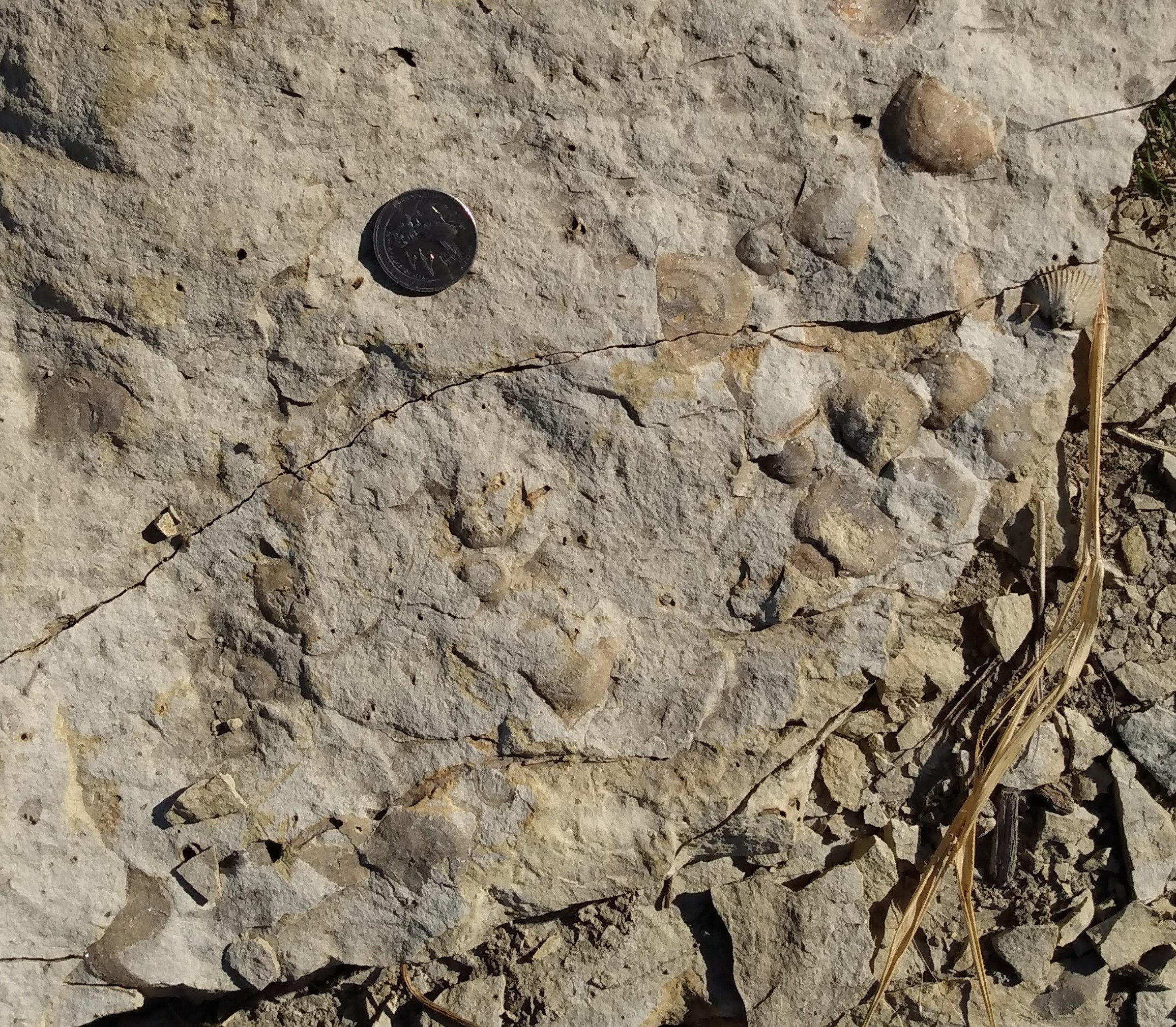
|
|
Here's a closer view showing a few nice examples, representing multiple
species. |

|
|
Also, just for fun, some of the stones used for landscaping are loaded
with burrows. |
If you stop by, please don't attempt to remove the fossils; it's a park, after all, and the fossils aren't really going to come off in one piece because they're molds and casts. Just enjoy the experience of walking on the seafloor without ever getting wet!
Sunday, August 21, 2022
On the eating of one's words
Back in the day, when I was an undergrad at the University of St. Thomas, I was still very much a vert paleo chauvinist, just getting my toes wet in the Decorah. I'd been going through some of the old journals and textbooks, and was dismayed by the lack of coverage of vertebrates (well, dinosaurs). Everything seemed to be about invertebrates, particularly those with some kind of useful economic function (biostratigraphy) or with extensive fossil records permitting the testing of pet evolutionary hypotheses. While discussing this with my professors, I said something to the effect of "A brachiopod can't bring you love. A trilobite, maybe, but not a brachiopod."
Two decades later, I am the proud namesake of a brachiopod, specifically (in both senses) Ivdelinia (Ivdelinia) tweeti Blodgett et al. 2022: "The species name is in honor of Justin S. Tweet, paleontologist dedicated to the documentation, preservation, and study of National Park Service fossils." Thank you, Robert, Valeryi, and Vince!
 |
| A handsome fellow, isn't it? (Scale bar is 1 cm; Figure 6 in Blodgett et al. 2022). |
I. tweeti comes from the Emsian-age (late Early Devonian) rocks of the Shellabarger Limestone in Denali National Park. The formation itself is also newly minted in Blodgett et al. (2022), and is part of the Mystic sequence of the Farewell Terrane. If you're not familiar with the geology of Alaska, it's almost entirely made up of bits and pieces of crust that collided with each other during the Phanerozoic. Characteristics such as biogeography have been used to reconstruct where the crustal fragments came from and the timing of their journeys. In this case, the Shellabarger Limestone brachiopods and other invertebrates show more of an affiliation to northeast Russia than to North America, indicating the fragment rifted from Siberia before arriving at what became Alaska (Blodgett et al. 2022).
References
Blodgett, R. B., V. V. Baranov, and V. L. Santucci. 2022. Two new late Emsian (latest Early Devonian) pentameridine brachiopods from the Shellabarger Limestone (New Formation), Shellabarger Pass, Denali National Park and Preserve, south-central Alaska. New Mexico Museum of Natural History and Science Bulletin 90:73–83.
Sunday, October 24, 2021
The Matagamon Sandstone
I recently had occasion to go to north-central Maine for work. If you've never been there, the geology is the tectonic equivalent of taking a bunch of little leftover bits of colorful modeling clay and smooshing them together: the area was on the margin of the North American craton during the Paleozoic and thus was the recipient of a conveyor belt of crustal fragments. Of course, when this happens, you get all kinds of interesting structural features and metamorphism, which does unfortunately tend to obscure the original geology. Tack on the Pleistocene glaciations and subsequent dumping of drift, followed by the growth of forests, and you can see how things can get complicated and confusing to follow.
One of the geologic units I observed in this region is the Lower Devonian Matagamon Sandstone. The Matagamon has been interpreted as part of a deltaic system that advanced to the northwest during the Acadian Orogeny (Hall et al. 1976; Pollock et al. 1988). We've got a pretty good idea of when its deposition ended because it transitions upward into the Traveler Rhyolite (Rankin 1965), the explosive component of a supervolcano that erupted approximately 407 million years ago (Seaman et al. 2019). Curious about the guts of that volcano? Look no further than Katahdin.
 |
| Maine's tallest mountain? The crystallized heart of one of North America's largest volcanoes? Why not both? (Incidentally, they told us this was the best time of year to do geologic work in north-central Maine. They were right!) |
Anyway, the Matagamon is a fossiliferous unit, with an assemblage dominated by brachiopods. Clarke (1909) described a few assemblages from this formation, which was then identified as the Moose River Sandstone (it did not receive its present name until Rankin 1965). The fauna includes plant fragments, corals, brachiopods, monoplacophorans, bivalves, nautiloids, gastropods, tentaculitids, trilobites, crinoids, and invertebrate trace fossils. Brachiopods certainly seemed to be the most abundant fossils in the outcrops I saw.
 |
| A fairly large brachiopod with Leptaena-type ridges. |
 |
| A bulbous shell on the left and a cylindrical object of unknown origin on the right. |
 |
| A shell bed. |
Fossils tended to be abundant in localized areas, mostly preserved as molds, external casts, and steinkerns, with occasional shell material in the brachiopods. (Overall, the rocks, the fossils, and their preservation rather reminded me of the somewhat younger Mahantango Formation from the Delaware River valley.) In some cases, the fossils had been stained bright orange, very appropriate for autumn and Halloween.
 |
| Slightly orange small flat ribbed brachiopods, resembling potato chips. |
 |
| Two strongly orange brachiopods: a small shell with few but heavy ribs on the left, and a much larger brach with many fine ribs in the center. |
 |
| Some calcitic material remains with these shells. |
References
Hall, B. A., S. G. Pollock, and K. M. Dolan. 1976. Lower Devonian Seboomook Formation and Matagamon Sandstone, northern Maine: a flysch basin-margin delta complex. Pages 57–63 in L. R. Page, editor. Contributions to the stratigraphy of New England. Geological Society of America, Boulder, Colorado. Memoir 148.
Pollock, S. G., A. J. Boucot, and B. A. Hall. 1988. Lower Devonian deltaic sedimentary environments and ecology: examples from the Matagamon Sandstone, northern Maine. Pages 81–99 in R. D. Tucker and R. G. Marvinney, editors. Structure and stratigraphy. Maine Geological Survey, Augusta, Maine. Studies in Maine geology: papers to commemorate the 150th anniversary of C. T. Jackson’s reports on the geology of Maine. Volume 1.
Rankin, D. W. 1965. The Matagamon Sandstone–a new Devonian formation in north-central Maine. U.S. Geological Survey, Washington, D.C. Bulletin 1194-F.
Seaman, S. J., R. Hon, M. Whitman, R. A. Wobus, J. P. Hogan, M. Chapman, G. C. Koteas, D. Rankin, A. Piñán-Llamas, and J. C. Hepburn. 2019. Late Paleozoic supervolcano-scale eruptions in Maine, USA. GSA Bulletin 131(11–12):1995–2010.
Sunday, September 5, 2021
Bryozoan Overload
Sometimes you look at a slab, and you notice one special thing about it. "That's a nice Isotelus hypostome." "Neat strophs." "Look at that Phycodes!" In this case, it's "Gee, that's a lot of bryozoans!"

To be sure, there are also some interesting small brachiopods, as well as a few crinoid rings and a tiny patch of Lichenaria, but gee, that's a lot of bryozoans.

|
|
(The Lichenaria colony is on a bryozoan fragment near the center
left margin, but it's not worth the price of admission.) |
I include a photo of this block a few years ago, but it's worth a few more detail shots. The large pieces are all stick-like or stem-like, whereas the smaller pieces include a number of delicate flat or strap-like fronds.

|
|
Branching straps plus a few different brachiopods. |
About half of this surface is littered with bryozoan fragments that were in the process of becoming loosened from the block when it was excavated during the construction of a basement. Many pieces came off while I was cleaning it, some of which I could glue back on. (Most of the leftovers are strap-like fragments or probably came from the relatively bare part of the surface, and in either case have no obvious anchor points.) Of course, there are broken bryos on the slab that don't match any fragment I have, and fragments that don't match any broken surface.

|
|
Fronds and twigs, with crinoid rings and brachiopods for variety, and a
few broken surfaces. |
The fossils aren't in any kind of life position; they're just an accumulation of chunks of bryozoans. Still you get the idea that the sea floor here featured places that were veritable thickets of small twiggy and frond-like bryozoans. To all you time travelers: probably not recommended for bare feet.

|
|
It's bryozoans almost all the way through, as well. |
Sunday, April 11, 2021
Paleozoic Taxa of the St. Croix Valley
Back when I was working on the Saint Croix National Scenic Riverway project, I'd compiled a spreadsheet of all of the fossil genera and species that had been reported from the rocks exposed along the valley. There had been some talk of spinning it off as a separate thing, but that never happened, so I played with the idea of posting it here. I then forgot about it until recently looking through the backlog of half-formed ideas. The spreadsheet itself was all ready to go, so I figured "why not?"
It's pretty simple; a column of numbers so it can be sorted back to the original organization when I'm working, a column for the genus/species, a column for the broad classification, twelve columns for the formations (go here for a refresher; the names are abbreviated for space, but each one has a note providing the full name), a column for references (defined on the "References" tab), and a column for additional notes. If a given species is present in a particular formation, the corresponding cell is marked "Y" and filled blue; if there's some question, the cell is marked "?" and filled yellow. If it's not present, there's a dash and no color fill. To check it out, you can enter here. I would not be surprised if there has been some oversplitting, if for no other reason than the challenges of preservation (we're dealing with a lot of natural molds and casts of partial trilobites in sandstone; fragility and preservation fidelity leave something to be desired).

It's worth mentioning that there is a document that covers some of the same ground, Raasch (1950). In one sense it's more narrowly focused, on Cambrian trilobite biostratigraphy, but in another it's more diffuse, with a larger area of interest.
References
Raasch, G. O. 1950. Zonal range of Croixan trilobite genera in the upper Mississippi Valley. Cambrian Subcommittee Memorandum No. V. Illinois State Geological Survey, Urbana, Illinois.
Sunday, July 26, 2020
Decorah craniate brachiopods
- Trilobite glabellas
- Echinoderm plates
- Bivalves
- Monoplacophorans
- Small Scenella
 |
| One of these... |
Craniates, in brief, are brachiopods from the "inarticulate" structural wing but the "calcitic" compositional wing. At the Brickyard section, the two most abundant are Acanthocrania setigera and Petrocrania halli, which can be difficult to distinguish in practice (Rice 1987). The phosphatic inarticulate Schizocrania, which does a lot of the same things, is also present but much rarer. Other inarticulates at the Brickyard, from the phosphatic side, include Craniops minor, Pseudolingula eva, and Trematis sp. (Rice 1987). Other species are cited in museum collections; one which I've seen, "Crania" (now Acanthocrania) granulosa, looks suspiciously like the "raspberry cystoids" in this post.
 |
| Several more, in situ. A might be a ringer; I'm not sure. B is an overturned shell (note also the tiny pygidium just above and to the right). C is partially encrusted. D shows what happens when a thin piece of rock and a thin shell meet inexperienced preparation from the underside. |
Acanthocrania and Petrocrania have thin domed shells with concentric growth rings. Unlike most of the other Decorah brachs, they do not have strong ridges (and, of course, they don't look much like the other brachiopods in a lot of other ways, too). They seem to have been attractive to encrusters; all of the loose specimens I have are covered with bryozoans, and some of them have either tabulate corals or cornulitids growing on them as well. For their part, craniates are noted encrusters of other brachiopods; presumably the unattached specimens in the photos were also originally attached to other brachiopods, becoming dislodged (probably after the death of the craniate).
 |
| What do the five rounded domed blobs of bryozoans have in common? If you turn them over, they all have the heart of a brachiopod. |
 |
| This strophomenid has a craniate encrusting on the lower right, as well as several cornulitids. |
References
Rice, W. F. 1987. The systematics and biostratigraphy of the Brachiopoda of the Decorah Shale at St. Paul, Minnesota. Pages 136–166 in R. E. Sloan, editor. Middle and Late Ordovician lithostratigraphy and biostratigraphy of the Upper Mississippi Valley. Minnesota Geological Survey, St. Paul, Minnesota. Report of Investigations 35.
Sunday, May 10, 2020
Revisiting Shadow Falls Park
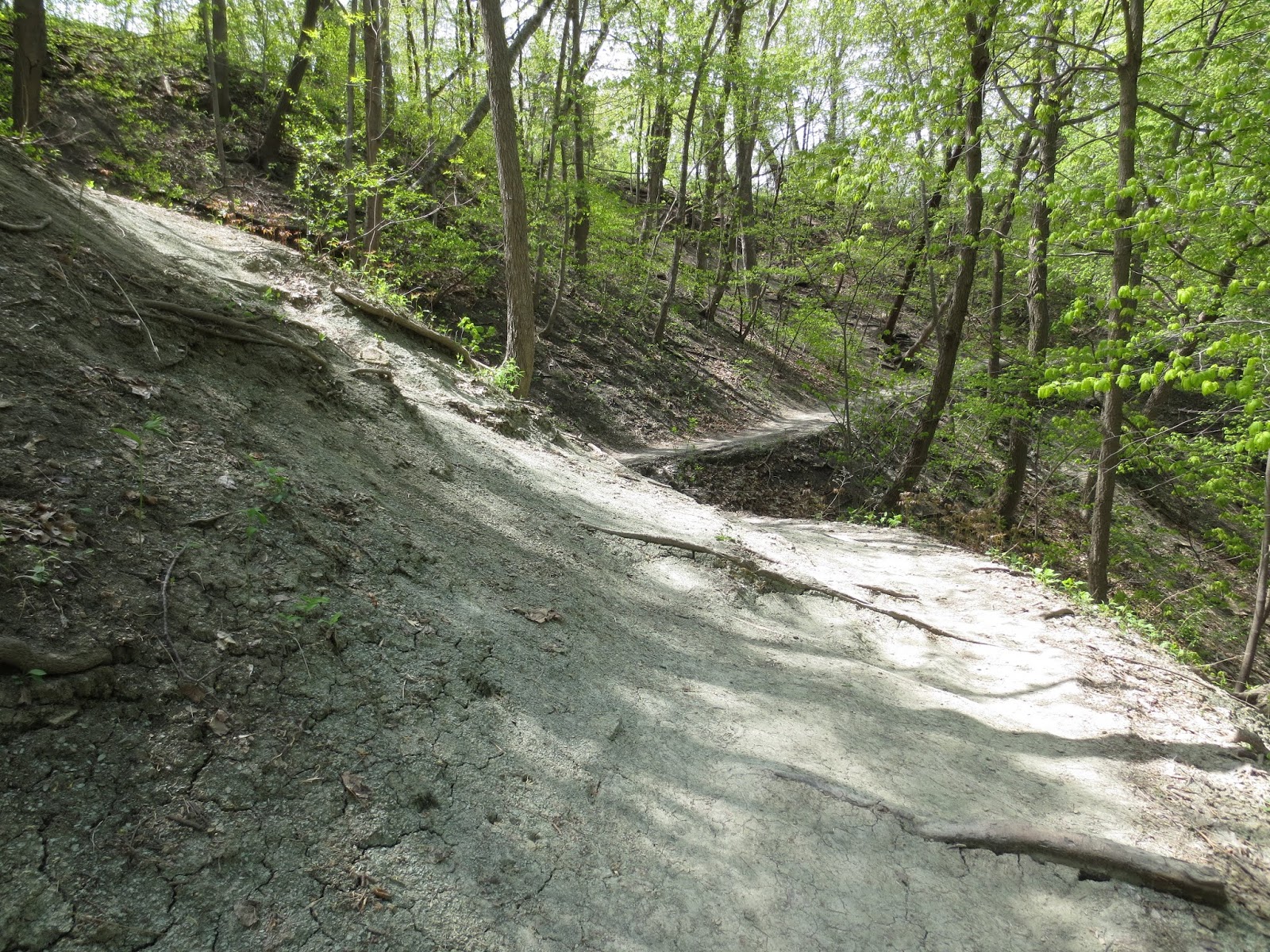 |
| Here's the trail on the south side of the valley past the falls (which are essentially just to the right and a little below the vantage point of this photo). |
Erosion may not be immediately evident if you don't have something to measure the loss of sediment, but in places with tree roots near the surface on the slopes it's easy to see how running water and gravity have done their work.
 |
| Almost a staircase of roots. |
The usual array of lower Decorah fossils was present, in small chunks of rock and loose. It seemed to be a particularly good day for observing strophomenids (in the hash plates, primarily; they tend to break up otherwise). One example in the photo below is probably Rafinesquina, based on the thinness of the valve. This genus is named after Rafinesque, who we met last week and had a much more substantial career than getting into arguments about sloths. Another nice piece observed was a Bumastoides pygidium.
 |
| A. Probable Rafinesquina valve. B. Bumastoides pygidium |
In one area I observed two pieces of a larger specimen of Rauffella palmipes. This is all catch-and-release, of course!
 |
| Two fragments of a large Rauffella palmipes. |
Shadow Falls includes not only the falls, but a long valley oriented east-west with its head near but not quite reaching Cretin Avenue. I haven't spent much time in the valley above the falls because the area right above the falls tends to turn into a muddy swamp, but it's been a dry spring. The creek feeding the falls is in a very deep valley for its size, but would have been somewhat bigger in the days before sewers and roads.
 |
| The creek valley above Shadow Falls... |
 |
| ...opens up into this near its head. |
There are several large fossiliferous blocks along the creek that include crinoid columnals notably larger in diameter than the run-of-the-mill lower Decorah columnals (note that the photo in the linked post is biased to larger, more photogenic columnals). The obvious guess is that they were brought to the area by glaciers and represent a different part of the stratigraphic column, say the upper Decorah or one of the overlying Ordovician formations that have been stripped from the area.
 |
| Large columnals |
Sunday, May 19, 2019
Trilobites and strange fate
Boulder Dam Recreation Area, later renamed Lake Mead National Recreation Area, was established in the 1930s to administer the reservoir Lake Mead that was filling behind Hoover Dam, at the time known as Boulder Dam. As originally conceived, the recreation area extended quite a bit farther east, into what is now part of western Grand Canyon National Park. This is because at the time it was planned that another dam, the Bridge Canyon Dam, was going to be constructed in that area, and the recreation area was sized to accommodate the anticipated reservoir. Obviously, unless you are a reader who has stumbled in from another timeline, no such dam was ever built, and in 1975 the park boundaries were reconfigured, with most of eastern Lake Mead NRA (Grand Wash Cliffs area and east) being transferred to Grand Canyon National Park.
 |
| This area, as a matter of fact, looking due south into the western end of the park (photo taken from small plane, hence the plane structures and the whole "up in the air" thing). |
Anyway, we were still back in the 1930s. The NPS had a few people on staff in the 1930s who specialized in geology, such as H. Donald Curry at Death Valley and Edwin McKee at Grand Canyon. Working at Boulder Dam Recreation Area was Ed Schenk, who had the challenge of contending with a field area that was steadily shrinking by the day as the reservoir filled. A substantial portion of his work at Lake Mead remains unpublished, but his research on the Cambrian escaped that fate (Schenk and Wheeler 1942). His counterpart at Grand Canyon, McKee, was also working on the Cambrian, and published a rather more famous work a few years later (McKee and Resser 1945). You may not recognize the citation, but if you've studied geology at the college level you may well have run into material that's been derived from this publication, in which McKee described the facies changes of the Cambrian formations in terms of marine advances and retreats: very briefly (and simply), there's the nearshore Tapeats Sandstone, the shallow marine Bright Angel Shale, and the deeper marine Muav Limestone.
As part of his work, Schenk collected fossils from about four dozen localities in and around the recreation area. About a quarter of the collections were from Cambrian rocks, all in that area which is now in western Grand Canyon NP. These collections included a fairly typical assortment of mid-Cambrian life, such as trilobites, brachiopods, and hyoliths. Several of these collections were cited in Schenk and Wheeler (1942). It is not immediately obvious, but the same collections are also cited in McKee and Resser (1945), with a few re-identifications. I only realized it when I thought to check because Schenk was noted as a collector in McKee and Resser (1945). Charles Resser, whom we met briefly earlier, also provided identifications for Schenk's paper. Essentially, the two papers were being worked on contemporaneously with contact between the groups of authors, and Schenk's shorter publication beat McKee's work into press by a couple of years (M&R '45 would also have been affected by wartime circumstances and Resser's passing in 1943).
If you're super-curious about these things, the collections definitely mentioned in both S&W and M&R are as follows, using M&R's stratigraphy ("F-" collections are Schenk's):
Peach Springs Member, Muav Limestone: fauna 73 = F-40
Bright Angel Shale tongue: fauna 74 = F-47
Spencer Canyon Member, Muav
Bright Angel Shale tongue
Sanup Plateau Member, Muav
Bright Angel Shale tongue: fauna 75 = F-37
Rampart Cave Member, Muav: fauna 76 = F-39
Flour Sack Member, Bright Angel Shale: faunas 46, 47 = F-16, F-17
Bright Angel Shale tongue
Tincanebits Tongue, Muav
Bright Angel Shale upper slope units: fauna 48 = F-44; fauna 49 = F.C. 761
Bright Angel Shale red-brown cliff unit?
Bright Angel Shale lower slope units: fauna 8 = F-15
Resser named several taxa from the F-# collections, and the holotypes for these taxa were sent to the USNM. These include Albertella schenki from F-44 (McKee and Resser #48; holotype USNM 108583), Lingulella mckeei from F-17 (M&R #47; USNM 108561a), Acrocephalops? arizonaensis from F-16 (M&R #46; USNM 108624), Kootenia simplex from F-37 (M&R #75; USNM 108591a), Kootenia schenki from F-40 (M&R #73; USNM 108586a), and Solenopleurella porcata from F-40 (M&R #73; USNM 108586a and 108626a). If you check the online USNM database, specimens with photos have the F-numbers on their slabs, showing their origin.
We come now to strange fate. Around 1960, with Schenk having long since left the NPS, staff at Lake Mead sent his old collections to the USGS for taxonomic identification. The USGS used to have a system where field geologists could send material for identification, usually to determine the relative age of rock units for mapping and resource projects. The resulting files were called "Examine & Report" (E&R) files. I've seen the files for the Lake Mead project, which took a while to complete for various reasons. Trilobite specialist A.R. "Pete" Palmer was sent the Cambrian samples for identification. Naturally enough, given the rock units involved, he used McKee and Resser (1945) for reference, as he remarked in the memo. Given that most of the fossils in McKee and Resser (1945) were only mentioned in lists, and type and figured specimens that might have given away the tale were retained from the collections by the Smithsonian, there was very little way of knowing that this exercise was actually about using McKee and Resser (1945) to identify fossils from some of the collections in McKee and Resser (1945).
References
McKee, E. D., and C. E. Resser. 1945. Cambrian history of the Grand Canyon region. Carnegie Institution of Washington Publication 563.
Palmer, A. R. 1963/10/17. O-60-55. USGS internal memo to M. B. Ingham (E&R file).
Schenk, E. T., and H. E. Wheeler. 1942. Cambrian sequence in western Grand Canyon, Arizona. Journal of Geology 50(7):822–899.
Sunday, April 14, 2019

Sunday, February 3, 2019

Sunday, October 7, 2018
Hyoliths III: Season of the Hyolith
The pedicle is a fleshy organ, found in most brachiopods, which anchors the shell to the substrate. (Curiously enough, our last visit with the brachiopods covered the strophomenids, noted for not having pedicles.) Sun et al. (2018a) describe a new hyolith taxon, Pedunculotheca diania, which has the typical elongate pointed main shell and lid-like operculum of hyoliths (a bit more oval in cross-section than the classic triangles we've seen so far), with the addition of a short nonmineralized stalk ending in a small holdfast growing from the tip of the shell.
An anchored hyolith, like Pedunculotheca diania, would be a suspension feeder, but other, more derived hyoliths were unattached (Sun et al. 2018a). Moysiuk et al. (2017) interpreted hyoliths in general as filter feeders, but it appears that hyoliths were more ecologically flexible. Recent publications have documented aggregations of hyoliths around coprolites (Kimmig and Pratt 2018; Sun et al. 2018b) and dead animals (Sun et al. 2018b), indicating scavenging/detritivore roles. Because skeletal fragments have never been reported in hyolith guts, Sun et al. (2018b) suggested that they focused on the more fluid phase of the decomposing detritus (or at least the non-mineralized phase), or on microbial films growing around the detritus. The authors also found hyoliths associated with small burrows, indicating that they could enter the uppermost substrate.
 |
| In my quest to always have different hyolith images when the topic comes up, here is Figure 2a from Plate LXIII in Walcott (1899). It is a "reproduction of photograph of a slab of sandstone, with numerous specimens of H. primordialis, from the St. Croix sandstone of Wisconsin. The small shells are identical with H. gregaria of M. and H. [Meek and Hayden]." The publication is actually on fossils of Yellowstone National Park, but Walcott had identified hyoliths there as basically the same as H. primordialis from Wisconsin, which is why he included this figure. Later, the Yellowstone hyoliths would be transferred to a new species (H. gallatinensis Resser 1938) and eventually genus (Haydenoconus Malinky 2014). |
References
Kimmig, J, and B. R. Pratt. 2018. Coprolites in the Ravens Throat River Lagerstätte of northwestern Canada: implications for the Middle Cambrian food web. Palaios 33:125–140. doi:10.2110/palo.2017.038.
Malinky, J. M. 2014. Cambrian Hyolitha and problematica from West Laurentian North America: taxonomy and palaeobiology. Alcheringa 38(3):338–362.
Moysiuk, J., M. R. Smith, and J.-B. Caron. 2017. Hyoliths are Palaeozoic lophophorates. Nature 541:394–397. doi:10.1038/nature20804.
Resser, C. E. 1938. Fourth contribution to nomenclature of Cambrian fossils. Smithsonian Miscellaneous Collections 97(10).
Sun, H., M. R. Smith, H. Zeng, F. Zhao, G. Li, and M. Zhu. 2018a. Hyoliths with pedicles illuminate the origin of the brachiopod body plan. Proceedings of the Royal Society B: Biological Sciences 285(1887). doi:10.1098/rspb.2018.1780.
Sun, H.-J., F.-C. Zhao, R.-Q. Wen, H. Zeng, and J. Peng. 2018b. Feeding strategy and locomotion of Cambrian hyolithides. Palaeoworld 27(3):334–342. doi:10.1016/j.palwor.2018.03.003.
Walcott, C. D. 1899. Cambrian fossils. Pages 440-478 in Geology of the Yellowstone national park. U.S. Geological Survey, Washington, D.C. Monograph 32.