Showing posts with label sponges. Show all posts

Sunday, May 11, 2025

The downside of reef building?

I was reviewing text for a website a few weeks back dealing with aspects of the history of life, and a couple of things struck me about biological reefs. First, a quick look at reef-builders through time (a useful overview can be found here if you'd prefer more flesh on the bones, or corallites or shells or whatever may be more appropriate):

The first multicellular reef-builders were the archaeocyathan sponges, who flourished briefly in the Cambrian but did not even make it to the end of the period. Corals, in the form of rugose and tabulate corals, spread in the Ordovician but took a while to make reefs. They were joined by stromatoporoid sponges (layered like stromatolites, spelled like stromatolites, but not stromatolites) and various microbes, with the Devonian being an apex of reef-building. The classic stromatoporoid-tabulate reefs of the Devonian went kaput in the End-Devonian extinction. Permian reefs were a conglomeration of just about everything that couldn't get out of the way: various algae, sponges, bryozoans, and other less obvious things. This assortment bought it at the end of the Permian. False starts with scleractinian corals in the first part of the Mesozoic gave way to the rudist bivalves in the Cretaceous. The rudist reefs went out with non-avian dinosaurs, marine reptiles, pterosaurs, ammonites, and so forth at the end-Cretaceous extinction. Finally we get to the big scleractinian coral reefs in the Cenozoic, with some sponge and oyster reefs and such for variety.

So far, a typical pattern: group of organisms branches into reef building, reefs spread and become ecologically complex, reefs flourish for a while, mass extinction wipes out reefs. Then after a hiatus reefs become fashionable again, with some other group laying the foundation for a new iteration, and the cycle continues. A couple of observations come to mind. First, reefs seem to be an obvious evolutionary path for immobile marine invertebrates. It may take some time, but some group always takes up the baton after another falters.

Then, the other shoe. What happens to the previous reef-builders? Seen any archaeocyaths lately? Any vacation packages advertising stromatoporoid reef visits for their island getaways? Run across any rudists while snorkeling? Could it be that once a group goes all-in on the reef habit, it's stuck with it?

Furthermore, reefs have a habit of getting smacked in mass extinction events. Does a reef inherit a narrowing range of environmental restrictions from its components as its complexity increases? Does it become vulnerable to unpredictable instability, such as some minor constituent going through a bad patch leading to collapse via a Rube Goldbergian-cascade of events? More broadly, does reef building amount to an evolutionary Faustian bargain, in which a group becomes dominant for a while by locking itself into a doomed arrangement? (Granted, we're all doomed in the final analysis, but some of us are more obviously doomed than others.) Or am I just playing the gloomy Minnesotan?

Monday, October 7, 2024

Rockford, Part 2: Fossils (exclusive of brachiopods)

Before we get into the festivities, I've recently written an article for the online magazine Agate, about identifying common Paleozoic fossils of Minnesota. It's a compact summary that covers the most abundant groups, so if you're looking for something like that, go have a look!

In our previous post we had a look at the geology of the Fossil & Prairie Park Preserve of Floyd County, Iowa, also known as the Rockford site. For this post I'm going to briefly detail the fossils I collected, with the exception of the brachiopods, which will get a post of their own. For most of the non-brachiopods, I didn't get too far into the weeds on taxonomy, because many of the groups don't lend themselves to simple eye-checks for genera and species. Horn corals and bryozoans, for example, usually require thin sections, and crinoid columnals are generally only diagnostic of the presence of crinoids. I did, though, have recourse to Fenton and Fenton (1924) and other peoples' identifications to get some ideas.

Monday, March 20, 2023

Brooksella: what are star cobbles?

Back in the far-off year of 2012, when I was helping to compile instances of paleontological type specimens found in National Park Service units, we had to make decisions about various edge cases. One of these was how to handle names for what later turned out to be pseudofossils. We decided to record the information as historically relevant but did not include the "taxa" in any counts. On this blog we've actually covered a couple of them already, "Lingula calumet" and "Paradoxoides barberi" from within or very near Pipestone National Monument. Another is "Brooksella canyonensis", a putative jellyfish from the Proterozoic Nankoweap Formation of Grand Canyon National Park. It was first reported as such in Van Gundy (1937) and then named, not entirely enthusiastically, in Bassler (1941). "B. canyonensis" has fared poorly as a jellyfish, but has had its supporters as an organic feature (e.g., Glaessner 1969; Kauffman and Steidtmann 1981; Kauffman and Fursich 1983; tentatively Ciampaglio et al. 2006). However, I favor an inorganic interpretation. Admittedly, there are several to choose from: gas-escape structures or compaction (Cloud 1968), "sand-volcano"-type fluid escape (Ford and Breed 1977; Ford 1990), and mud rolls (Fedonkin and Runnegar 1992).

"B. canyonensis" was not the first species in the genus Brooksella, though. Brooksella was named by Charles Walcott for "star cobbles" from the Coosa Valley of Alabama (Walcott 1896), now attributed to the middle Cambrian-age Conasauga Formation (Nolan et al. 2023). In fact, he named three taxa for different forms of cobbles: B. alternata, B. confusa, and Laotira cambria (Walcott 1896). Star cobbles got their name because at their best they look like the stereotypical twinkly pointed things you might doodle. Some of them even have five rays, although six is more typical and they are more lobed than pointed, so it's not a perfect match.
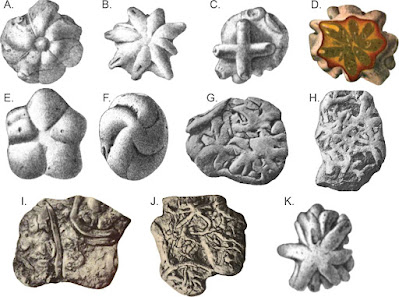
Brooksella (A–D, K) and Laotira (E–H, J) as illustrated by Walcott (1898) and reproduced as Figure 1 in Nolan et al. (2023) (which see for full caption). CC BY 4.0.

Walcott interpreted the objects as representing jellyfish, which are probably not the first thing you think of when fossils come to mind, but jellyfish fossils are in fact known elsewhere. In this case, though, the interpretation hasn't proved tremendously popular over time, and numerous alternatives have been proposed. These alternatives, though, generally involve some kind of organic origin, either as a true body fossils or a trace fossil of some sort. It's not hard to see why: they look like something that *ought* to be organic, even if the identity of that something is unclear. (Anyone who has gone out fossil hunting will probably recognize this feeling. Sometimes you're right, sometimes you're wrong.)

Nolan et al. (2023) have published a detailed reassessment of Alabama Brooksella. As part of it, they prepared a lovely supplemental figure of various hypotheses, with thumbnail evaluations (discussed at greater length in the text). (*Warning*: Hold off on clicking the link if you'd rather not get their solution immediately.) Studies of Brooksella from the past couple of decades have interpreted it as a trace fossil (either a feeding burrow or a coprolite) or a glass sponge (hexactinellid). Nolan et al. subjected star cobbles to about as many tests as can legally be done to rocks in their analysis of the various possibilities, and came to several conclusions, including:

  • Brooksella specimens do not have a sponge's anatomy. There aren't spicules, features previously interpreted as ostia (pores) bear a strong resemblance to pitting left behind when lichen are cleaned off, and lobes do not feature opening at their ends for radial canals (which were also not found).
  • The orientation of the specimens when found in situ was with the putative central osculum (excurrent vent) down in the sediment, which is an inconvenient place for an osculum. Furthermore, many examples did not even have an "osculum".
  • The specimens include internal voids and tubes, but these spaces do not correspond to the external form, unlike primary burrows (although this does not preclude the specimens having "captured" parts of burrows that were passing through). Furthermore, the internal features do not include common burrowing structures such as backfill.
  • The specimens have the same composition as silica concretions from the same rocks, and are very comparable overall, with the same kind of weathering rings, lichen pitting, and random internal voids and tubes.

Nolan et al. concluded that Brooksella is no different from the local concretions except for the lobes, and should therefore "be considered a pseudofossil until proven otherwise." A consequence of this conclusion is that Brooksella, not being a glass sponge, would not have been a source of silica for preservation of fossils in the Conasauga. (It's not stated, but it seems that it would have been a sink instead.) It further goes to show that you shouldn't trust strange things in the Cambrian.
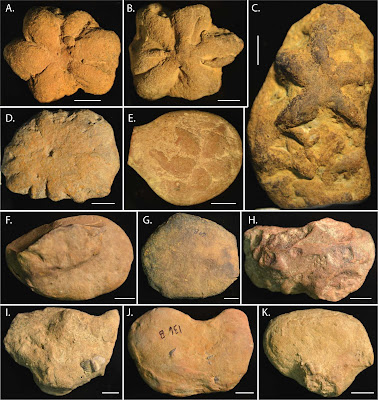
Brooksella (A–E) and concretions (F–K) collected from the Conasauga Formation by Nolan et al. (scale bar 1 cm, or 0.4 in); Figure 5. CC BY 4.0.

References

Bassler, R. S. 1941. A supposed jellyfish from the pre-Cambrian of the Grand Canyon. Proceedings of the United States National Museum 89(3104):519–522.

Ciampaglio, C. N., L. E. Babcock, C. L. Wellman, A. R. York, and H. K. Brunswick. 2006. Phylogenetic affinities and taphonomy of Brooksella from the Cambrian of Georgia and Alabama, USA. Palaeoworld 15:256–265.

Cloud, P. E., Jr. 1968. Pre-metazoan evolution and the origins of the Metazoa. Pages 1–72 in E. T. Drake, editor. Evolution and environment. Yale University Press, New Haven, Connecticut.

Fedonkin, M. A., and B. N. Runnegar. 1992. Proterozoic metazoan trace fossils. Pages 389–395 in J. W. Schopf and C. Klein, editors. The Proterozoic biosphere: A multidisciplinary study. Cambridge University Press, Cambridge, United Kingdom.

Ford, T. D. 1990. Grand Canyon Supergroup: Nankoweap Formation, Chuar Group, and Sixtymile Formation. Pages 49–70 in S. S. Beus and M. Morales, editors. Grand Canyon geology. Oxford University Press, New York, New York.

Ford, T. D., and W. J. Breed. 1977. Chuaria circularis Walcott and other Precambrian fossils from the Grand Canyon. Journal of the Palaeontological Society of India 20:170–177.

Glaessner, M. F. 1969. Trace fossils from the Precambrian and basal Cambrian. Lethaia 2(4):369–393.

Kauffman, E. G., and F. Fursich. 1983. Brooksella canyonensis: A billion year old complex metazoan trace fossil from the Grand Canyon. Abstracts with Programs - Geological Society of America 15(6):608.

Kauffman, E. G., and J. R. Steidtmann. 1981. Are these the oldest metazoan trace fossils? Journal of Paleontology 55:923–947.

Nolan, M. R., S. E. Walker, T. Selly, and J. Schiffbauer. 2023. Is the middle Cambrian Brooksella a hexactinellid sponge, trace fossil or pseudofossil? PeerJ 11:e14796. doi:https://doi.org/10.7717/peerj.14796.

Van Gundy, C. E. 1937. Jellyfish from Grand Canyon Algonkian. Science 85(2204):314.

Walcott, C. D. 1896. Fossil jelly fishes from the Middle Cambrian Terrane. Proceedings of the United States National Museum 18:611–614.

Walcott, C. D. 1898. Fossil Medusæ. U.S. Geological Survey, Washington, D.C. Monograph 30.

Sunday, January 5, 2020

A Devonian reef

When I visited Delaware Water Gap National Recreation Area and the surrounding area back in 2017, one of the places I stopped was at a Lower Devonian sponge-coral bioherm. A bioherm is a geological term for a mound-like feature made up of fossils. The useful thing about "bioherm" is that it just refers to the shape, rather than making any conclusions about how that structure came about. (You see, there are reefs, and then there are things that are like reefs but aren't reefs, and there are also just plain old accumulations of skeletal fragments, and there's actually a lot of nuance involved that can tell you things about depositional environment and so forth.)

Looks like circular stromatoporoid colonies with tabulates between them—or are there also some corallites in the circles? Things get complicated in a reef, especially 400 million years and some weathering later.

Anyway, this particular bioherm is one of a group identified as "patch reefs", which is more or less what it sounds like: a relatively small discrete reef. There's a handful of these scattered throughout the area, found in the Shawnee Island Member of the Coeymans Formation. They are described as including a central core up to 160 x 70 m (525 x 230 ft) in area and 15 m (15 ft) thick, surrounded by flank beds of skeletal debris. They are primarily formed of stromatoporoid sponges and favositid tabulate corals, and grew on a marine carbonate shelf (Monteverde 2001; Precht 1988). The rugged modern topography was still in the future; the Acadian Orogeny hadn't even kicked in yet and the previous topography generated by the Taconic Orogeny had been well eroded by the early Devonian.

This one's a bit easier to tell as a Favosites chunk (even if the photo isn't that sharp).

There hasn't been much occasion to talk about stromatoporoids previously. The first thing to know about stromatoporoids is that despite the confusingly similar name, they have nothing to do with stromatolites. Stromatolites, like Cryptozoon rosemontensis from back in 2014, are layered sedimentary structures left by microbial colonies. Stromatoporoids also show a layered appearance in cross-section, but that's because of layered body tissues: they were sponges (even if this is not immediately apparent), and produced body fossils, not trace fossils. The body, mineralized as calcium carbonate, consists of horizontal laminae supported by vertical pillars. A basic stromatoporoid plan has been adopted several times, including by some modern sponges, but classic Stromatoporoidea had its heyday in the middle Paleozoic as a reef-forming group. I don't think anyone has attempted to identify the Coeymans Formation stromatoporoids to genus or species since White (1882) invoked Stromatopora, but I might have missed that reference.

Not sure what's going on here; maybe a branching-type stromatoporoid (e.g., Amphipora) has gotten into the act as well.

On the other hand, the common Coeymans patch reef tabulate has been identified to the genus level as Favosites (Weller 1903; Willard et al. 1939; Epstein et al. 1967). Swartz and Swartz (1941) put it in F. helderbergiae, which is appropriate for the time and place, but you wouldn't be able to tell just walking by (unless you carry your own thin-sectioning equipment and microscope with you when you're out for a walk). Favosites, the "honeycomb coral", is rather more impressive than most of the tabulates in the Ordovician of Minnesota, rare Foerstephyllum colonies excepted. The reason for "honeycomb coral" isn't obvious from these photos, but if you did have a loose colony sitting in front of you, you'd be able to see the logic: it's a coral colony that resembles a chunk of honeycomb. Each "cell" of the "honeycomb" is a corallite that held a polyp, much smaller than the polyps of horn corals and other rugose corals but still much larger than the tiny animals of a bryozoan colony.

Not dinosaur skin, just weathering across a favositid that's been more effective on the corallite walls than the fill, producing a pebbly-looking "negative".

This photo shows a clear demarcation between favositid on the left and not-favositid on the right.

References

Epstein, A. G., J. B. Epstein, W. J. Spink, and D. S. Jennings. 1967. Upper Silurian and Lower Devonian stratigraphy of northeastern Pennsylvania, New Jersey, and southeasternmost New York. U.S. Geological Survey, Washington, D.C. Bulletin 1243.

Monteverde, D. H., leader. 2001. Road log and stop descriptions; Day 1, Stop 5: Montague mini-mall fossil site; flank of a coralline bioherm in the Coeymans Formation. Pages 191–198 in J. D. Inners and G. M. Fleeger, editors. 2001: a Delaware River odyssey. Field Conference of Pennsylvania Geologists, Harrisburg, Pennsylvania. Guidebook for the Annual Field Conference of Pennsylvania Geologists 66.

Precht, W. F. 1988. Lower Devonian reefs of the Coeymans Formation in the northern Appalachian Basin. Pages 514–519 in H. H. J. Geldsetzer, N. P. James, and G. E. Tebbutt, editors. Reefs; Canada and adjacent areas. Canadian Society of Petroleum Geologists, Calgary, Alberta. Memoir 13.

Swartz, C. K., and F. M. Swartz. 1941. Early Devonian and Late Silurian formations of southeastern Pennsylvania. Bulletin of the Geological Society of America 52:1129–1192.

Weller, S. 1903. The Paleozoic faunas. New Jersey Geological Survey, Trenton, New Jersey. Report on Paleontology 3.

White, I. C. 1882. The geology of Pike and Monroe Counties. Geological Survey of Pennsylvania, Harrisburg, Pennsylvania. Report of Progress 9(6).

Willard, B., F. M. Swartz, and A. B. Cleaves. 1939. The Devonian of Pennsylvania. Pennsylvania Geological Survey, Harrisburg, Pennsylvania, 4th series. General Geology Report 19.

Sunday, August 10, 2014

Sponge detective: when faunal lists go bad

I set out to do something simple, really I did. All I wanted to write was an introduction to sponges and a quick description of the forms known from the Twin Cities region. I already had a list of appropriate species, and I knew that most of the original forms weren't actually sponges, which I thought would make things easier. "There's only a couple left, that's not too bad." Then I made the mistake of checking into those leftovers. It turns out that you can never assume a classification for early Paleozoic sponge-like things. There's always room for an argument. In paleontology, the answer to any question always includes "start digging," whether it be rocks or research, and, frankly, isn't some mystery more interesting than a list?