Showing posts with label hadrosaurs. Show all posts

Monday, June 19, 2023

Gonkoken nanoi

The Great Dinosaur Drought of 2022–2023 persisted from mid-December 2022 to early June 2023, nearly six months with three new dinosaurs and one silesaur, but with five showing up in the past few weeks, it looks like things have gone back to business as usual. Obviously that calls for some recognition, so this week and next week (pending anything else) I'll look at a couple of new arrivals, starting with the not-quite-hadrosaurid Gonkoken nanoi from the south end of Chile.

Figure 2 in Alarcón-Muñoz et al. (2023), showing a reconstruction of Gonkoken nanoi and an assortment of bones (CC BY 4.0).

Sunday, September 8, 2019

Kamuysaurus japonicus

Some of you may have come across online photos or information concerning a dinosaur skeleton from Japan informally named "Mukawaryu" ("Mukawa dragon", "-ryu" for "dragon" being the traditional suffix for informally named Japanese dinosaurs). The specimen went from "informally named" to getting a real scientific name in just a couple of years, exchanging "Mukawaryu" for Kamuysaurus japonicus.

"Mukawaryu", now Kamuysaurus japonicus. Figure 3 in Kobayashi et al. (2019) (go to link for full caption). The scale bars are all 10 cm (4 in) except for the skeleton itself (b), which is 1 m (40 in). CC-BY-4.0.

Sunday, July 14, 2019

Aquilarhinus palimentus

I get to knock another notable fossil park off my list today with a new basal hadrosaur from Big Bend National Park. The NPS doesn't have a park covering the classic Upper Great Plains terrestrial Upper Cretaceous rocks, but it does have Big Bend, one of the best southern North American Upper Cretaceous areas known (to say nothing of its Lower Cretaceous and Cenozoic records). Our visitor today is the arch-snouted trowel-jawed Aquilarhinus palimentus.

But first, a brief note which connects to the history of this blog: "Lori" the Morrison troodontid has been officially described, as Hesperornithoides miessleri (Hartman et al. 2019). There's really no point in my writing anything about it, because the two lead authors (Scott Hartman and Mickey Mortimer) have their own blogs where they are covering it and I certainly couldn't add anything to them, so check them out!

Sunday, December 3, 2017

The News in Hadrosaur Dietary Paleobiology

I don't follow dinosaurs quite as avidly as I once did, but one topic I've kept an eye on is the paleobiology of hadrosaurs. If you're looking to work on paleobiology in dinosaurs, hadrosaurs are pretty much ideal. Many species are known from good remains of numerous individuals of various ages, giving about the best sample sizes you can get for nonavian dinosaurs. In addition, with all the bells and whistles like crests, soft tissue impressions, and the unique feeding adaptations, there's plenty of room for arguments. I've picked a few recent papers, focusing on feeding: what they ate and how they ate it.

Edmontosaurus at the Denver Museum of Nature and Science wonders how you get by with just two sets of teeth.

Sunday, August 27, 2017

75 years of "Hadrosaurian Dinosaurs of North America"

This Thursday will mark the 75th anniversary of the publication of "Hadrosaurian Dinosaurs of North America", published August 31, 1942. Written by Richard Swann Lull and Nelda E. Wright, "Hadrosaurian Dinosaurs of North America" is one of the classics of dinosaur science, and even today is one of the basic building blocks of any serious work on duckbills. As a GSA Special Paper, it is available for download, so if you have institutional access and pretty much any level of scholarly interest in hadrosaurs, you should pick up a copy.

Sunday, November 6, 2016

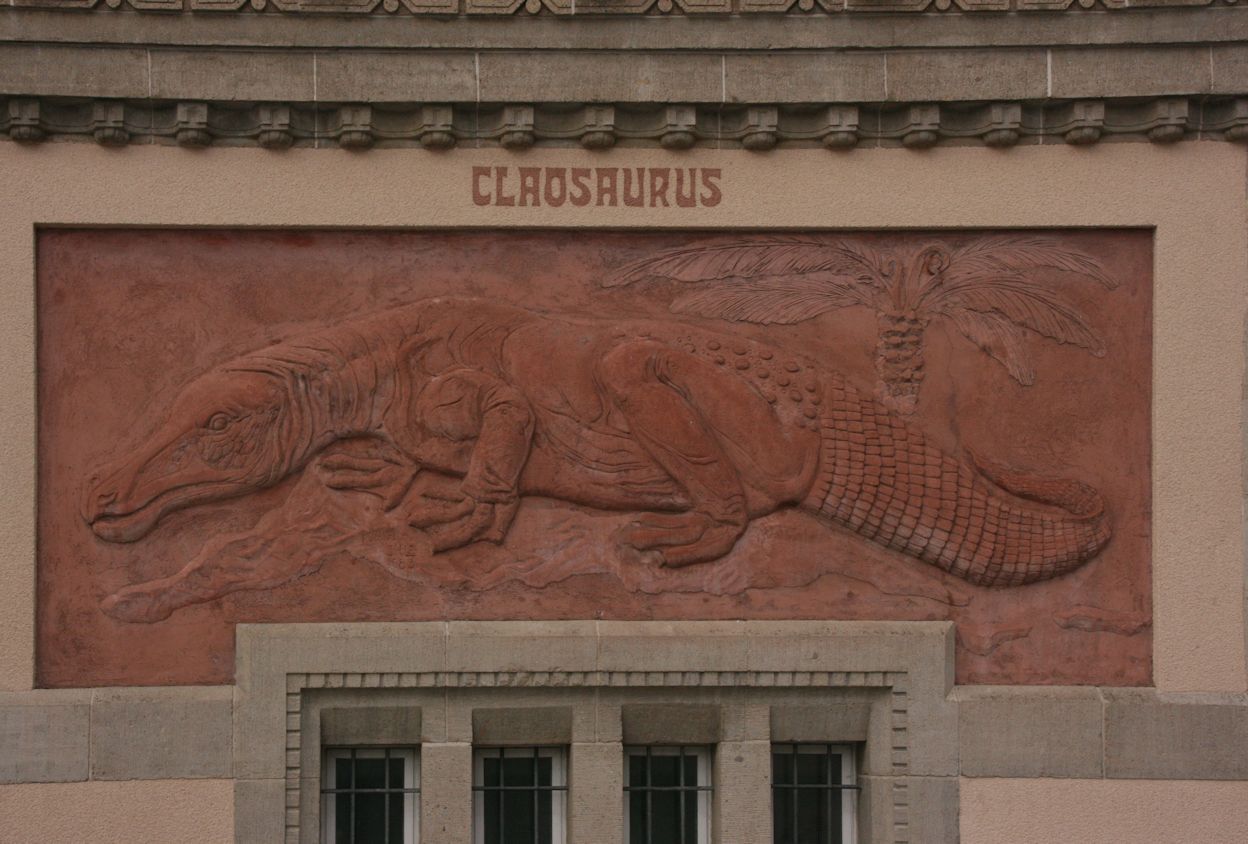
Claosaurus

Out of the blue, my supervisor recently asked me if I knew anything about a piece of art depicting a shall-we-say stylized and retro dinosaur labeled "Claosaurus" at the Berlin Aquarium. This was one of those odd coincidences that we are taught to avoid in fiction: I'd been thinking about writing a post on Claosaurus, and now I was being commanded by the gods of serendipity. I've had a soft spot for this modestly publicized duckbill since before I was ten, when I read about it in a magazine and it became my first "hipster" dinosaur. (My second was Epanterias, because this was the late '80s/early '90s, when iconoclasts like Bob Bakker and Greg Paul had just raised the siren song for the splitting of Allosaurus fragilis and the community was not yet hardened by cynicism about mysterious giant theropods not known from enough material to draw a dirty look in the express checkout.)

Sunday, July 3, 2016

A locked dinosaur mystery


So, one of the things you're supposed to do if you have a blog is to talk about your research when a paper you authored comes out. Okay, give me a minute. I mentioned back in the gut contents post that I did my thesis on what was found in the inside of a brachylophosaur. The first part, on the gut contents themselves, was published back in 2008 (Tweet et al. 2008). Finally, after about a decade of gnawing on the manuscript, comes the other part (Tweet et al. 2016).

Saturday, February 21, 2015

Reports of gut contents in herbivorous dinosaurs

I generally avoid writing "nuts and bolts" posts about dinosaurs, because there's a lot of people already doing that who know what they're doing. There is, however, one topic on which I'm uniquely qualified to pontificate. In a previous lifetime I was a fresh-faced graduate student who wrote his thesis on possible gut contents in the "Leonardo" specimen of Brachylophosaurus. As such, I spent a fair amount of time considering the history of possible gut contents in herbivorous dinosaurs, which consists of an exclusive club populated by four hadrosaurs, one ankylosaur, and one sauropod. In retrospect, the Leonardo project was somewhat beyond my powers, but I battled on against overwhelming oddities and came out of it eventually. (For you folks playing along at home, by "herbivorous dinosaurs" I mean more or less classic dinosaurs that aren't theropods. I've got nothing against birds, which include many a herbivorous dinosaur, but they aren't why I got interested in these things, and I don't feel sentimental about them being dinosaurs, because "my" dinosaurs are almost all ornithischians and have all been dead for 66 million years.)