Showing posts with label Platteville. Show all posts

Sunday, September 28, 2025

More odds and ends

At the moment I'm preparing the grand annual update to The Compact Thescelosaurus. If you've been following along over the past couple of years, it doesn't take being Sherlock Holmes to guess what it will be. Actually, it doesn't even take being 1940s Radio Program Watson to guess, but do act surprised. In completely unrelated news, there's a taxon published this week I recommend you see: the little croc Thikarisuchus xenodentes. (What, you were expecting the theropod?) T. xenodentes, from the Cenomanian-age Blackleaf Formation of Montana, had a sharply triangular skull in top view and strongly differentiated teeth, among them the expected bitey teeth at the very front and long, low, narrow teeth at the back. This small croc may have had a taste for plants, or perhaps sliced up insects.

Something we love around here at Equatorial Minnesota is historical content about Minnesota geology. You may be familiar with the Minnesota Geological Survey's publication archive. It turns out that there are a bunch of MGS field notebooks scanned and available via the University of Minnesota libraries. You can find notebooks there from paleontologists such as Frederick Sardeson, Robert Sloan, and Clinton R. Stauffer, all of whom curiously have last names starting with "S". (Also interesting: Sardeson's field notebooks all have the left-hand pages filled out, but right-hand pages are much less frequently used. Was Sardeson a lefty?) There are also materials from the Department of Earth and Environmental Science.

Do you prefer to see your geology in the field? I came across a nice section of the St. Peter through Platteville under the I-94 bridge, on the east bank of the Mississippi. I'd been there years before but don't remember being so impressed with it. Maybe it wasn't as well-exposed then, or maybe I just wasn't experienced enough to appreciate it. The Platteville interval at the top was definitely exposed, but maybe this lower exposure is the result of more recent erosion or something. It definitely bears further photography and investigation, as it has a great view of the Glenwood.

The important part looks like this.

And here's what it looks like if I annotate all over it. I'm not entirely confident with the thickness of the Hidden Falls Member; for some reason the Mifflin is really grungy here. The Glenwood bits are open to interpretation (the Nokomis gets "Glenwood/St. Peter" because it's technically in the Glenwood but can't be distinguished from the St. Peter in well logs or gamma logs). The Tonti Member makes up most of the St. Peter Sandstone, if you're curious. There may be some Carimona at the very top. 

Oh yeah, also saw Bridal Veil Falls nearby, which has, y'know, seen better days, but is still running, after a fashion.

Or maybe you'd like some historical trivia? One of the things I wanted to find more about for the Mammoth Cave National Park paleo inventory was whatever became of the type specimen of Lithodrumus veryi, a Mississippian coral possibly collected from the park. It was described in 1904 by George Greene and the specimen has been lost to science since at least 1944. Greene's collection went first to the American Museum of Natural History and then to the National Museum of Natural History, but Lithodrumus veryi apparently went missing, as Easton (1944) couldn't find it at the AMNH. Just a few days ago I was looking up images of tabulate corals when I came upon a post at Louisville Fossils and Beyond that stated one cabinet had not been sold, and its contents were eventually going to the Indiana State Museum. Hope springs eternal! I've sent a message to the Indiana State Museum to see if perhaps L. veryi's type is there.

It's supposed to look like this (Greene 1904: Plate 49). Have you seen it, by any chance?

So that's what's going on around here. (Oh, that and some unusually intense bot "readership", or the whole of Hong Kong has suddenly discovered a passionate interest in the Ordovician fossils of Minnesota and Elliot Formation prosauropods. Maybe I'm cynical.) Tune in for the next post!

References

Allen, H. J., E. W. Wilberg, A. H. Turner, and D. J. Varricchio. 2025. A new, diminutive, heterodont neosuchian from the Vaughn Member of the Blackleaf Formation (Cenomanian), southwest Montana, and implications for the paleoecology of heterodont neosuchians. Journal of Vertebrate Paleontology e2542185. doi: https://doi.org/10.1080/02724634.2025.2542185

Easton, W. M. 1944. Revision of Campophyllum in North America. Journal of Paleontology 18(2): 119–132.

Greene, G. K. 1904. Contribution to Indiana palæontology 1(17): 168–175.

Tuesday, April 30, 2024

Uŋčí Makhá Park 2024: another winter, more echinoderms

Two years after opening, Uŋčí Makhá Park can be considered a paleontological gem in the Twin Cities. With its Magnolia Member bedding planes, side cuts through the Magnolia and Carimona, easy access, and lack of vehicle traffic, it's nigh-on perfect for getting in touch with St. Paul as it was about 454–453 million years ago. It's kind of like our own Carnegie Quarry wall, except it's tiny marine invertebrates rather than dinosaurs, it probably wasn't planned, and you can walk right out over it. It's always fun to get to spend time there for work, and like last year, I got the opportunity to assist with a training session for Mississippi National River & Recreation Area seasonals there. Then, of course, I just had to make a quick return trip later to follow up on some things we'd seen.

Sunday, January 7, 2024

Cottage Grove cystoid

I recently paid a return visit to the site in Cottage Grove where I'd previously spotted a few blocks with brachiopods/etc. of the typical Platteville persuasion. While there, a few true outcrops were visible under the snow-free conditions of the so-called winter of December 2023, confirming that the Platteville is indeed at the surface and not just present as lag or buried under a bad toupee of soil and glacial debris. More significant was one of the blocks. See if you can spot what drew my attention:

Any ideas?

How about if we go in closer on the area of interest?

If you answered something along the lines of "the thing near the center that looks kind of like a truncated letter K", you've won! I snapped a couple of pictures thinking it might be echinoderm in origin and moved on. Later, upon reviewing the photos, the rectangular bit below it caught my eye; that definitely looked echinoderm. In fact, there is only one kind of thing it could belong to, as proclaimed by the chevron arrangement of slots on it surface. This is a plate from a rhombiferan cystoid bearing a pore rhomb in a pectinirhomb configuration. ("Of course!" you shout.) (Okay, so I looked up the anatomical terminology). Basically, the slots are vents for the animal's water circulation system.

This rock was obviously a good candidate for further study and photography, so I took some more photos with the hope of doing some taxonomy. Further inspection revealed a couple sharply ridged features similar to the "K", but more weathered.

There's a pretty well-developed one in the upper right, and one that is more poorly exposed near the left side.

When I first noticed the "K", I thought it might be ridges on a crinoid plate, but local crinoid plates don't usually have such sharp ridges. Instead, it turns out that there is a Platteville cystoid that does, Coronocystis durandensis. Coincidentally, this particular cystoid also has pore rhombs that are a good match for the pore rhomb plate on this rock (see photos in Kolata 2021).

Here close-up and with a tiny drip of water applied. There is also a gray rectangular ridge visible near the right border that I suspect to be another plate, but it's not as well-exposed.

I hesitate to make a firm identification from the available material, but it certainly appears that we have Coronocystis or something very similar. Coronocystis is interpreted as a stalked rhombiferan cystoid, unlike its free-thrashing cousin Pleurocystities (which does pore rhombs differently and has softer ridges). I interpret the block as from the Mifflin Member of the Platteville, but I suppose it could be higher. Whatever the exact identification at the genus or species level, this is clearly a rhombiferan cystoid, and the first I've ever seen in the field (and I'm pretty sure the first record from Cottage Grove). Plus, the several bits suggest a disarticulated but fairly associated specimen.

References

Kolata, D. R. 2021. Fossils of the Upper Ordovician Platteville Formation in the upper Midwest USA: an overview. Illinois State Geological Survey, Prairie Research Institute, University of Illinois at Urbana-Champaign, Champaign, Illinois. Bulletin 108.

Thursday, September 14, 2023

Fossils of the Upper Ordovician Platteville Formation in the Upper Midwest USA: An Overview

I'm not really in the business of plugging books, but I *have* gotten one recently that those of you who read this blog for the Ordovician posts may find interesting (if you haven't already come across it). The book is "Fossils of the Upper Ordovician Platteville Formation in the Upper Midwest USA: An Overview" by Dennis Kolata, Illinois State Geological Survey emeritus (and also one of the authors on a volume on the Deicke K-bentonite). I was tipped off to it by member "connorp" on The Fossil Forum during my quest to identify what turned out to be Zittelloceras.

The Platteville of Illinois and southern Wisconsin isn't *exactly* the same as in Minnesota (the strata are thicker and the fossils are better preserved than what we see in the Twin Cities), but anyone looking for information or comparative photos for Minnesota Platteville fossils is going to find plenty in the book to consider. The book is also useful for identifying fossils in the overlying rocks (e.g., the Decorah Shale), because many of the genera are the same. Several graphics clarify the correlation of different Platteville divisions across the area where the formation was deposited.

The text, organized by broad taxonomic group, is technical. Each species is given a diagnosis, followed by remarks about aspects such as notable features or distinguishing it from other species, and then its stratigraphic and geographic distribution. This is not unlike the various group-focused articles in Sloan (1987), but unlike the small black-and-white figures in the 1987 book, Kolata's book is filled with gorgeous color plates featuring large photos of every species. (The one quibble I have is that scaling is given by numbers, e.g., "x1.5", instead of scale bars, but I can certainly use them either way!) For anyone who is interested in the fossils but is not versed in the details of invertebrate anatomy, or anyone just looking to identify a particular find, these plates are invaluable.

If you'd like to find out more about this volume, the Illinois State Geological Survey bookstore is online here. The book can also be found on Amazon. It is 316 pages and costs $60.00.

References

Kolata, D. R. 2021. Fossils of the Upper Ordovician Platteville Formation in the upper Midwest USA: an overview. Illinois State Geological Survey, Prairie Research Institute, University of Illinois at Urbana-Champaign, Champaign, Illinois. Bulletin 108.

Sloan, R. E., editor. 1987. Middle and Late Ordovician lithostratigraphy and biostratigraphy of the Upper Mississippi Valley. Minnesota Geological Survey, St. Paul, Minnesota. Report of Investigations 35.

Sunday, June 4, 2023

Uŋčí Makhá Park Revisited, Part 2: Further Fossils

We're now up to the fourth entry in a completely unexpected series on the Platteville–Decorah rocks and fossils of Uŋčí Makhá Park. We've already seen the common fossils from the site, so for this go-round I'm focusing on rarities.

Sunday, May 28, 2023

Uŋčí Makhá Park Revisited, Part 1: Freeze-Thaw

After I'd come across the new exposures at Uŋčí Makhá Park last fall, I was very curious about how a Minnesota winter and spring would treat them. After all, these were fresh, with no previous direct exposure to snow, ice, and freeze-thaw cycles. Would they rapidly degrade, or were they made of sterner material? Last week I had the opportunity to spend some quality time at the park, in preparation for and leading a training session for Mississippi National River & Recreation Area seasonals (and if any of the participants happen on this post, hello! I hope you had a good time!).

What were the results of this natural experiment? A few observations:

The Carimona Member of the Decorah (blue-gray upper interval), particularly the blocks used as landscaping, suffered appreciably more than the Magnolia Member of the Platteville (tan lower interval). I attribute this to the greater shale content of the Carimona.

This is a pretty illustrative comparison. The blue-gray block on the upper left is Carimona, and the tan block on the lower right is Magnolia. The Carimona block's upper surface is littered with small chips, while the only chips on the Magnolia block came from the Carimona block. (Note also the large burrow on the Magnolia block.)

More Carimona landscaping showing exfoliation.

This indicates that the Carimona blocks will weather faster than the Magnolia blocks; eventually, both lithologies will reach equilibrium with their new surroundings, but the "fucoidal" surfaces on the landscaping are going to go away faster than the shell beds.

Note the burrows popping off the surface in some places.

It wasn't all smooth sailing for the Magnolia, though. Although many blocks and beds seemed fine, others had definite signs of damage.

Here a thin bed is breaking up.

This isolated block appears to be shattered. (Colors are weird because when I took this photo, I'd forgotten to reset the lighting from tungsten bulbs.)

Unlike last fall, which was a time of drought, this spring we can also definitely see where the seeps are.

And they're concentrated at the bentonite layers in the Carimona.

Many fossils and features came through without particular damage, though. I included a photo of a bivalve in the fossil guide post. Here it is last week:

Dare I say that it's "happy as a clam"? (Ignore the color balance differences.)

With that out of the way, did we find other fossils I hadn't seen in the fall? Well, of course! Tune in next week for some less-typical fossils!

Sunday, May 7, 2023

Replacement of Fossils

You might think that getting a shell or bone or wood chunk safely buried is the tough part for fossilization, that once something's entombed in sediment it's all smooth sailing. Burial is certainly important, but it's not the end of the story. A lot of things can happen between deposition and exposure. Pore spaces are filled with new minerals. Existing minerals are replaced. Entire structures can be replaced, then lost. These changes all fall under diagenesis. What exactly happens depends on things like the physical and chemical structure of the object in question, temperature and pressure of burial, and the chemical composition of the fluids in the sediment. Denser fossils like teeth are less vulnerable to changes than more porous materials. The form of calcium carbonate known as aragonite is less stable than calcite. Many different minerals and mineraloids can get involved in the fun; for example, there are opalized fossils and pyritized fossils.

Bivalve mold and internal cast (steinkern). Not pictured: bivalve shell.

Because silica and carbonate minerals are so abundant at typical surface and near-surface temperatures and pressures, they are the minerals most frequently involved. In Minnesota, we generally get dolomitization. This is somewhat inconvenient, because dolomitization has a tendency to destroy fossils, and even when it doesn't, it usually leaves behind molds and casts that aren't as crisp as the original. It's a bit like replacing the Venus de Milo or Michelangelo's David with nothing but 2x4 Lego bricks; you'll notice a difference. Dolomitic replacement may give a fossil a quirky sparkly appearance thanks to the dolomite rhombs, but that's about the only plus. Pervasive dolomitization is why many fossils in the Platteville are gray with a sugary appearance: you're actually looking at a natural mold or cast of the original in dolomite.

Sometimes diagenesis gives you exotic, spectacular fossils, and sometimes it gives you dolomite.

Although once in a while you get something to write home about; this is a nautiloid in the Science Museum of Minnesota collections with its internal structures replaced.

I was inspired to write a note about this topic by a different kind of replacement. Someone reviewing one of my work projects commented on a type of replacement seen in some of the fossils, consisting of circular mineralizations. They informed me this was a kind of silicification known as beekite. This immediately twigged my memory banks, because I'd also seen it in photos of fossils from other work projects. Like dolomitization, it's not exactly faithful reproduction, although it can be aesthetically pleasing.

A beekitized (beekitified?) lower Permian brachiopod, central Kansas.

Saturday, December 31, 2022

Platteville fossils in Cottage Grove

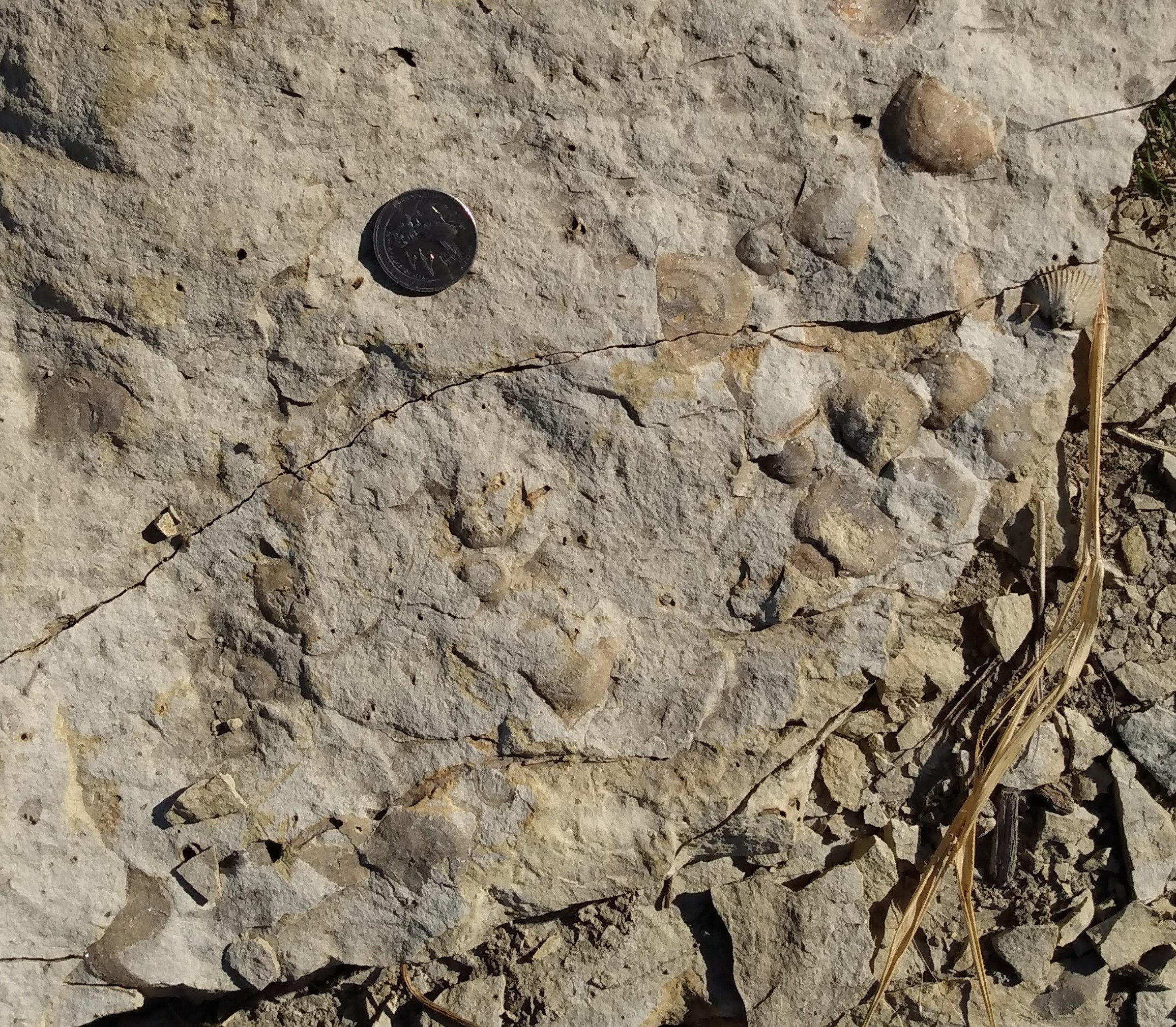
Cottage Grove, Minnesota is not noted as a geological wonderland, although Cottage Grove Ravine Regional Park certainly has its charms if you are willing to put in a little shoe leather. There are also scattered outcrops of the St. Peter Sandstone. However, persistence may be rewarded. Back in November I came across a couple of small fossiliferous blocks in town.

The first thing to do was to figure out the stratigraphy. The rocks were not in situ, but they were not heavily worn, either; in other words, they hadn't fallen off a glacier. The rocks of the area included outcrops of the St. Peter, and initially I wondered if I'd stumbled on a stray carbonate lens in the upper part of the formation. A rather more likely identity, though, is as erosional lag from the Platteville. In fact, the rocks look not unlike the occasional poorly dolomitized intervals I've seen in the Mifflin, and the fossils are certainly appropriate.

A (relatively) large brachiopod shell, among numerous teeny-tiny crinoid columnals and other fragments.

They include a mix of the BBC (brachiopods, bryozoans, and crinoids). There is also one object that looks like a whorl of a small Phragmolites sticking out. A couple of notable features include the small size of the fossils, particularly the crinoids; and the density of small fossil fragments and elements.

A different relatively large brachiopod shell among numerous teeny-tiny crinoid columnals and other fragments; note some nice bryozoan fragments on the left.
A hash of tiny fragments.
See what looks like tire tread near the center? That's what reminds me of Phragmolites.

Before we sign off for the year, I'd like to note that for some reason, over the past few weeks the "Fossil Felids of the National Park Service" post has been attracting a few dozen views a week. (Considering I don't do any external promotion and have reduced my social media presence from "negligible" to "zero", this is a lot!) I have no idea where this is coming from (probably picked up by a group somewhere that doesn't register in stats) or why it should have attracted interest (well, felines, I suppose, or maybe Pleistocene megafauna or predators in general), but I'm not complaining! Someone who actually knows something about cats could probably make an interesting and well-attended series like "Your Friends The Titanosaurs".

Sunday, November 13, 2022

Quick Guide to Fossils at Uŋčí Makhá Park

So I went back to Uŋčí Makhá Park last weekend and spent a couple of hours taking photos of fossils, because it makes such an ideal place to see the upper Platteville fauna. After all, a winter of freezes and thaws may not leave these new exposures looking as nice as they do now. Here's a quick guide to what can be seen there. (Let's see how many photos I can squeeze into one post, and how many species I can misidentify!)

Determining where you are stratigraphically

First of all, I'd just like to reiterate the stratigraphy. Most of the vertical extent is in the Magnolia Member of the Platteville Formation, with the upper part composed of the Carimona Member of the Decorah Shale. I'm thinking more or less the entire extent of the Carimona is exposed, based on thickness; at any rate the next thing up would be the shaly part of the Decorah, and there isn't a trace of it to be seen. I'm suspicious because the difference is just so darn clear, but at this site there is an unmistakable color change between the two units: the Carimona is the upper blue-gray interval and the Magnolia is the light tan-gray interval below. The Deicke K-bentonite is the lower and thicker of the two bentonite gaps in the Carimona. (Note that the Carimona is sometimes supplemented or replaced by landscaping, but this is pretty obvious.) As you walk from south to north, the "floor" goes up stratigraphically, so it's not all one bedding plane but a gently rising series of planes, until by the exit you're close to the color change.

The color change is quite evident here. The Deicke K-bentonite is the cut-in about halfway up the blue-gray Carimona (above the scale bar in the center of the photo).

Here we've gone north, and the floor has risen. The Deicke is still the seam in the middle of the blue-gray rocks.

Sunday, October 30, 2022

Strolling on the Magnolia Member by Hidden Falls

If you're looking for something geological to do in the Twin Cities while we're still under our unseasonably warm and dry weather, may I suggest paying a visit to the new park area above Hidden Falls? [Update, 2022/11/01: this park is called Uŋčí Makhá Park.] As part of the conversion of the former Ford Plant environs, part of the area of the creek into Hidden Falls has been daylighted. The landscaping has produced a mini-bedrock gorge that exposes significant vertical and bedding-plane surfaces of the Magnolia Member of the Platteville and the overlying Carimona Member of the Decorah.

There's nothing quite like this kind of exposure in the Twin Cities; we don't have a lot of exposed non-vertical bedrock in the first place, and this particular stratigraphic interval tends to be out of reach. The closest might be the platform below the overlook at Shadow Falls, but that's more limited in extent and has more of a stair-step profile.

Bonus points for spotting the Deicke K-bentonite.

Many of the exposed bedding plane surfaces reveal the shell beds the Magnolia is known for. The fossils are almost entirely brachiopods (with a few snails) and are represented by dolomitized molds and casts, giving them that characteristic sugary appearance.

See the little bumps? Brachs.

Enlarge for a world of brachiopods.

Here's a closer view showing a few nice examples, representing multiple species.

Also, just for fun, some of the stones used for landscaping are loaded with burrows.

If you stop by, please don't attempt to remove the fossils; it's a park, after all, and the fossils aren't really going to come off in one piece because they're molds and casts. Just enjoy the experience of walking on the seafloor without ever getting wet!

Sunday, May 15, 2022

Rockfall

One of the characteristic aspects of the Mifflin Member of the Platteville Formation is its habit of planar jointing. The faces of outcrops often look like someone took a rock saw to them. Nor are they necessarily single flat planes; sometimes joints intersect to form sharp angles. The heavy thunderstorms the previous week inspired a large chunk of Mifflin outcrop to collapse along intersecting joints.

Tumbled down

The joint planes did not form overnight, which can be seen by the amount of roots and soil in the new outcrop faces. There were some pretty big roots in there as well, but whatever tree(s) had once produced them is long gone.

A view into the wedge more or less along one of the two joints.

This particular rockfall was about as polite as possible, occurring not at the top of a stereotypical 30-foot bluff but from a much lower bluff, adjacent to a bike path. The orientation of the wedged stack shows that it toppled out of its former position. The top of the stack is therefore farthest from the bluff. Perhaps it failed at the base first, due to poor support from the Pecatonica, then flopped over.

History going from left to right

Sunday, November 15, 2020

How to complicate the Glenwood

Recently I've been doing some work with geological stratotypes in National Park Service areas. The naming of geological formations is not unlike naming a fossil species of organism (or living species for that matter), except the type locality is also the type "specimen", and you don't dig up the type locality and put it in a museum (although you could certainly take a core). Anyway, there are a few stratotypes located within Mississippi National River and Recreation Area. I've alluded a couple of times to the type locality of the St. Peter Sandstone being the bluff under Fort Snelling. This locality is no longer accessible due to protective measures, but the formation *is* exposed in the immediate vicinity. The type locality of the Hidden Falls Member of the Platteville is in Hidden Falls Park (Sloan 1956). Sloan didn't state specifically where, but I have a pretty good idea. Finally, there are two units named from the section exposed at Lock and Dam No. 1.

Beautiful exposure, even if you can't climb around on it.

The Twin Cities Basin is just a small part of the area where the St. Peter–Glenwood–Platteville–Decorah sequence is exposed, and across this area, the rocks differ and the names differ. Reconciling nomenclature across states is part of what Mossler (2008) was about. An example of outstate attention on the Twin Cities Basin is Templeton and Willman (1963), from the Illinois Geological Survey. This publication brings the Illinois nomenclature into the Twin Cities, via a section at Lock and Dam No. 1 (p. 226–227). If you're used to the local names, the Lock and Dam section requires a lot of translation. For example, the Platteville is considered a group, divided into three formations and nine members. The Templeton and Willman nomenclature has not taken off in Minnesota, which has preferred a simpler system, and I can't say I disagree. It seems like overkill to pack that many formal divisions into about 9 vertical meters (30 ft), many of which are not visually distinguishable at a distance of a few meters. Their divisions of the transition from the St. Peter to the Platteville are another matter.

Beginning with our old friend the Pecatonica and going down, Templeton and Willman (1963) divided the Lock and Dam rocks into the Chana Member and Hennepin Member of the Pecatonica Formation (Platteville Group), the Harmony Hill Member and Nokomis Member of the Glenwood Formation, and the St. Peter Sandstone. Two of these members were named from this section: the Hennepin Member and Nokomis Member. In turn:

My initial thoughts. Arrows point to the approximate center of the named unit, so I don't have to commit to contacts like the coward and cad I am. The scale boxes are *very* rough; I was able to put a scale bar on the outer wall, but this is some distance back, so prefer a larger number and don't take it too seriously.

...Or is this what Templeton and Willman intended? Might be easier if I could get closer.

The Chana Member, 28 cm thick (11 in), is basically what we recognize as the Pecatonica;

The Hennepin Member is 69 cm (27 in) thick, divided into three parts: 46 cm (18 in) of clay-rich greenish-gray limestone, and green shale, over 15 cm (6 in) of clay-rich greenish-gray slightly sandy limestone, over 8 cm (3 in) of brown dolomitic sandstone (Templeton and Willman 1963). This unit, or at least the upper part of it, can be easily distinguished visually beneath the blocky overlying rocks (pers. obs.; see also the photos at the end of this post—areas that look white are weathered). The other two parts I'm not as sure about. The Hennepin Member should be thicker than the Chana and the underlying Harmony Hill put together, but from my photos and observations, I see four distinct units over whitish sandstone. Three of them seem fairly similar in thickness: the classic Minnesota Pecatonica, a light-colored recessive unit, and a greenish-brown recessive unit. Below them is a thinner, even more recessive yellow-brown unit. My first thought was that the greenish recessive unit was the Harmony Hill Member, but if I put it in the Hennepin Member and assume that the 15 cm and 8 cm beds of Templeton and Willman (1963) are both included in it, we get something much closer to the overall relative thicknesses T&W found for the Hennepin versus the Chana. Plus, the underlying thin yellow-brown interval looks to be closer to their description of the Harmony Hill Member. The internal proportions are still out of whack, though (three roughly equal units in photos versus 28 cm over 46 cm over 15+8 cm in the publication). (In case you were wondering, there is a grand total of zero [0] photos of outcrops in T&W '63, which is regrettable. A single decent photo with a couple of arrows would have helped immensely.) At any rate, the Hennepin Member is more shaley than the description in T&W '63 implies, or, rather, is less carbonate-rich (Mossler 2008). The Minnesota Geological Survey regards it as the upper part of the Glenwood Formation, rather than the basal part of the Platteville (Mossler 2008);

The Harmony Hill Member is 23 cm (9 in) of yellow-green shale (Templeton and Willman 1963);

The Nokomis Member is also tricky. Templeton and Willman (1963) described it as 330 cm (110 in) thick, divided into 10 to 18 cm (4 to 7 in) of silty white sandstone, over 58 cm (23 in) of very silty, greenish-buff to red-brown, thin-bedded, partly ferruginous sandstone, over 224 cm (78 in) of very silty white to yellow-buff sandstone. Mossler (2008) noted that an interval of silty sand is commonly found in Minnesota between standard Glenwood and standard St. Peter, and this interval has frequently been included in the Glenwood. (The Glenwood is a bigger deal outside of Minnesota.) However, this interval is difficult to distinguish from standard St. Peter in well logs and natural gamma logs, so for practical purposes Mossler (2008) recommended including it in the St. Peter. It is also difficult to identify a difference just by looking at the outcrop from the vantage point of the landing. The best I can do is identify a couple of slope breaks that may indicate changes in mineralogy which are not otherwise apparent from color or bedding at that distance. A contact in the vicinity of the lower slope break would give a thickness in the vicinity of the quoted figure.

The breaks are easier to see in oblique view than straight on. Note also how plants like to colonize the Glenwood–upper Nokomis interval.

References

Mossler, J. H. 2008. Paleozoic stratigraphic nomenclature for Minnesota. Minnesota Geological Survey, St. Paul, Minnesota. Report of Investigations 65.

Sloan, R. E. 1956. Hidden Falls Member of Platteville Formation, Minnesota. Bulletin of the American Association of Petroleum Geologists 40(12):2955–2956.

Templeton, J. S., and H. B. Willman. 1963. Champlainian Series (Middle Ordovician) in Illinois. Illinois Geological Survey, Champaign, Illinois. Bulletin 89. [large file]

Sunday, June 28, 2020

Revisiting Coldwater Spring and Fort Snelling State Park

The same day I got out to Shadow Falls Park, I also stopped at Coldwater Spring and Fort Snelling State Park. These locations are geologically restricted to the Platteville down to the St. Peter, and the exposures are much more in the bluff mode of expression.

Lo, the type section of the St. Peter Sandstone, mostly behind a wall (probably for the best, given the way people use any handy outcrop of the St. Peter to practice their rock-carving skills)

What impressed me at these sites were the numerous rockfalls. It seemed like a lot, but I don't have the numbers to judge. It would actually be a simple project: somebody could periodically go along the paved path and document new falls by photos and GPS. The rub is that it's also a long-term project; you wouldn't get useful information from a couple of years.

At this fall, out of the Mifflin Member of the Platteville, it's easy to see the lighter color where the rocks used to be.

The outcrops of the Hidden Falls and Magnolia members just north of Coldwater have been taking a beating lately, although I'll grant that it's not as impressive when they only fall a few feet. There's both day-to-day attrition and larger collapses.


If you should happen to go below the paved path, down toward the river (say if you're going into the dog park), you can also see evidence of older disruption, where large blocks of Platteville have been displaced.

If the beds are noticeably tilted, that's a good indication they aren't where they started. (And also the whole "lying in jumbled heaps" thing, that's a good clue.)

A small, gentle waterfall southeast of Coldwater, unnamed as far as I know, running through a cleft in the St. Peter.

Given the geology, fossils weren't terribly diverse or well-preserved. There were the usual brachiopod beds exposed on some of the fallen blocks:


There were also these things. 99.999% says they're a couple of weathered burrows, although the coincidental weathering on the longer of the two made me think of segmented stems when I first saw them, which would be rather odd for the Platteville. Further study of the photo showed that the "segmented" feature was longer than I thought, and that the apparent segmentation was limited to the two lines.


Same photo, light red lines added to trace the features.

Sunday, February 2, 2020

Phragmolites

I could have titled this "That One Snail", because that's what Phragmolites seems to have become in my circle of acquaintances; for whatever reason, we remember having seen this distinctive fossil but can't remember what it's called. This is where a common name, something like "sculpted ring snail", might come in handy. If you haven't seen them, they could easily be mistaken for a tiny coiled cephalopod, or some kind of worm tube or crinoid columnal if the specimen is not exposed clearly. They range in size from less than a centimeter to about an inch across and are flat-coiled (planispiral), with the outer coils wider than the inner coils and partially covering them, and a distinct but small keel. There are strong markings on the coils that resemble the sutures of a nautiloid or ammonite.

These little fellas.