Showing posts with label corals. Show all posts

Sunday, September 28, 2025

More odds and ends

At the moment I'm preparing the grand annual update to The Compact Thescelosaurus. If you've been following along over the past couple of years, it doesn't take being Sherlock Holmes to guess what it will be. Actually, it doesn't even take being 1940s Radio Program Watson to guess, but do act surprised. In completely unrelated news, there's a taxon published this week I recommend you see: the little croc Thikarisuchus xenodentes. (What, you were expecting the theropod?) T. xenodentes, from the Cenomanian-age Blackleaf Formation of Montana, had a sharply triangular skull in top view and strongly differentiated teeth, among them the expected bitey teeth at the very front and long, low, narrow teeth at the back. This small croc may have had a taste for plants, or perhaps sliced up insects.

Something we love around here at Equatorial Minnesota is historical content about Minnesota geology. You may be familiar with the Minnesota Geological Survey's publication archive. It turns out that there are a bunch of MGS field notebooks scanned and available via the University of Minnesota libraries. You can find notebooks there from paleontologists such as Frederick Sardeson, Robert Sloan, and Clinton R. Stauffer, all of whom curiously have last names starting with "S". (Also interesting: Sardeson's field notebooks all have the left-hand pages filled out, but right-hand pages are much less frequently used. Was Sardeson a lefty?) There are also materials from the Department of Earth and Environmental Science.

Do you prefer to see your geology in the field? I came across a nice section of the St. Peter through Platteville under the I-94 bridge, on the east bank of the Mississippi. I'd been there years before but don't remember being so impressed with it. Maybe it wasn't as well-exposed then, or maybe I just wasn't experienced enough to appreciate it. The Platteville interval at the top was definitely exposed, but maybe this lower exposure is the result of more recent erosion or something. It definitely bears further photography and investigation, as it has a great view of the Glenwood.

The important part looks like this.

And here's what it looks like if I annotate all over it. I'm not entirely confident with the thickness of the Hidden Falls Member; for some reason the Mifflin is really grungy here. The Glenwood bits are open to interpretation (the Nokomis gets "Glenwood/St. Peter" because it's technically in the Glenwood but can't be distinguished from the St. Peter in well logs or gamma logs). The Tonti Member makes up most of the St. Peter Sandstone, if you're curious. There may be some Carimona at the very top. 

Oh yeah, also saw Bridal Veil Falls nearby, which has, y'know, seen better days, but is still running, after a fashion.

Or maybe you'd like some historical trivia? One of the things I wanted to find more about for the Mammoth Cave National Park paleo inventory was whatever became of the type specimen of Lithodrumus veryi, a Mississippian coral possibly collected from the park. It was described in 1904 by George Greene and the specimen has been lost to science since at least 1944. Greene's collection went first to the American Museum of Natural History and then to the National Museum of Natural History, but Lithodrumus veryi apparently went missing, as Easton (1944) couldn't find it at the AMNH. Just a few days ago I was looking up images of tabulate corals when I came upon a post at Louisville Fossils and Beyond that stated one cabinet had not been sold, and its contents were eventually going to the Indiana State Museum. Hope springs eternal! I've sent a message to the Indiana State Museum to see if perhaps L. veryi's type is there.

It's supposed to look like this (Greene 1904: Plate 49). Have you seen it, by any chance?

So that's what's going on around here. (Oh, that and some unusually intense bot "readership", or the whole of Hong Kong has suddenly discovered a passionate interest in the Ordovician fossils of Minnesota and Elliot Formation prosauropods. Maybe I'm cynical.) Tune in for the next post!

References

Allen, H. J., E. W. Wilberg, A. H. Turner, and D. J. Varricchio. 2025. A new, diminutive, heterodont neosuchian from the Vaughn Member of the Blackleaf Formation (Cenomanian), southwest Montana, and implications for the paleoecology of heterodont neosuchians. Journal of Vertebrate Paleontology e2542185. doi: https://doi.org/10.1080/02724634.2025.2542185

Easton, W. M. 1944. Revision of Campophyllum in North America. Journal of Paleontology 18(2): 119–132.

Greene, G. K. 1904. Contribution to Indiana palæontology 1(17): 168–175.

Sunday, May 11, 2025

The downside of reef building?

I was reviewing text for a website a few weeks back dealing with aspects of the history of life, and a couple of things struck me about biological reefs. First, a quick look at reef-builders through time (a useful overview can be found here if you'd prefer more flesh on the bones, or corallites or shells or whatever may be more appropriate):

The first multicellular reef-builders were the archaeocyathan sponges, who flourished briefly in the Cambrian but did not even make it to the end of the period. Corals, in the form of rugose and tabulate corals, spread in the Ordovician but took a while to make reefs. They were joined by stromatoporoid sponges (layered like stromatolites, spelled like stromatolites, but not stromatolites) and various microbes, with the Devonian being an apex of reef-building. The classic stromatoporoid-tabulate reefs of the Devonian went kaput in the End-Devonian extinction. Permian reefs were a conglomeration of just about everything that couldn't get out of the way: various algae, sponges, bryozoans, and other less obvious things. This assortment bought it at the end of the Permian. False starts with scleractinian corals in the first part of the Mesozoic gave way to the rudist bivalves in the Cretaceous. The rudist reefs went out with non-avian dinosaurs, marine reptiles, pterosaurs, ammonites, and so forth at the end-Cretaceous extinction. Finally we get to the big scleractinian coral reefs in the Cenozoic, with some sponge and oyster reefs and such for variety.

So far, a typical pattern: group of organisms branches into reef building, reefs spread and become ecologically complex, reefs flourish for a while, mass extinction wipes out reefs. Then after a hiatus reefs become fashionable again, with some other group laying the foundation for a new iteration, and the cycle continues. A couple of observations come to mind. First, reefs seem to be an obvious evolutionary path for immobile marine invertebrates. It may take some time, but some group always takes up the baton after another falters.

Then, the other shoe. What happens to the previous reef-builders? Seen any archaeocyaths lately? Any vacation packages advertising stromatoporoid reef visits for their island getaways? Run across any rudists while snorkeling? Could it be that once a group goes all-in on the reef habit, it's stuck with it?

Furthermore, reefs have a habit of getting smacked in mass extinction events. Does a reef inherit a narrowing range of environmental restrictions from its components as its complexity increases? Does it become vulnerable to unpredictable instability, such as some minor constituent going through a bad patch leading to collapse via a Rube Goldbergian-cascade of events? More broadly, does reef building amount to an evolutionary Faustian bargain, in which a group becomes dominant for a while by locking itself into a doomed arrangement? (Granted, we're all doomed in the final analysis, but some of us are more obviously doomed than others.) Or am I just playing the gloomy Minnesotan?

Monday, October 7, 2024

Rockford, Part 2: Fossils (exclusive of brachiopods)

Before we get into the festivities, I've recently written an article for the online magazine Agate, about identifying common Paleozoic fossils of Minnesota. It's a compact summary that covers the most abundant groups, so if you're looking for something like that, go have a look!

In our previous post we had a look at the geology of the Fossil & Prairie Park Preserve of Floyd County, Iowa, also known as the Rockford site. For this post I'm going to briefly detail the fossils I collected, with the exception of the brachiopods, which will get a post of their own. For most of the non-brachiopods, I didn't get too far into the weeds on taxonomy, because many of the groups don't lend themselves to simple eye-checks for genera and species. Horn corals and bryozoans, for example, usually require thin sections, and crinoid columnals are generally only diagnostic of the presence of crinoids. I did, though, have recourse to Fenton and Fenton (1924) and other peoples' identifications to get some ideas.

Tuesday, April 30, 2024

Uŋčí Makhá Park 2024: another winter, more echinoderms

Two years after opening, Uŋčí Makhá Park can be considered a paleontological gem in the Twin Cities. With its Magnolia Member bedding planes, side cuts through the Magnolia and Carimona, easy access, and lack of vehicle traffic, it's nigh-on perfect for getting in touch with St. Paul as it was about 454–453 million years ago. It's kind of like our own Carnegie Quarry wall, except it's tiny marine invertebrates rather than dinosaurs, it probably wasn't planned, and you can walk right out over it. It's always fun to get to spend time there for work, and like last year, I got the opportunity to assist with a training session for Mississippi National River & Recreation Area seasonals there. Then, of course, I just had to make a quick return trip later to follow up on some things we'd seen.

Sunday, November 13, 2022

Quick Guide to Fossils at Uŋčí Makhá Park

So I went back to Uŋčí Makhá Park last weekend and spent a couple of hours taking photos of fossils, because it makes such an ideal place to see the upper Platteville fauna. After all, a winter of freezes and thaws may not leave these new exposures looking as nice as they do now. Here's a quick guide to what can be seen there. (Let's see how many photos I can squeeze into one post, and how many species I can misidentify!)

Determining where you are stratigraphically

First of all, I'd just like to reiterate the stratigraphy. Most of the vertical extent is in the Magnolia Member of the Platteville Formation, with the upper part composed of the Carimona Member of the Decorah Shale. I'm thinking more or less the entire extent of the Carimona is exposed, based on thickness; at any rate the next thing up would be the shaly part of the Decorah, and there isn't a trace of it to be seen. I'm suspicious because the difference is just so darn clear, but at this site there is an unmistakable color change between the two units: the Carimona is the upper blue-gray interval and the Magnolia is the light tan-gray interval below. The Deicke K-bentonite is the lower and thicker of the two bentonite gaps in the Carimona. (Note that the Carimona is sometimes supplemented or replaced by landscaping, but this is pretty obvious.) As you walk from south to north, the "floor" goes up stratigraphically, so it's not all one bedding plane but a gently rising series of planes, until by the exit you're close to the color change.

The color change is quite evident here. The Deicke K-bentonite is the cut-in about halfway up the blue-gray Carimona (above the scale bar in the center of the photo).

Here we've gone north, and the floor has risen. The Deicke is still the seam in the middle of the blue-gray rocks.

Sunday, April 10, 2022

Mitchell Caverns

Back in the fall of 2021, I made a work visit to Mojave National Preserve, located logically enough within the Mojave Desert of southern California. While there, I had the opportunity to tour Mitchell Caverns. Mitchell Caverns is in the unusual position of being part of a state land parcel (Mitchell Caverns Natural Preserve or State Natural Preserve, depending on the source), entirely surrounded by another parcel of state land (Providence Mountains State Recreation Area), which is itself surrounded by a National Park Service unit (Mojave National Preserve). For good measure, the cave system is also a National Natural Landmark. It's parks all the way down in the Providence Mountains. (To be fair, the natural preserve designation is kind of a map artifact; it's not really distinct from the state recreation area.)

Sunday, September 5, 2021

Bryozoan Overload

Sometimes you look at a slab, and you notice one special thing about it. "That's a nice Isotelus hypostome." "Neat strophs." "Look at that Phycodes!" In this case, it's "Gee, that's a lot of bryozoans!"

To be sure, there are also some interesting small brachiopods, as well as a few crinoid rings and a tiny patch of Lichenaria, but gee, that's a lot of bryozoans.

(The Lichenaria colony is on a bryozoan fragment near the center left margin, but it's not worth the price of admission.)

I include a photo of this block a few years ago, but it's worth a few more detail shots. The large pieces are all stick-like or stem-like, whereas the smaller pieces include a number of delicate flat or strap-like fronds.

Branching straps plus a few different brachiopods.

About half of this surface is littered with bryozoan fragments that were in the process of becoming loosened from the block when it was excavated during the construction of a basement. Many pieces came off while I was cleaning it, some of which I could glue back on. (Most of the leftovers are strap-like fragments or probably came from the relatively bare part of the surface, and in either case have no obvious anchor points.) Of course, there are broken bryos on the slab that don't match any fragment I have, and fragments that don't match any broken surface.

Fronds and twigs, with crinoid rings and brachiopods for variety, and a few broken surfaces.

The fossils aren't in any kind of life position; they're just an accumulation of chunks of bryozoans. Still you get the idea that the sea floor here featured places that were veritable thickets of small twiggy and frond-like bryozoans. To all you time travelers: probably not recommended for bare feet.

It's bryozoans almost all the way through, as well.

Sunday, January 5, 2020

A Devonian reef

When I visited Delaware Water Gap National Recreation Area and the surrounding area back in 2017, one of the places I stopped was at a Lower Devonian sponge-coral bioherm. A bioherm is a geological term for a mound-like feature made up of fossils. The useful thing about "bioherm" is that it just refers to the shape, rather than making any conclusions about how that structure came about. (You see, there are reefs, and then there are things that are like reefs but aren't reefs, and there are also just plain old accumulations of skeletal fragments, and there's actually a lot of nuance involved that can tell you things about depositional environment and so forth.)

Looks like circular stromatoporoid colonies with tabulates between them—or are there also some corallites in the circles? Things get complicated in a reef, especially 400 million years and some weathering later.

Anyway, this particular bioherm is one of a group identified as "patch reefs", which is more or less what it sounds like: a relatively small discrete reef. There's a handful of these scattered throughout the area, found in the Shawnee Island Member of the Coeymans Formation. They are described as including a central core up to 160 x 70 m (525 x 230 ft) in area and 15 m (15 ft) thick, surrounded by flank beds of skeletal debris. They are primarily formed of stromatoporoid sponges and favositid tabulate corals, and grew on a marine carbonate shelf (Monteverde 2001; Precht 1988). The rugged modern topography was still in the future; the Acadian Orogeny hadn't even kicked in yet and the previous topography generated by the Taconic Orogeny had been well eroded by the early Devonian.

This one's a bit easier to tell as a Favosites chunk (even if the photo isn't that sharp).

There hasn't been much occasion to talk about stromatoporoids previously. The first thing to know about stromatoporoids is that despite the confusingly similar name, they have nothing to do with stromatolites. Stromatolites, like Cryptozoon rosemontensis from back in 2014, are layered sedimentary structures left by microbial colonies. Stromatoporoids also show a layered appearance in cross-section, but that's because of layered body tissues: they were sponges (even if this is not immediately apparent), and produced body fossils, not trace fossils. The body, mineralized as calcium carbonate, consists of horizontal laminae supported by vertical pillars. A basic stromatoporoid plan has been adopted several times, including by some modern sponges, but classic Stromatoporoidea had its heyday in the middle Paleozoic as a reef-forming group. I don't think anyone has attempted to identify the Coeymans Formation stromatoporoids to genus or species since White (1882) invoked Stromatopora, but I might have missed that reference.

Not sure what's going on here; maybe a branching-type stromatoporoid (e.g., Amphipora) has gotten into the act as well.

On the other hand, the common Coeymans patch reef tabulate has been identified to the genus level as Favosites (Weller 1903; Willard et al. 1939; Epstein et al. 1967). Swartz and Swartz (1941) put it in F. helderbergiae, which is appropriate for the time and place, but you wouldn't be able to tell just walking by (unless you carry your own thin-sectioning equipment and microscope with you when you're out for a walk). Favosites, the "honeycomb coral", is rather more impressive than most of the tabulates in the Ordovician of Minnesota, rare Foerstephyllum colonies excepted. The reason for "honeycomb coral" isn't obvious from these photos, but if you did have a loose colony sitting in front of you, you'd be able to see the logic: it's a coral colony that resembles a chunk of honeycomb. Each "cell" of the "honeycomb" is a corallite that held a polyp, much smaller than the polyps of horn corals and other rugose corals but still much larger than the tiny animals of a bryozoan colony.

Not dinosaur skin, just weathering across a favositid that's been more effective on the corallite walls than the fill, producing a pebbly-looking "negative".

This photo shows a clear demarcation between favositid on the left and not-favositid on the right.

References

Epstein, A. G., J. B. Epstein, W. J. Spink, and D. S. Jennings. 1967. Upper Silurian and Lower Devonian stratigraphy of northeastern Pennsylvania, New Jersey, and southeasternmost New York. U.S. Geological Survey, Washington, D.C. Bulletin 1243.

Monteverde, D. H., leader. 2001. Road log and stop descriptions; Day 1, Stop 5: Montague mini-mall fossil site; flank of a coralline bioherm in the Coeymans Formation. Pages 191–198 in J. D. Inners and G. M. Fleeger, editors. 2001: a Delaware River odyssey. Field Conference of Pennsylvania Geologists, Harrisburg, Pennsylvania. Guidebook for the Annual Field Conference of Pennsylvania Geologists 66.

Precht, W. F. 1988. Lower Devonian reefs of the Coeymans Formation in the northern Appalachian Basin. Pages 514–519 in H. H. J. Geldsetzer, N. P. James, and G. E. Tebbutt, editors. Reefs; Canada and adjacent areas. Canadian Society of Petroleum Geologists, Calgary, Alberta. Memoir 13.

Swartz, C. K., and F. M. Swartz. 1941. Early Devonian and Late Silurian formations of southeastern Pennsylvania. Bulletin of the Geological Society of America 52:1129–1192.

Weller, S. 1903. The Paleozoic faunas. New Jersey Geological Survey, Trenton, New Jersey. Report on Paleontology 3.

White, I. C. 1882. The geology of Pike and Monroe Counties. Geological Survey of Pennsylvania, Harrisburg, Pennsylvania. Report of Progress 9(6).

Willard, B., F. M. Swartz, and A. B. Cleaves. 1939. The Devonian of Pennsylvania. Pennsylvania Geological Survey, Harrisburg, Pennsylvania, 4th series. General Geology Report 19.

Sunday, February 18, 2018

Identifying invertebrate fossils

Pop quiz! (don't worry, it's not for credit)

Romance *and* brachiopods

Here we have an assortment of fossils, tastefully arranged in a holiday-appropriate setting. They're all the typical local Ordovician stuff, but many Paleozoic shallow marine formations will have a lot of the same general things. What are they, and how can you tell?

Sunday, November 12, 2017

The first fossils described from Dinosaur National Monument

The first fossils described from Dinosaur National Monument (to the best of my knowledge) were not dinosaurian. They weren't vertebrate. They weren't from the Morrison Formation. They weren't from the Jurassic, or even the Mesozoic. You may not realize it, but the monument has a geologic record extending from the Neoproterozoic to the Quaternary (see for example Untermann and Untermann 1954, Gregson et al. 2010, or Santuci and Kirkland 2010). For this bit of history, we're also going back in geologic time.

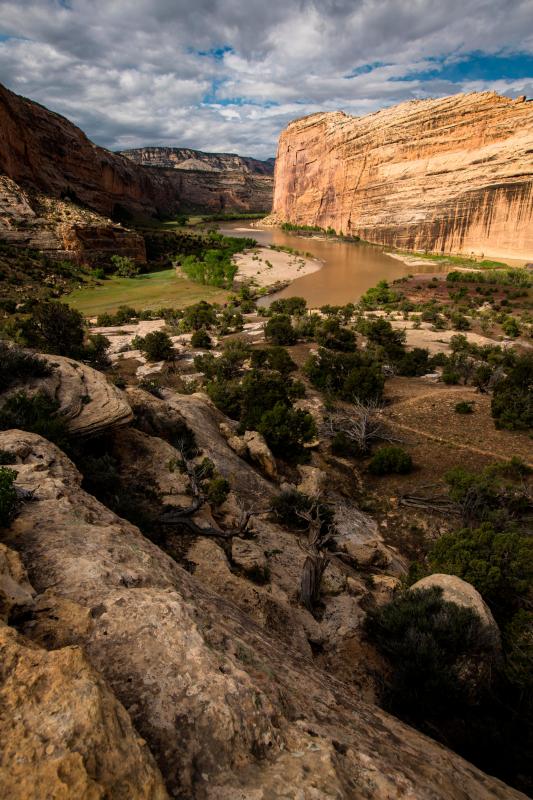
Echo Park, at the confluence of the Green and Yampa rivers (NPS/Jacob W. Frank). Why this landmark? Read on!

Saturday, November 28, 2015

Thanksgiving Leftovers

You're probably pretty busy this weekend. How about something light, like some photos? These all come from a few site visits over October and November, taking advantage of the very pleasant autumn weather conditions in the Twin Cities metro.

This and the next photo come from the U.S. Route 10 roadcuts, in the Shakopee Formation (Prairie du Chien Group). All of the little stone rainbows are small domed stromatolites. At very close range, you can distinguish between layers that are "crystalline", so to speak, representing minerals deposited by the microbes, and layers of sand (a grain or two thick). There is a band populated by these small stromatolites about as thick as the area photographed here that extends for at least a few tens of meters. (I do not recommend casual visits along this busy road; the couple of times I've stopped have been Sunday mornings.)

Saturday, August 23, 2014

Corals of the Twin Cities

The Ordovician seas of the Twin Cities would have been unfamiliar in a lot of ways. There were no sharks, no bony fish, no marine mammals, no seabirds. No driftwood bobbed in the water. There were no octopuses or true squids, no lobsters or crabs scuttling about. The kings of the echinoderms were not sea stars, brittle stars, and sea urchins, but crinoids. A diver would see a Lilliputian sea-scape featuring cm-scale brachiopods, profusions of bryozoans, and "forests" of sea lilies, traversed by trilobites. Snails, of course, would provide a common point of reference. "Are there no corals?" you ask, thumbing through your waterproof guidebook as you try to figure out if you have just stepped on an inarticulate brachiopod, a bivalve, or a monoplacophoran. Well, yes, there are corals; it's just they are all representatives of groups that have been extinct since the end of the Permian (that pesky Permian–Triassic extinction).