Last week's publication of the stem-caecilian Funcusvermis reminded me
that I really ought to show off Petrified Forest National Park (PEFO) more
often. Since the last spotlight, on the "biloph" trilophosaur
Trilophosaurus phasmalophus
in spring 2020, four more species of Triassic vertebrates have been described
from fossils found in the park, to go along with a bushel of reports on anatomy,
identifications of rare forms, vertebrate trace fossils, stratigraphy and
geochronology, and other topics, to say nothing of conference abstracts and
papers that mention PEFO fossils in wider contexts. (SVP conferences are
usually good for a handful of PEFO topics.) Because we're talking the Late
Triassic, the taxonomic diversity is wide. There's a little bit of almost
everything.*
*Interestingly enough, that includes Paleozoic marine invertebrates: reworked
fossiliferous cobbles of the Permian Kaibab Formation have been found in the
park's Chinle Formation outcrops, particularly the Sonsela Member. There are
also limited Neogene deposits with Hemphillian vertebrates.
Classically, as with most places that have produced vertebrate fossils for
more than a century, big singular fossils were long the focus (e.g., skulls of
phytosaurs). Although there is still interest in those kinds of fossils,
increasingly study has focused on bonebeds and microvertebrates, with much
more care given to stratigraphic placement. It turns out that PEFO holds a whole weird and wonderful landscape of
everything that gave it a go in the Late Triassic, before a couple of groups
of archosaurs took over land management for the rest of the Mesozoic. (And if
you don't like vertebrates, the plants are just about as wild in their own
way, and there are freshwater and terrestrial invertebrates as well.) It
practically begs for a book like those on Florissant, Fossil Lake, the
Morrison, and the White River Badlands.
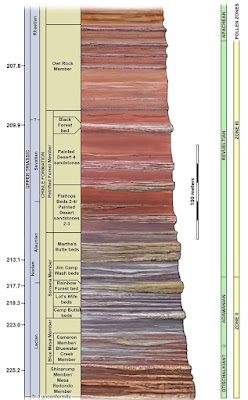 |
Here's a strat column to help keep the geologic units straight, borrowed from the park website.
|
With all of that in mind, here are a few quick hits from the past few years of
research at PEFO:


