
Sunday, July 24, 2016
Additions
Nothing particularly earth-shattering today. I would just like to direct you to the right-hand sidebar, where I've added a section to make it easier to get to The Compact Thescelosaurus, as well as a page that collects a few dozen sources for downloadable or viewable publications. As long as we're on the latter subject, I'll throw out a plug to Barnum Brown's description of the integument of the AMNH's panel-mounted Corythosaurus, and Henry Fairfield Osborn's description of the same for the "trachodon mummy" (note: 74 mb, but you also get an article on the skulls of Allosaurus and Tyrannosaurus). It also gives me an excuse to use this charmingly old-school restoration of various non-contemporaneous duckbills hanging out, found in Brown's publication.


Sunday, July 17, 2016
Hierosaurus sternbergii
One of the notable quirks of nodosaurids is a predilection for washing out to sea. Nodosaurus textilis and Stegopelta landerensis are a couple of featured examples. We turn now to another species from the Western Interior Seaway: Hierosaurus sternbergii.
Sunday, July 10, 2016
Dystactophycus, the crinoid swirl
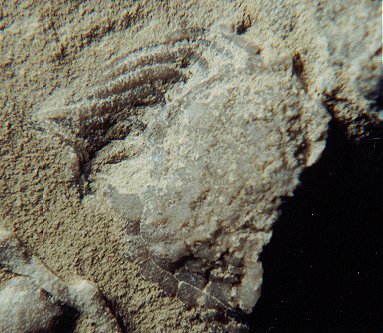
A few weeks ago, a friend brought in an odd object to the Science Museum, which he had collected from an excavation in the vicinity. The object is a carbonate rock featuring concentric ridges that seem to be radial around a central depression. On the off-chance that it was some kind of exotic trace or trace-like pseudofossil, and that it had been illustrated, I went across the hall, pulled the volume of the Treatise on Invertebrate Paleontology that covers traces, and was pleasantly rewarded in the pseudofossil section with an illustration of something called Dystactophycus. The illustrated specimen was even from the Cincinnatian, which is practically as good as the Platteville/Decorah, being just a couple of million years younger. Of course, when something comes this quickly I'm honor-bound to be suspicious, but in this case the actual existence of something like Dystactophycus is more interesting than the question of whether or not I was right. (I do get back to the question of identity in the last paragraph.)
Dystactophycus, as currently understood, is one of those things that makes perfect sense once you've heard of it, but otherwise would probably never occur to you. It is composed of concentric markings on a conical structure. The initial describers (Miller and Dyer 1878) interpreted it as a seaweed, because the year was 1878 and the campaign to wrap peoples' minds around invertebrate trace fossils was far from being over. In short order, it was dismissed as an impression of a concentrically ringed bryozoan (Monticulipora by way of Lichenalia concentrica, both then considered corals) (James 1885, 1895–1896). More recently, Dystactophycus has been attributed to crinoids (Osgood 1970; Meyer and Davis 2009). As Osgood described it, the earlier researchers had the thing upside down: instead of an upward-pointing cone, the center was a low depression. The stem was partially buried by mud and the rest of it was spun around by swirling currents, causing its arms to sweep out an area that became the depression and quite naturally leave concentric markings. At some point, the crinoid detached, and the depression filled in the absence of the sweeping action. Although kind of like a trace fossil, these markings are not trace fossils because they are not evidence of biological activity. Think of them more like an Ordovician equivalent to marks left by a log on a river bottom (tool marks, in the parlance). (If you'd like to see a true crinoid trace, check this out!)
So, do I think that the specimen in hand is an example of Dystactophycus? Although it is superficially similar to the description, there are a couple of characteristics that lead me to say "no". The major issue is that the specimen is not a simple cone shape. Instead, after rising from the center, it slopes again (so kind of a doughnut shape), and the concentric lines are not confined to the cone but continue on the back side. In addition, the markings are not so much grooves and ridges but concentric terraces. My guess instead is some sort of abiotic sedimentary deformation.
References:
James, J. F. 1885. Fucoids of the Cincinnati Group. Journal of the Cincinnati Museum of Natural History 7(4):151–166.
James, J. F. 1895–1896. Manual of the paleontology of the Cincinnati Group, Part VII. Journal of the Cincinnati Museum of Natural History 18(3–4):115–140.
Meyer, D. L., and R. A. Davis. 2009. A Sea Without Fish. Indiana University Press, Bloomington and Indianapolis.
Miller, S. A., and C. B. Dyer. 1878. Contributions to Paleontology 2.
Osgood, R. G., Jr. 1970. Trace fossils of the Cincinnati area. [regrettably, the plates are not included] Palaeontographica Americana 6(41):280–444.
Dystactophycus, as currently understood, is one of those things that makes perfect sense once you've heard of it, but otherwise would probably never occur to you. It is composed of concentric markings on a conical structure. The initial describers (Miller and Dyer 1878) interpreted it as a seaweed, because the year was 1878 and the campaign to wrap peoples' minds around invertebrate trace fossils was far from being over. In short order, it was dismissed as an impression of a concentrically ringed bryozoan (Monticulipora by way of Lichenalia concentrica, both then considered corals) (James 1885, 1895–1896). More recently, Dystactophycus has been attributed to crinoids (Osgood 1970; Meyer and Davis 2009). As Osgood described it, the earlier researchers had the thing upside down: instead of an upward-pointing cone, the center was a low depression. The stem was partially buried by mud and the rest of it was spun around by swirling currents, causing its arms to sweep out an area that became the depression and quite naturally leave concentric markings. At some point, the crinoid detached, and the depression filled in the absence of the sweeping action. Although kind of like a trace fossil, these markings are not trace fossils because they are not evidence of biological activity. Think of them more like an Ordovician equivalent to marks left by a log on a river bottom (tool marks, in the parlance). (If you'd like to see a true crinoid trace, check this out!)
 |
| The specimen in question (I didn't have a scale handy, so my fingertips will have to do). Although similar in some ways to Dystactophycus, I don't think it's an example. |
So, do I think that the specimen in hand is an example of Dystactophycus? Although it is superficially similar to the description, there are a couple of characteristics that lead me to say "no". The major issue is that the specimen is not a simple cone shape. Instead, after rising from the center, it slopes again (so kind of a doughnut shape), and the concentric lines are not confined to the cone but continue on the back side. In addition, the markings are not so much grooves and ridges but concentric terraces. My guess instead is some sort of abiotic sedimentary deformation.
References:
James, J. F. 1885. Fucoids of the Cincinnati Group. Journal of the Cincinnati Museum of Natural History 7(4):151–166.
James, J. F. 1895–1896. Manual of the paleontology of the Cincinnati Group, Part VII. Journal of the Cincinnati Museum of Natural History 18(3–4):115–140.
Meyer, D. L., and R. A. Davis. 2009. A Sea Without Fish. Indiana University Press, Bloomington and Indianapolis.
Miller, S. A., and C. B. Dyer. 1878. Contributions to Paleontology 2.
Osgood, R. G., Jr. 1970. Trace fossils of the Cincinnati area. [regrettably, the plates are not included] Palaeontographica Americana 6(41):280–444.
Sunday, July 3, 2016
A locked dinosaur mystery

So, one of the things you're supposed to do if you have a blog is to talk about your research when a paper you authored comes out. Okay, give me a minute. I mentioned back in the gut contents post that I did my thesis on what was found in the inside of a brachylophosaur. The first part, on the gut contents themselves, was published back in 2008 (Tweet et al. 2008). Finally, after about a decade of gnawing on the manuscript, comes the other part (Tweet et al. 2016).
Sunday, June 19, 2016
Stegopelta
After my years of puzzlement versus Leonardo, I have the greatest sympathy for the early generations of dinosaur paleontologists, being confronted with the often-scanty remains of beasts that had never been seen by anyone. We've already touched on Marsh dealing with Atlantosaurus and Cope dealing with Monoclonius recurvicornis. Ankylosaurians were no exception to the confusion. If a dinosaur skeleton is like a puzzle, a partial ankylosaur skeleton is like getting 300 pieces of a 2,000 piece puzzle, with the only guide being a hand-drawn copy of the box cover drawn by a right-handed person using their left hand, who is also in denial about the state of their vision. The puzzle, of course, is a stand of birch trees in a Great Lakes winter, in black and white. Small wonder that ankylosaurs spent most of the 20th century in the guise of magnified grouchy horned toads, covered in a pavement of armor laid out with enough regularity to satisfy the most tyrannical of 1950s suburb planners.
Monday, June 13, 2016
Cambrian island-hopping at Taylors Falls
Taylors Falls in the St. Croix Valley of eastern Minnesota presents an unusual geologic snapshot along a Cambrian coast. Within the south part of Interstate State Park, for an investment of a little more than a mile of walking round-trip, you can go from ancient basaltic islands, to the lithified rubble surrounding them, to the flanking sandy beach. Geologists love to try to paint verbal pictures of vanished settings, but rarely do the modern outcrops cooperate so nicely. Thank you to the park staff for suggesting an interpretative walk!
Sunday, June 5, 2016
Oklahomacystis
Something I'd hoped to find at Chickasaw National Recreation Area was an example of Oklahomacystis. The Bromide Formation is one of the great rock units for echinoderm diversity, and Oklahomacystis is one of the classic forms. Unfortunately, we didn't end up getting into the Bromide in the recreation area, although it should be there, so it will have to wait for another time. I did see plenty of Oklahomacystis in the collections of the Sam Noble Museum, as well as one slab featuring a group of them at the Travertine Nature Center in the recreation area. Here are some photos of the slab:
Other photos of the same slab are on the Internet, but my photos may be the only ones without the glass, so they've got that going for them. The scale is important, because for some reason, when taken without it, the fossils look to be about the size of dates, when they are actually more like the size of the first joint of a finger. The fossils represent the body, or "theca".
These are visually unusual fossils, looking something like a pine cone, or a pineapple, or a cluster of berries, or a grenade. A close look shows that their surfaces are covered by shared circular arrangements of six (usually) wedge shapes, kind of like Trivial Pursuit pies that share wedges with other pies. If you're familiar with the kinds of words that are frequently used in scientific names, you may have already guessed that we're dealing with an echinoderm. If you guessed "paracrinoid", congratulations, either you are really good with echinoderms or you already know something about Oklahoma's fossils.* A paracrinoid is one of the numerous varieties of stalked echinoderms that flourished for a relatively brief span of time during the Paleozoic and then went extinct. The name suggests affinities with crinoids, but it should be noted that sometimes they are classified more distantly, with relatives to blastoids ("sea buds") or as their own group distinct from either crinoids or blastoids. Like those two groups, a complete paracrinoid would have also featured a stalk attaching it to the seafloor. Presumably Oklahomacystis would have had a fairly simple feeding apparatus compared to crinoids, like the similar paracrinoids Amygdalocystites or Comarocystites (which looks quite a bit different because its thecal plates are strongly concave, giving it that "puckered hexagon" look that was such a craze in the Ordovician). Oklahomacystis had recumbent arms which are part of the thecal structure; as the species name "tribrachiatus" indicates, there are three of these (tri + brachi, meaning arm, which of course we know from Brachiosaurus, the "arm lizard". Snuck in a dinosaur!). Like the other two genera mentioned above, Oklahomacystis's filter feeding apparatus would have consisted of pinnules attached to the arms. If you'd like more technical information on paracrinoids, there's a monograph on the subject available here (no. 288; it just happens to name Oklahomacystis as well).
(*Oklahomacystis is sometimes identified as a cystoid echinoderm, as under the "Bromide Formation" page at Wikipedia. I hinted at this a little bit in a previous post, but in the past people have occasionally had recourse to shovel various enigmatic extinct echinoderms into the cystoids. I'd just stick with paracrinoids here.)
I'll be at an event for Interstate State Park next weekend, so expect some Cambrian in the next post. After that, I'll try to do something dinosaurian; otherwise they'll take away my card!
 |
| Oklahomacystis tribrachiatus |
Other photos of the same slab are on the Internet, but my photos may be the only ones without the glass, so they've got that going for them. The scale is important, because for some reason, when taken without it, the fossils look to be about the size of dates, when they are actually more like the size of the first joint of a finger. The fossils represent the body, or "theca".
 |
| Mysteriously larger |
These are visually unusual fossils, looking something like a pine cone, or a pineapple, or a cluster of berries, or a grenade. A close look shows that their surfaces are covered by shared circular arrangements of six (usually) wedge shapes, kind of like Trivial Pursuit pies that share wedges with other pies. If you're familiar with the kinds of words that are frequently used in scientific names, you may have already guessed that we're dealing with an echinoderm. If you guessed "paracrinoid", congratulations, either you are really good with echinoderms or you already know something about Oklahoma's fossils.* A paracrinoid is one of the numerous varieties of stalked echinoderms that flourished for a relatively brief span of time during the Paleozoic and then went extinct. The name suggests affinities with crinoids, but it should be noted that sometimes they are classified more distantly, with relatives to blastoids ("sea buds") or as their own group distinct from either crinoids or blastoids. Like those two groups, a complete paracrinoid would have also featured a stalk attaching it to the seafloor. Presumably Oklahomacystis would have had a fairly simple feeding apparatus compared to crinoids, like the similar paracrinoids Amygdalocystites or Comarocystites (which looks quite a bit different because its thecal plates are strongly concave, giving it that "puckered hexagon" look that was such a craze in the Ordovician). Oklahomacystis had recumbent arms which are part of the thecal structure; as the species name "tribrachiatus" indicates, there are three of these (tri + brachi, meaning arm, which of course we know from Brachiosaurus, the "arm lizard". Snuck in a dinosaur!). Like the other two genera mentioned above, Oklahomacystis's filter feeding apparatus would have consisted of pinnules attached to the arms. If you'd like more technical information on paracrinoids, there's a monograph on the subject available here (no. 288; it just happens to name Oklahomacystis as well).
(*Oklahomacystis is sometimes identified as a cystoid echinoderm, as under the "Bromide Formation" page at Wikipedia. I hinted at this a little bit in a previous post, but in the past people have occasionally had recourse to shovel various enigmatic extinct echinoderms into the cystoids. I'd just stick with paracrinoids here.)
I'll be at an event for Interstate State Park next weekend, so expect some Cambrian in the next post. After that, I'll try to do something dinosaurian; otherwise they'll take away my card!
Subscribe to:
Posts (Atom)