Sunday, December 11, 2022

Historical miscellany, including O.P. Hay, Whitesburg fossils, and the "Scientific Swindler"

A selection of brief historical items for your approval:

If you're like me and have an interest in Pleistocene megafauna, you've probably spent some time tooling around Neotoma and NeoMap (which unfortunately doesn't work anymore), as well as the Paleobiology Database. (In fact, it's kind of necessary to use multiple databases because they don't all have the same information.) Compiling datasets like these can be a thankless job. The actual business of making one is time-consuming and requires access to a vast array of scholarly (and less-scholarly) resources. To make it more efficient, you can bring in a crowd to contribute smaller parts, with the obvious trade-off that quality control is harder to maintain (and participants may disagree strongly about things like taxonomy). Synthesizing material doesn't get as much respect as producing new information. It takes a certain kind of personality to compile these things (I ain't about to name any characteristics, because I'd just be pointing in the mirror). You also want to be very, very sure you get it right, because sometimes people just accept the compendium and forget to check the original sources.

There are many state-level compendia of Pleistocene finds for the US, and at least one excellent regional resource (for the southwestern US and northwestern Mexico). They don't exist for every state, though, and unfortunately many are in the neighborhood of a century old. (If anyone wants a reference for a specific state, I can see what I can do.) By far the most monumental of these monuments to industry are the three volumes produced by Oliver Perry Hay in the 1920s, the "Vertebrated Animals of North America" series. Hay was no stranger to compiling information, with two bibliographies on North American fossil vertebrates under his belt. For people used to the Internet, it takes a moment to realize the staggering amount of work that must have gone into these books, which cover the entire continental US and Canada from the beginning of scientific documentation of fossils to his own day. Even granting that the field was smaller and there were fewer publications, the number of references he must have seen must have been immense (to say nothing of the work of tracking them down). That there are occasional errors and omissions is not the wonder; the wonder is that these books exist at all. I've included citations to several of his volumes at the end; all are freely available for download at the moment except the third volume of the "Vertebrated Animals" series, but even this one can be read online.

I've referred to Hay's works many times in my own work; on this occasion he came to mind because I happened upon a seemingly forgotten Pleistocene fauna from northeastern Tennessee that he described with five other Pleistocene collections (Hay 1920). The Smithsonian had received a collection made by USGS geologist Ira Sayles in 1885 from "one mile north of Whitesburg, Hamblen Co., Tenn." Matrix with the bones indicated that the site had once been a cave, now eroded. Hay recognized twenty species from the fauna, eight of which were extinct and three of which were new species (turtle Testudo munda, tapir Tapirus tennesseae, and deer Sangamona fugitiva; none of them is considered valid anymore, which tends to happen with supposed new Pleistocene species in North America, but Sangamona fugitiva is a nice name). What gets me is that there's never been any real follow-up outside of Hay's own 1923 compendium of Pleistocene sites. The actual location is still unknown to this day, if it could even be rediscovered. That's one of the things that I love about these compilations and databases: there's a story behind every site, even if it's not known in detail.

Finally, I wanted to mention a historical story I came across this spring while working on another topic. It is a story of fraud in science, but not the usual "unscrupulous scientist scoops another worker or commits a nefarious action against a graduate student." It goes like this: from the mid-1880s to the early 1890s there was a man operating in the Midwest and Northeast who would use false pretenses to swindle scientific books, equipment, and fossils from unsuspecting geologists, to sell them. Among his methods were pretending to be deaf-mute and stealing the identities of other geologists, including such luminaries as Leo Lesqueroux and Charles Walcott. His trail can be followed by a series of letters in scientific journals reporting encounters and giving warnings, but he was able to operate for years. The icing on the cake is that he was actually a competent paleontologist, as attested by several of the victims. It's a fascinating story worthy of a journal article, and fortunately we have what amounts to one in a lengthy blog post, so if you're looking for something to read, it's well worth the time!

References

Hay, O. P. 1902. Bibliography and catalogue of the vertebrata of North America. U.S. Geological Survey, Washington, D.C. Bulletin 179.

Hay, O. P. 1908. The fossil turtles of North America. Carnegie Institution of Washington Publication 75.

Hay, O. P. 1914. The Pleistocene mammals of Iowa. Iowa Geological Survey Annual Report 23(1):1–662.

Hay, O. P. 1920. Descriptions of some Pleistocene vertebrates found in the United States. Proceedings of the United States National Museum 58:83–146.

Hay, O. P. 1923. The Pleistocene of North America and its vertebrated animals from the states east of the Mississippi River and from the Canadian provinces east of longitude 95°. Carnegie Institution of Washington Publication 322.

Hay, O. P. 1924. The Pleistocene of the middle region of North America and its vertebrated animals. Carnegie Institute of Washington Publication 322A.

Hay, O. P. 1927. The Pleistocene of the western region of North America and its vertebrated animals. Carnegie Institute of Washington Publication 322B.

Hay, O. P. 1929. Second bibliography and catalogue of the fossil vertebrata of North America, volumes I and II. Carnegie Institution of Washington Publication 390.

Sunday, November 27, 2022

Musings on Hanyusuchus

Every year a handful of new croc taxa are described. If you're strictly in this business for the dinosaurs, you ought to see what the croc side of Archosauria has been up to from time to time; they were quite versatile in palmier days. Even though they aren't quite as diversified as they used to be, it turns out they had hitherto-unsuspected tricks up their sleeves even as recently as a few hundred years ago. This spring a new genus and species of gavialid was described from the Holocene of south China: Hanyusuchus sinensis. This is fascinating, for many reasons. The obvious is that here we have a species of [insert expletive of choice] 20-foot-long gavial that existed up to perhaps a few hundred years ago in full contact with one of the most thoroughly documented civilizations in history, and it was completely overlooked. It may not have gone extinct until the time of the Ming dynasty. This is something like discovering that bears in Greek and Roman mythology were actually Arctodus, only if Arctodus was the size of a pickup truck. China, of course, is noted for the extant Alligator sinensis, but although the Chinese alligator is many things, not even on its best days has it been a 20-foot-long gavial.

Figure 2(s) from Iijima et al. (2022). Depicted: Hanyusuchus sinensis (composite, scaled to holotype) and 1.8 m (5.9 ft) tall human. Not pictured: Alligator sinensis (to imagine, mentally scale the Hanyusuchus to be about the same size as the human). CC BY 4.0.

Another fascinating aspect is the namesake. Han Yu was a significant writer, philosopher, and politician of the Tang dynasty. At one point in his life, he got in trouble at court and was packed off to Chaozhou in Guangdong, southeastern China to serve as prefect. In this capacity, he issued a proclamation in 819 concerning the crocodilian population. This in itself is not remarkable, except for the audience: he issued it to the crocodiles themselves. A translation of the statement can be found here (well worth a read). The icing on the cake is that the crocodiles reportedly did as instructed and departed, although we can presume that if they *did* indeed vanish from the area, strong hands wielding metal implements (like the Bronze Age weapons that left marks on some specimens) were more important in enforcing the departure. The reader may suppose that Han Yu's action was just a quaint old-time delusion; after all, there is a long history of animals being prosecuted for crimes. However, as the author of the translation notes drily, "Tang prefects did not habitually make formal verbal addresses to the local fauna" (footnote 7, p. 60). One wonders if perhaps Han Yu, who was noted for a sense of humor, had his tongue firmly in cheek.

There's also a melancholic existential aspect to the discussion. H. sinensis was part of the fabric of life in southern China for thousands of years. Descriptions of the species can be identified in historical sources, now that we know what to look for. Dynasties, cultural flowerings and renaissances, wars, conquerors, travelers like Marco Polo and Ibn Battuta, all came and went while 6-m gavials patrolled the southern rivers. They took livestock and killed people. They were apparently very noisy, probably the source of reportedly "thunder-like sounds in the night". Then they were driven into extinction and basically forgotten for hundreds of years.

References

Iijima M, Qiao Y, Lin W, Peng Y, Yoneda M, and Liu J. 2022. An intermediate crocodylian linking two extant gharials from the Bronze Age of China and its human-induced extinction. Proceedings of the Royal Society B: Biological Sciences 289:20220085. doi:10.1098/rspb.2022.0085.

Sunday, November 20, 2022

Your Friends The Titanosaurs: Caieiria allocaudata

This edition of "Your Friends The Titanosaurs" is a little different in that not only are we welcoming a new friend, we are saying goodbye to an old friend. The latter is something that should come as no surprise; with well over a hundred species, notorious for incomplete material, some of them are eventually going to turn out to be the same.

(Also, I should have mentioned this, but I moved the external links to a separate page to conserve space on the sidebar.)

Sunday, November 13, 2022

Quick Guide to Fossils at Uŋčí Makhá Park

So I went back to Uŋčí Makhá Park last weekend and spent a couple of hours taking photos of fossils, because it makes such an ideal place to see the upper Platteville fauna. After all, a winter of freezes and thaws may not leave these new exposures looking as nice as they do now. Here's a quick guide to what can be seen there. (Let's see how many photos I can squeeze into one post, and how many species I can misidentify!)

Determining where you are stratigraphically

First of all, I'd just like to reiterate the stratigraphy. Most of the vertical extent is in the Magnolia Member of the Platteville Formation, with the upper part composed of the Carimona Member of the Decorah Shale. I'm thinking more or less the entire extent of the Carimona is exposed, based on thickness; at any rate the next thing up would be the shaly part of the Decorah, and there isn't a trace of it to be seen. I'm suspicious because the difference is just so darn clear, but at this site there is an unmistakable color change between the two units: the Carimona is the upper blue-gray interval and the Magnolia is the light tan-gray interval below. The Deicke K-bentonite is the lower and thicker of the two bentonite gaps in the Carimona. (Note that the Carimona is sometimes supplemented or replaced by landscaping, but this is pretty obvious.) As you walk from south to north, the "floor" goes up stratigraphically, so it's not all one bedding plane but a gently rising series of planes, until by the exit you're close to the color change.

The color change is quite evident here. The Deicke K-bentonite is the cut-in about halfway up the blue-gray Carimona (above the scale bar in the center of the photo).

Here we've gone north, and the floor has risen. The Deicke is still the seam in the middle of the blue-gray rocks.

Sunday, October 30, 2022

Strolling on the Magnolia Member by Hidden Falls

If you're looking for something geological to do in the Twin Cities while we're still under our unseasonably warm and dry weather, may I suggest paying a visit to the new park area above Hidden Falls? [Update, 2022/11/01: this park is called Uŋčí Makhá Park.] As part of the conversion of the former Ford Plant environs, part of the area of the creek into Hidden Falls has been daylighted. The landscaping has produced a mini-bedrock gorge that exposes significant vertical and bedding-plane surfaces of the Magnolia Member of the Platteville and the overlying Carimona Member of the Decorah.

There's nothing quite like this kind of exposure in the Twin Cities; we don't have a lot of exposed non-vertical bedrock in the first place, and this particular stratigraphic interval tends to be out of reach. The closest might be the platform below the overlook at Shadow Falls, but that's more limited in extent and has more of a stair-step profile.

Bonus points for spotting the Deicke K-bentonite.

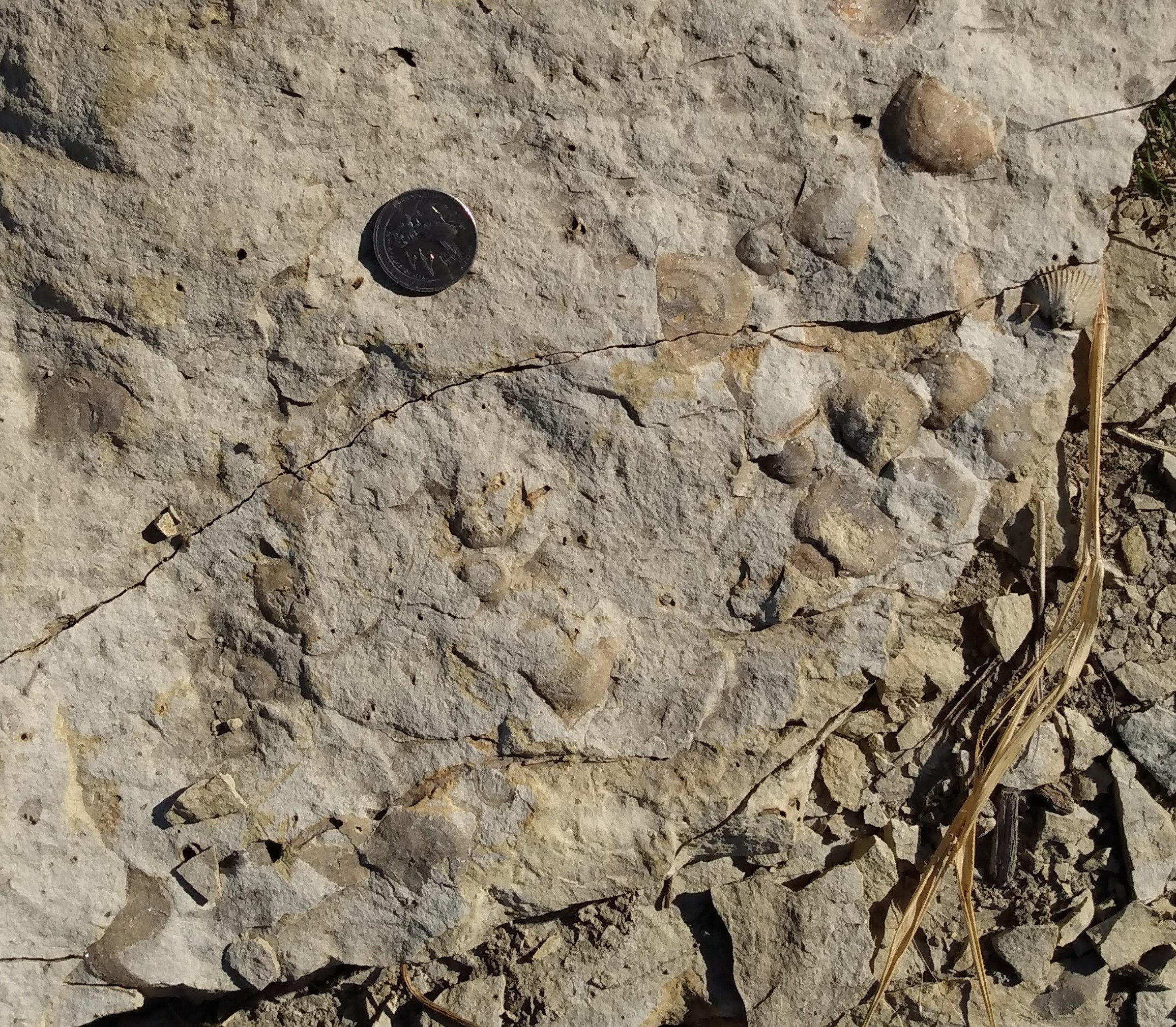
Many of the exposed bedding plane surfaces reveal the shell beds the Magnolia is known for. The fossils are almost entirely brachiopods (with a few snails) and are represented by dolomitized molds and casts, giving them that characteristic sugary appearance.

See the little bumps? Brachs.

Enlarge for a world of brachiopods.

Here's a closer view showing a few nice examples, representing multiple species.

Also, just for fun, some of the stones used for landscaping are loaded with burrows.

If you stop by, please don't attempt to remove the fossils; it's a park, after all, and the fossils aren't really going to come off in one piece because they're molds and casts. Just enjoy the experience of walking on the seafloor without ever getting wet!

Sunday, October 23, 2022

Abbott and Costello Meet the Hyolith

I seem to have missed doing a hyolith post last year, which is really a shame and is all on me. Honestly, where else are you going to get the latest information on hyoliths? Social media? Cable news? Public radio? No, of course not! This is really a public service I'm running here, and you'll thank me for it someday. With that out of the way, what's been going on in the world of hyoliths over the past couple of years? A few thoughtfully curated highlights:

If you've ever spent time looking at the origins and relationships of gastropods, you'll be familiar with the seemingly endless debates about whether such-and-such is a gastropod or something that just happens to have a shell that looks like a snail shell (like monoplacophorans, helcionelloids, and maybe bellerophonts). We've had a bit of that with the local snail-oids, although by the Late Ordovician most of the hard cases had been cleared out. Down in the Cambrian things are more complicated. One example is Protowenella, an itty-bitty (smaller than 1 mm long) shell thing that looks kind of like a Phrygian cap. (Okay, fine, it looks like an exaggerated Smurf hat.) Is it a gastropod, a monoplacophoran, or a helcionelloid? According to Peel (2021), it is none of these. Instead, it is... a hyolith.

(Admittedly, the surprise you are feeling is probably tempered by the fact that this is a post about hyoliths, so it wouldn't have made sense for it to be a chiton or graptolite or something.)

Peel based his conclusion on the presence of a bilaterally symmetric operculum (a mineralized cap that covers the shell aperture) with features consistent with a hyolith origin. Gastropods frequently have opercula, but they aren't symmetric, and hyoliths are the only thing known to have had opercula in the Cambrian. If this referral is accurate, it would be something of an unexpected expansion of hyolith morphological talents. Hyoliths, of course, are famous for having long triangular shells with triangular cross-sections, whereas Protowenella as mentioned looks like a curled-over pointed hat.

Now let's turn from something that doesn't look like a typical hyolith but has something that *is* typical, to something that looks like a typical hyolith but is missing something expected. Hyoliths are generally divided into two groups, the orthothecids and hyolithids. Orthothecids showed up first and have a flat, retracting operculum (rather than the more complex operculum of hyolithids) and no helens (the paired spiny appendages that make hyolithids look kind of like they have wide spindly mustaches). It turns out that there are some hyoliths with hyolithid anatomy except for no helens. Liu et al. (2022) examined one such example, "Ambrolinevitus" ventricosus, an early Cambrian form from China (which they moved to Paramicrocornus, also known to lack helens). The implication is that the hyolithid body shape evolved before helens. Therefore, whatever ecological specialization was held by hyolithids over their earlier cousins, it was underway before helens appeared.

Finally, I leave you with Sun et al. (2021), a description of some beautifully preserved Cambrian hyoliths from China. Assigned to the new species Novakotheca weifangensis, they're small (less than 2 cm at most, although some have even smaller brachiopods attached) and pretty typical in shape. The neat thing about them is the preservation of mineralized soft parts of the digestive tract, interpreted as including a pharynx, esophagus, stomach, U-shaped intestine, and possible digestive gland. The anatomy is more complex than previously thought, and suggests that at least some hyoliths were not simply filter feeders.

References

Liu, F., C. B. Skovested, T. P. Topper, and Z. Zhang. 2022. Hyolithid-like hyoliths without helens from the early Cambrian of South China, and their implications for the evolution of hyoliths. BMC Ecology and Evolution 22: article 64. doi:10.1186/s12862-022-02022-9.

Peel, J. S. 2021. In-place operculum demonstrates that the Middle Cambrian Protowenella is a hyolith and not a mollusc. Alcheringa: An Australasian Journal of Palaeontology 45(4):385–394. doi:10.1080/03115518.2021.2004225.

Sun H., Sun Z., and Zhao F. 2021. Exceptionally preserved hyolithids from the middle Cambrian of north China. Geological Magazine 158(11):1951–1959. doi:10.1017/S0016756821000510.

Sunday, October 9, 2022

Compact Thescelosaurus Year Seven

Here we are at the second weekend of October, which means it's time for three things: National Fossil Day; a new sheet for The Compact Thescelosaurus; and our annual roundup of what's been added to the spreadsheet. National Fossil Day falls on Wednesday, October 12 this year, although events occur throughout the month (especially the weekends before and after), so check your nearest museum or National Park System unit for events! Our fall Park Paleontology newsletter is also up for viewing (including more fun with packrats).