This time around there are two more from Argentina to close out a streak of five consecutive entries from Patagonia which we began last time, and then one from China. Puertasaurus reuili completes the set of super-titanosaurs and again overshadows the other two entries, Pitekunsaurus macayai and Qingxiusaurus youjiangensis.
Sunday, May 17, 2020

Sunday, May 10, 2020
Revisiting Shadow Falls Park
I like to periodically recheck various sites along the Mississippi corridor, to see how the elements are treating them, if there have been any major rock falls, damage from downed trees, changes in usage, etc. One of the places I get to more frequently than others is Shadow Falls Park. It has an informal reputation for collecting and is a place with soil on steep slopes (plus access is good and I like going there).
Erosion may not be immediately evident if you don't have something to measure the loss of sediment, but in places with tree roots near the surface on the slopes it's easy to see how running water and gravity have done their work.
The usual array of lower Decorah fossils was present, in small chunks of rock and loose. It seemed to be a particularly good day for observing strophomenids (in the hash plates, primarily; they tend to break up otherwise). One example in the photo below is probably Rafinesquina, based on the thinness of the valve. This genus is named after Rafinesque, who we met last week and had a much more substantial career than getting into arguments about sloths. Another nice piece observed was a Bumastoides pygidium.
In one area I observed two pieces of a larger specimen of Rauffella palmipes. This is all catch-and-release, of course!
Shadow Falls includes not only the falls, but a long valley oriented east-west with its head near but not quite reaching Cretin Avenue. I haven't spent much time in the valley above the falls because the area right above the falls tends to turn into a muddy swamp, but it's been a dry spring. The creek feeding the falls is in a very deep valley for its size, but would have been somewhat bigger in the days before sewers and roads.
There are several large fossiliferous blocks along the creek that include crinoid columnals notably larger in diameter than the run-of-the-mill lower Decorah columnals (note that the photo in the linked post is biased to larger, more photogenic columnals). The obvious guess is that they were brought to the area by glaciers and represent a different part of the stratigraphic column, say the upper Decorah or one of the overlying Ordovician formations that have been stripped from the area.
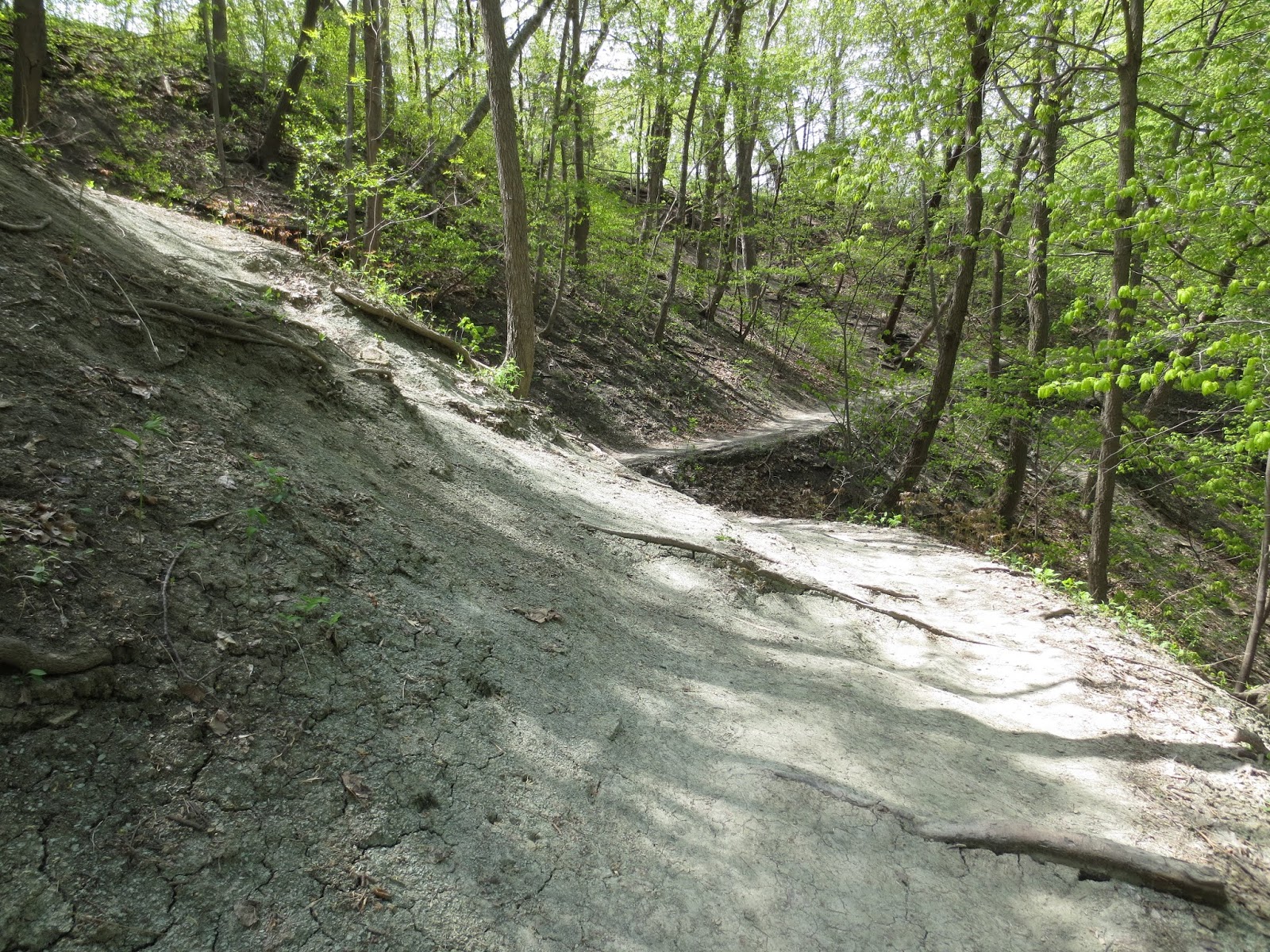 |
| Here's the trail on the south side of the valley past the falls (which are essentially just to the right and a little below the vantage point of this photo). |
Erosion may not be immediately evident if you don't have something to measure the loss of sediment, but in places with tree roots near the surface on the slopes it's easy to see how running water and gravity have done their work.
 |
| Almost a staircase of roots. |
The usual array of lower Decorah fossils was present, in small chunks of rock and loose. It seemed to be a particularly good day for observing strophomenids (in the hash plates, primarily; they tend to break up otherwise). One example in the photo below is probably Rafinesquina, based on the thinness of the valve. This genus is named after Rafinesque, who we met last week and had a much more substantial career than getting into arguments about sloths. Another nice piece observed was a Bumastoides pygidium.
 |
| A. Probable Rafinesquina valve. B. Bumastoides pygidium |
In one area I observed two pieces of a larger specimen of Rauffella palmipes. This is all catch-and-release, of course!
 |
| Two fragments of a large Rauffella palmipes. |
Shadow Falls includes not only the falls, but a long valley oriented east-west with its head near but not quite reaching Cretin Avenue. I haven't spent much time in the valley above the falls because the area right above the falls tends to turn into a muddy swamp, but it's been a dry spring. The creek feeding the falls is in a very deep valley for its size, but would have been somewhat bigger in the days before sewers and roads.
 |
| The creek valley above Shadow Falls... |
 |
| ...opens up into this near its head. |
There are several large fossiliferous blocks along the creek that include crinoid columnals notably larger in diameter than the run-of-the-mill lower Decorah columnals (note that the photo in the linked post is biased to larger, more photogenic columnals). The obvious guess is that they were brought to the area by glaciers and represent a different part of the stratigraphic column, say the upper Decorah or one of the overlying Ordovician formations that have been stripped from the area.
 |
| Large columnals |
Sunday, May 3, 2020
On the mis-location of a giant sloth
To start off, I though you might be interested in a new series of pages on the National Park Service paleontology site, concerning the history of paleontology in NPS lands (including going back to before the sites were parks). We're always on the lookout for historical information. One odd case we've recently come across is a sloth which was at one time thought to come from a cave in the Mammoth Cave system.
Sunday, April 26, 2020
Kholumolumo ellenbergerorum and "Thotobolosaurus"
With the twin unofficial missions of Equatorial Minnesota to cover Elliot Formation "prosauropods" and find out what happened to unpublished dinosaurs of the past, it was imperative that Kholumolumo ellenbergerorum receive a post. Before we get into the actual science of K. ellenbergerorum, though, let's step back through the mists of time. First we'll stop off in the far-off world of 1985.
You've just gotten the Normanpedia (Norman 1985) and are busy committing it to memory. On page 97, in the "Dubious" section of the list of prosauropod genera, is Thotobolosaurus. It doesn't ring a bell, so you pull out "A Field Guide to Dinosaurs" (Lambert 1983). It shows up on page 104, as a "roccosaurid" with Riojasaurus and something called Roccosaurus, which wasn't in the Normanpedia. "Roccosaurids" apparently have "unusually sharp fangs and an especially strong joint linking hips with the backbone", but might actually be melanorosaurids. This last bit just ends up being confusing because (stepping outside of 1985 for a moment) "A Field Guide to Dinosaurs" was caught up in the contemporary fad for lumping all kinds of prosauropods, so Melanorosaurus is sunk into Euskelosaurus. Anyway, Thotobolosaurus is "a big prosauropod that lived in early Late Triassic Lesotho, southern Africa." Okay, sure. Does "The New Dinosaur Dictionary" (Glut 1982) have anything more, and can it explain what exactly is a Roccosaurus?
You've just gotten the Normanpedia (Norman 1985) and are busy committing it to memory. On page 97, in the "Dubious" section of the list of prosauropod genera, is Thotobolosaurus. It doesn't ring a bell, so you pull out "A Field Guide to Dinosaurs" (Lambert 1983). It shows up on page 104, as a "roccosaurid" with Riojasaurus and something called Roccosaurus, which wasn't in the Normanpedia. "Roccosaurids" apparently have "unusually sharp fangs and an especially strong joint linking hips with the backbone", but might actually be melanorosaurids. This last bit just ends up being confusing because (stepping outside of 1985 for a moment) "A Field Guide to Dinosaurs" was caught up in the contemporary fad for lumping all kinds of prosauropods, so Melanorosaurus is sunk into Euskelosaurus. Anyway, Thotobolosaurus is "a big prosauropod that lived in early Late Triassic Lesotho, southern Africa." Okay, sure. Does "The New Dinosaur Dictionary" (Glut 1982) have anything more, and can it explain what exactly is a Roccosaurus?
Sunday, April 19, 2020
Your Friends The Titanosaurs, part 23: Patagotitan, Pellegrinisaurus, and Petrobrasaurus
It's an all-Patagonia show this time with Patagotitan mayorum (Chubut Province), Pellegrinisaurus (Río Negro Province), and Petrobrasaurus puestohernandezi (Neuquén Province). By now Patagotitan needs no introduction; Pellegrinisaurus and Petrobrasaurus are easily overshadowed by it, both literally and figuratively.
Sunday, April 5, 2020
Trilophosaurus and Ophthalmothule
For this post, we highlight two extinct reptiles that have been the subjects of publications in the past few days. Other than that, they don't have much in common. One is a short-necked terrestrial herbivore less than three meters long that lived during the Late Triassic in what is now Arizona, the other is a long-necked marine carnivore between five and six meters long that lived at about the Jurassic–Cretaceous boundary at what is now an Arctic island (not quite so arctic at the time).
Sunday, March 29, 2020
George Washington's dolphins, and other NPS paleontology news
Here are a few recent items from the world of National Park Service paleontology:
Feel free to also check out the back issues from the past few years, too!
Fossil Dolphins at George Washington Birthplace National Monument
You may remember from a couple of months ago the announcement of shark fossils from within the cave system of Mammoth Cave National Park, embedded in the Mississippian-aged rocks which host the caves. Here's another announcement of a marine nature, this time coming from George Washington Birthplace National Monument in eastern Virginia. At this park, dolphin fossils including two skulls were recently excavated from the Miocene-aged Calvert Formation bluffs along the Potomac. I'm particularly proud and pleased about this news, because I have been going to GEWA annually since 2014 to conduct monitoring of fossil resources. (I am also jealous because I wasn't available to participate!) There are two things going on here that threaten fossil resources: the Potomac can rather effectively batter the poorly lithified Calvert Formation bluffs when it gets churning; and there has been a long-time culture of collecting, which we've been trying to change. |
| March 2015, on part of the Potomac shore. |
 |
| November 2019, somewhere close to the same place as the previous photo. The colors seem to be a seasonal thing (the colorful surfaces are scrubbed off during winter storms). Note the trees looming above. |
 |
| When you're at a park, remember to leave the fossils where they are. Tell park staff if you come across something interesting. Maybe another dolphin will turn up! |
Park Paleontology News, spring 2020
A couple of years ago we resumed the Park Paleontology newsletter as a collection of short online articles, published in the spring and fall. This venue gives us a chance to put out short pieces on our various projects, covering a variety of aspects of NPS paleontology from a range of viewpoints. The spring 2020 collection was recently made public and includes the following:- The piece on the GEWA dolphins mentioned above
- "Fossils in Focus: Using Photogrammetry and 3D Models to Highlight Recent Paleontological Discoveries at Chaco Culture National Historical Park" by Cait Conley and Phil Varela, which ties in with Phil's inventory for the park (public version here)
- "The Second Bank of the United States: Ordovician Fossils in 19th Century Flooring" by Samantha Freise
- "Preserving Fossils: How the National Natural Landmarks Program Advances Resource Management" by Jeff Orlowski
- "A Long-Awaited New Paleontological Research Facility for Hagerman Fossil Beds National Monument" by Kari Prassack
- "An Inventory of Fossils at Carlsbad Caverns National Park" by Scott Kottkamp
- "First Paleontologist Hired at Waco Mammoth National Monument" by Lindsey Yann
- "Preventative Conservation of an Allosaurus skull from Dinosaur National Monument" by Rebecca Hunt-Foster and Matt Smith (Dinosaur NM, of course, also making noise this year for a different Allosaurus skull, the one belonging to the at-long-last formally described A. jimmadseni)
Feel free to also check out the back issues from the past few years, too!
Grand Canyon NP and Chaco Culture NHP virtual museums
One of our favorite methods of documenting fossils is through the use of photogrammetry to create 3D models. The basic concept is that you take a number of overlapping photos of something and then use dedicated software to stitch the photos into a digital 3D model. (This can also be used to print tangible 3D models as well.) Our interest started with documenting fossil vertebrate tracks; they don't always lend themselves to collecting (size of track surface, fragility, tracks being part of the scenery) and casting can damage them. Led by crack photogrammetry specialist Jack Wood, we've since expanded to a wide variety of fossils. We've recently made two collections of photogrammetric models available for viewing. One set captures examples of the wide variety of fossil organisms found at Grand Canyon National Park. The other, for Chaco Culture National Historical Park, is focused on the Western Interior Seaway.
Subscribe to:
Posts (Atom)