Sunday, October 30, 2022

Strolling on the Magnolia Member by Hidden Falls

If you're looking for something geological to do in the Twin Cities while we're still under our unseasonably warm and dry weather, may I suggest paying a visit to the new park area above Hidden Falls? [Update, 2022/11/01: this park is called Uŋčí Makhá Park.] As part of the conversion of the former Ford Plant environs, part of the area of the creek into Hidden Falls has been daylighted. The landscaping has produced a mini-bedrock gorge that exposes significant vertical and bedding-plane surfaces of the Magnolia Member of the Platteville and the overlying Carimona Member of the Decorah.

There's nothing quite like this kind of exposure in the Twin Cities; we don't have a lot of exposed non-vertical bedrock in the first place, and this particular stratigraphic interval tends to be out of reach. The closest might be the platform below the overlook at Shadow Falls, but that's more limited in extent and has more of a stair-step profile.

Bonus points for spotting the Deicke K-bentonite.

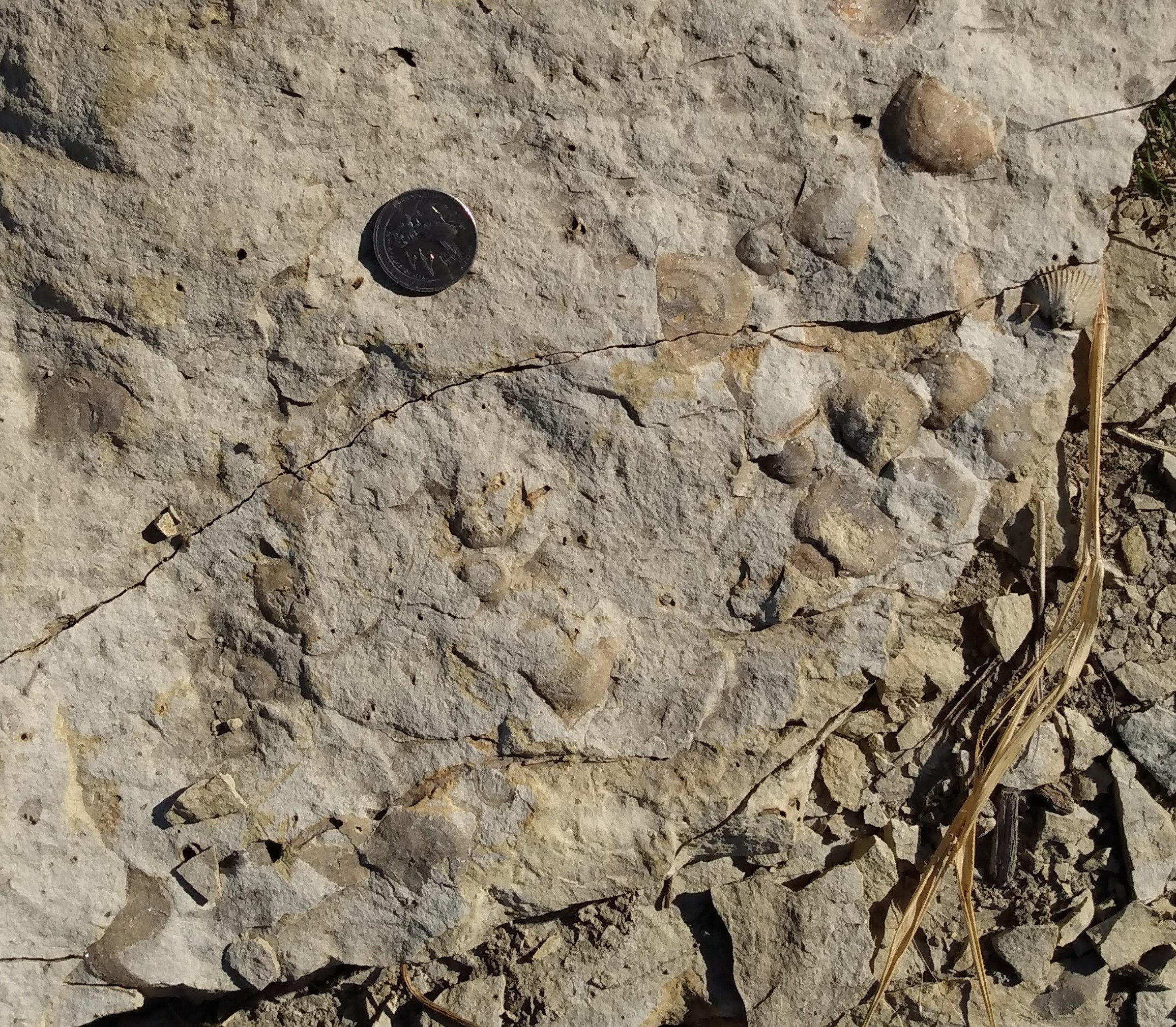
Many of the exposed bedding plane surfaces reveal the shell beds the Magnolia is known for. The fossils are almost entirely brachiopods (with a few snails) and are represented by dolomitized molds and casts, giving them that characteristic sugary appearance.

See the little bumps? Brachs.

Enlarge for a world of brachiopods.

Here's a closer view showing a few nice examples, representing multiple species.

Also, just for fun, some of the stones used for landscaping are loaded with burrows.

If you stop by, please don't attempt to remove the fossils; it's a park, after all, and the fossils aren't really going to come off in one piece because they're molds and casts. Just enjoy the experience of walking on the seafloor without ever getting wet!

Sunday, October 23, 2022

Abbott and Costello Meet the Hyolith

I seem to have missed doing a hyolith post last year, which is really a shame and is all on me. Honestly, where else are you going to get the latest information on hyoliths? Social media? Cable news? Public radio? No, of course not! This is really a public service I'm running here, and you'll thank me for it someday. With that out of the way, what's been going on in the world of hyoliths over the past couple of years? A few thoughtfully curated highlights:

If you've ever spent time looking at the origins and relationships of gastropods, you'll be familiar with the seemingly endless debates about whether such-and-such is a gastropod or something that just happens to have a shell that looks like a snail shell (like monoplacophorans, helcionelloids, and maybe bellerophonts). We've had a bit of that with the local snail-oids, although by the Late Ordovician most of the hard cases had been cleared out. Down in the Cambrian things are more complicated. One example is Protowenella, an itty-bitty (smaller than 1 mm long) shell thing that looks kind of like a Phrygian cap. (Okay, fine, it looks like an exaggerated Smurf hat.) Is it a gastropod, a monoplacophoran, or a helcionelloid? According to Peel (2021), it is none of these. Instead, it is... a hyolith.

(Admittedly, the surprise you are feeling is probably tempered by the fact that this is a post about hyoliths, so it wouldn't have made sense for it to be a chiton or graptolite or something.)

Peel based his conclusion on the presence of a bilaterally symmetric operculum (a mineralized cap that covers the shell aperture) with features consistent with a hyolith origin. Gastropods frequently have opercula, but they aren't symmetric, and hyoliths are the only thing known to have had opercula in the Cambrian. If this referral is accurate, it would be something of an unexpected expansion of hyolith morphological talents. Hyoliths, of course, are famous for having long triangular shells with triangular cross-sections, whereas Protowenella as mentioned looks like a curled-over pointed hat.

Now let's turn from something that doesn't look like a typical hyolith but has something that *is* typical, to something that looks like a typical hyolith but is missing something expected. Hyoliths are generally divided into two groups, the orthothecids and hyolithids. Orthothecids showed up first and have a flat, retracting operculum (rather than the more complex operculum of hyolithids) and no helens (the paired spiny appendages that make hyolithids look kind of like they have wide spindly mustaches). It turns out that there are some hyoliths with hyolithid anatomy except for no helens. Liu et al. (2022) examined one such example, "Ambrolinevitus" ventricosus, an early Cambrian form from China (which they moved to Paramicrocornus, also known to lack helens). The implication is that the hyolithid body shape evolved before helens. Therefore, whatever ecological specialization was held by hyolithids over their earlier cousins, it was underway before helens appeared.

Finally, I leave you with Sun et al. (2021), a description of some beautifully preserved Cambrian hyoliths from China. Assigned to the new species Novakotheca weifangensis, they're small (less than 2 cm at most, although some have even smaller brachiopods attached) and pretty typical in shape. The neat thing about them is the preservation of mineralized soft parts of the digestive tract, interpreted as including a pharynx, esophagus, stomach, U-shaped intestine, and possible digestive gland. The anatomy is more complex than previously thought, and suggests that at least some hyoliths were not simply filter feeders.

References

Liu, F., C. B. Skovested, T. P. Topper, and Z. Zhang. 2022. Hyolithid-like hyoliths without helens from the early Cambrian of South China, and their implications for the evolution of hyoliths. BMC Ecology and Evolution 22: article 64. doi:10.1186/s12862-022-02022-9.

Peel, J. S. 2021. In-place operculum demonstrates that the Middle Cambrian Protowenella is a hyolith and not a mollusc. Alcheringa: An Australasian Journal of Palaeontology 45(4):385–394. doi:10.1080/03115518.2021.2004225.

Sun H., Sun Z., and Zhao F. 2021. Exceptionally preserved hyolithids from the middle Cambrian of north China. Geological Magazine 158(11):1951–1959. doi:10.1017/S0016756821000510.

Sunday, October 9, 2022

Compact Thescelosaurus Year Seven

Here we are at the second weekend of October, which means it's time for three things: National Fossil Day; a new sheet for The Compact Thescelosaurus; and our annual roundup of what's been added to the spreadsheet. National Fossil Day falls on Wednesday, October 12 this year, although events occur throughout the month (especially the weekends before and after), so check your nearest museum or National Park System unit for events! Our fall Park Paleontology newsletter is also up for viewing (including more fun with packrats).

Saturday, September 24, 2022

Your Friends The Titanosaurs: Ibirania parva

It's been more than half a year since our last friendly titanosaur (Abditosaurus kuehnei), but September has brought us a new saltasaur. To be precise, our guest is Ibirania parva, hailing from the late Late Cretaceous of the Bauru Basin of southern Brazil. There is always room here for a sauropod that could have been transported in a standard shipping container,* so let's begin.

*Or, heck with that, in an Amazon van—curl the neck and/or tail and 5.7 meters/19 feet of sauropod can be yours with free shipping for Amazon Prime members. Or get a horse trailer and make allowance for your curious sauropod to poke its head out the sides.

Sunday, September 11, 2022

Mbiresaurus and Tuebingosaurus

Things have picked up since late June. In the past couple of weeks, two new "prosauropods" have been published that cover both ends of the prosauropod spectrum. One, Mbiresaurus raathi, represents the early part of sauropodomorph evolution, while the other, Tuebingosaurus maierfritzorum, is close to the transition from clear-cut "prosauropods" to clear-cut "sauropods". Long-time readers will be familiar with the author's inexplicable fondness for prosauropods, so let's invite them in.

Sunday, August 28, 2022

A comment on the history of the venomous Iguanodon

There's a funny little piece of trivia attached to Iguanodon on the Internet, that once upon a time someone suggested that the famous thumb spikes were not merely wielded as pointed instruments of close-quarters defense, but may have also delivered venom. This tidbit is most readily found in the Iguanodon entry on Wikipedia, where up until recently the idea was described as coming from Tweedie (1977) and being refuted in Naish and Martill (2001) and a Dinosaur Mailing List post by Darren Naish based on the absence of any anatomical evidence (e.g., hollow spike, grooves, open tip). All in all, the whole thing just comes across like an example of an out-there Dinosaur Renaissance concept.

There is a catch, though. "Love in the Time of Chasmosaurs" recently covered Tweedie's book in two posts, but the venomous Iguanodon did not make an appearance, as documented in the comments. I vaguely remembered reading the same thing about Iguanodon back in the day, though, so I thought I'd have a look, and I already had another source in mind: "Dinosaur Mysteries", a pop-sci-type dinosaur book from 1987 (Elting and Goodman 1987). (Coincidentally enough, LITC covered this book almost nine years ago to the day in their old digs.)

Problem: while I used to have a copy of this book (in fact, I think I had two at one point, there being relatively few dinosaur books available for many relatives looking for birthday and Christmas presents in the late 1980s), I don't now. Solution: it just so happened that Internet Archive includes a copy in their surprisingly thorough dinosaur collection. I simply signed in and there I was. Right there in the Table of Contents was "The Case of the Poisoned Spike". On page 46 was this passage:

"But could the spikes have contained poison—the way a snake's fang's hold venom? One scientist thinks that poisoned thumbs might have been a good form of protection. That is a mystery still to be solved."

And there we have it: a reference to venomous Iguanodon. It has about as much substance as your typical daydream ("one scientist" would have Wiki editors reaching for their templates), but it exists. But what of Tweedie?

It turns out Tweedie does have something to say. On page 69, we read this:

"It [the thumb spike] is usually regarded as a defensive weapon but no one has explained how it could have been effective against the great claws and rending teeth of a large theropod. There are many things concerning dinosaurs that the fossil record can never tell us about. If these living animals were known to us only as fossils, who would be bold enough to suggest that the spur on the hind leg of the platypus or the spine on a sting-ray's tail were weapons charged with venom? Dinosaurs must have been very diversely adapted animals, and it is reasonable to suppose that most of the more obvious defensive devices seen among modern animals were evolved by them."

This is a fascinating piece of work. Nowhere in it does the author explicitly propose that Iguanodon had venomous thumb spikes. Read as a whole, though, the effect is that the reader is drawn to that conclusion. To me, someone involved in the writing of this book really, really wanted to include a venomous Iguanodon but either couldn't pull the trigger on stating it plainly or was argued (or edited) out of it. Did Elting and/or Goodman read this passage and come to the unstated conclusion, making Tweedie "one scientist"? Fittingly, Naish and Martill (2001) write that Tweedie "implied" this conclusion.

References

Elting, M., and A. Goodman. 1987. Dinosaur mysteries. Platt & Munk, New York, New York.

Naish, D., and D. M. Martill. 2001. Ornithopod dinosaurs. Pages 60–132 in D. M. Martill and D. Naish, editors. Dinosaurs of the Isle of Wight. The Palaeontological Association, London, United Kingdom. Field Guide to Fossils 10.

Tweedie, M. W. F. 1977. The world of the dinosaurs. Weidenfeld & Nicolson, London, United Kingdom.

Sunday, August 21, 2022

On the eating of one's words

Back in the day, when I was an undergrad at the University of St. Thomas, I was still very much a vert paleo chauvinist, just getting my toes wet in the Decorah. I'd been going through some of the old journals and textbooks, and was dismayed by the lack of coverage of vertebrates (well, dinosaurs). Everything seemed to be about invertebrates, particularly those with some kind of useful economic function (biostratigraphy) or with extensive fossil records permitting the testing of pet evolutionary hypotheses. While discussing this with my professors, I said something to the effect of "A brachiopod can't bring you love. A trilobite, maybe, but not a brachiopod."

Two decades later, I am the proud namesake of a brachiopod, specifically (in both senses) Ivdelinia (Ivdelinia) tweeti Blodgett et al. 2022: "The species name is in honor of Justin S. Tweet, paleontologist dedicated to the documentation, preservation, and study of National Park Service fossils." Thank you, Robert, Valeryi, and Vince!

A handsome fellow, isn't it? (Scale bar is 1 cm; Figure 6 in Blodgett et al. 2022).

I. tweeti comes from the Emsian-age (late Early Devonian) rocks of the Shellabarger Limestone in Denali National Park. The formation itself is also newly minted in Blodgett et al. (2022), and is part of the Mystic sequence of the Farewell Terrane. If you're not familiar with the geology of Alaska, it's almost entirely made up of bits and pieces of crust that collided with each other during the Phanerozoic. Characteristics such as biogeography have been used to reconstruct where the crustal fragments came from and the timing of their journeys. In this case, the Shellabarger Limestone brachiopods and other invertebrates show more of an affiliation to northeast Russia than to North America, indicating the fragment rifted from Siberia before arriving at what became Alaska (Blodgett et al. 2022).

References

Blodgett, R. B., V. V. Baranov, and V. L. Santucci. 2022. Two new late Emsian (latest Early Devonian) pentameridine brachiopods from the Shellabarger Limestone (New Formation), Shellabarger Pass, Denali National Park and Preserve, south-central Alaska. New Mexico Museum of Natural History and Science Bulletin 90:73–83.