We've entered the "M"s, where we'll be for the next few entries. This entry features quasi-titanosaur Malarguesaurus florenciae and distinguished miniaturized sauropod Magyarosaurus dacus plus whatever else is in (or out of) Magyarosaurus. Before getting into the discussion, you may be interested to know of two recent freely available titanosaur publications, González Riga et al. (2019) and Mannion et al. (2019). González Riga et al. (2019) is an overview of the limb and girdle bones of South American titanosaurs, and names a clade Colossosauria for Lognkosauria plus Rinconsauria. Mannion et al. (2019) redescribes Dongyangosaurus sinensis and Jiangshanosaurus lixianensis, and finds them and a couple other taxa (Baotianmansaurus henanensis and Yongjinglong datangi) to be outside of Titanosauria (which required a few notes to be added to previous entries).
Sunday, September 15, 2019

Sunday, September 8, 2019
Kamuysaurus japonicus
Some of you may have come across online photos or information concerning a dinosaur skeleton from Japan informally named "Mukawaryu" ("Mukawa dragon", "-ryu" for "dragon" being the traditional suffix for informally named Japanese dinosaurs). The specimen went from "informally named" to getting a real scientific name in just a couple of years, exchanging "Mukawaryu" for Kamuysaurus japonicus.
 |
| "Mukawaryu", now Kamuysaurus japonicus. Figure 3 in Kobayashi et al. (2019) (go to link for full caption). The scale bars are all 10 cm (4 in) except for the skeleton itself (b), which is 1 m (40 in). CC-BY-4.0. |
Sunday, September 1, 2019
Geology at the Minnesota State Fair
When I've been available, for the past few years I've worked a shift at the Geological Society of Minnesota's booth at the Minnesota State Fair. (There are state fairs and state fairs; I was there last year when they set a daily attendance record of 270,426, and yesterday was probably well over 200,000 as well.) The GSM has had a booth in the Education Building for many years, with a display of rocks and educational materials.
Of course, the primary function of the GSM booth is to inform the public about the society itself, but we also spend a lot of time talking to visitors about the rocks and minerals of the state. Sometimes people have even asked us to identify objects in photos or hand sample. Given this is Minnesota, one of the favorite topics of conversation is agates. The state gemstone is the colorfully banded Lake Superior agate, although they certainly aren't limited to the North Shore; thanks to glaciers that moved south out of the Superior region, agates have been scattered across much of the state. The GSM booth has a few on-hand, but the DNR Building has a much larger assortment on display, including the nearly 50-pound (23-kg) "Agzilla".

"Agzilla" usually calls the Agate and Geological Center at Moose Lake State Park home. Incidentally, Moose Lake holds Agate Days annually in mid-July. Another notable geologic state park is Hill Annex Mine State Park, near Calumet, which is not only of note as an example of a Mesabi Range open-pit mine, but is also one of the best-known Cretaceous sites in Minnesota. The visiting season at the park has just ended, but the Minnesota Discovery Center in Chisholm also exhibits Cretaceous fossils from the Iron Range. A few of the fossils from Hill Annex joined the agates at the DNR building.
If you're looking for upcoming geological events, October is a very good month in Minnesota. The GSM's lecture series opens in mid-September and continues into December. The Minnesota Mineral Club holds its annual show at the Armory in Cottage Grove over the third weekend in October, and over the same weekend, Whitewater State Park will be holding a "Geology Gathering", which I will be participating in on Saturday the 19th. Also, the Science Museum of Minnesota will hold an Object ID day on Saturday the 5th, and we're tentatively planning a fossil walk at Coldwater for Saturday the 12th.
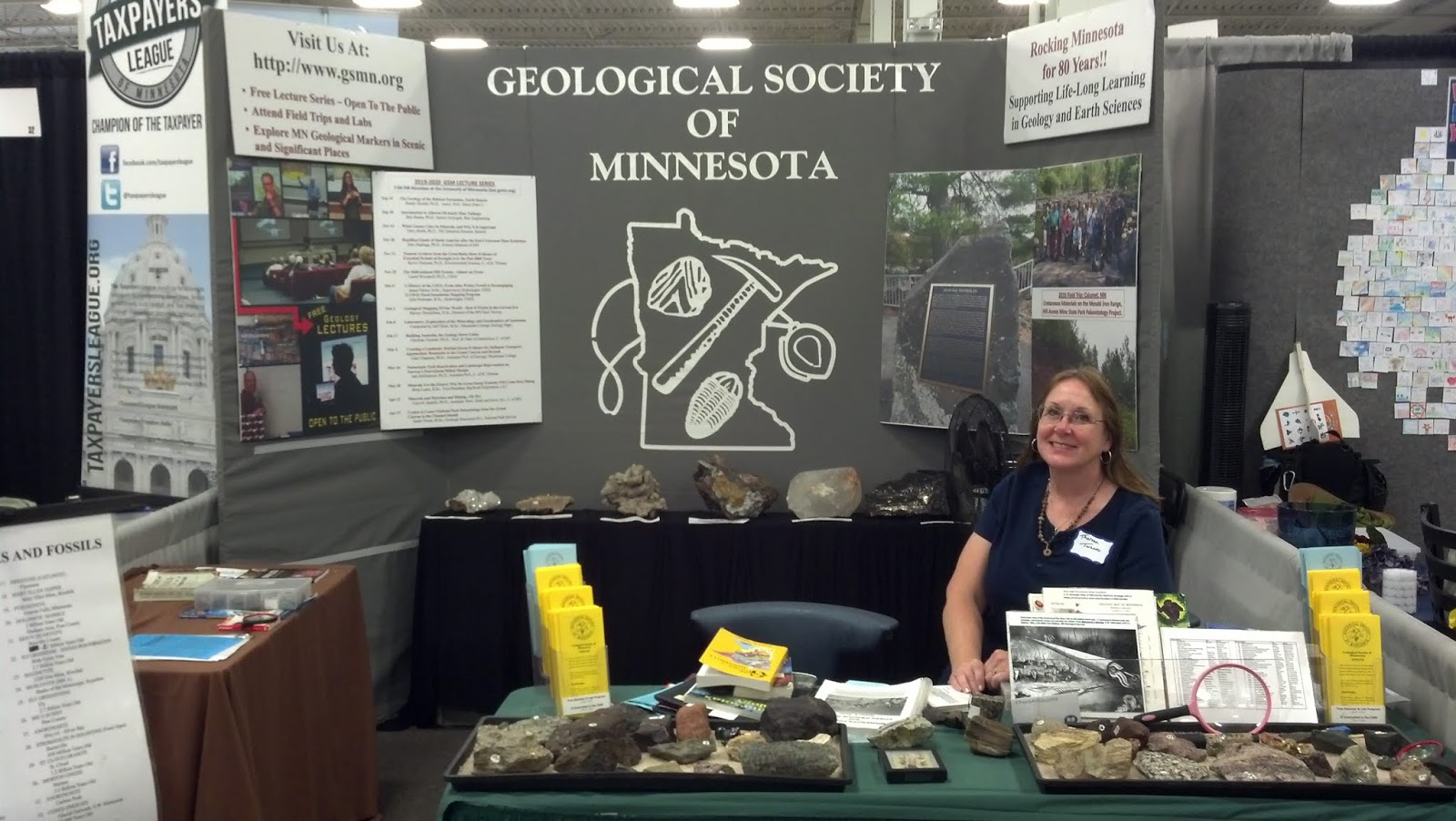 |
| The GSM's booth, featuring board member Theresa. |
 |
| If you'd like to try your eye, this tray has five fossils or fossil-bearing specimens, although one of them is difficult to tell from this angle. |
 |
| The other tray has two stromatolitic specimens, plus (in the lower right) schist-on-a-stick. It's the Minnesota State Fair, there has to be something on a stick! The rest of the tray includes such local specialties as Ely Greenstone (#25) (if you've never been here, "Ely" is pronounce "Eelee") and 3.5-billion-year-old Morton Gneiss (#30). |
Of course, the primary function of the GSM booth is to inform the public about the society itself, but we also spend a lot of time talking to visitors about the rocks and minerals of the state. Sometimes people have even asked us to identify objects in photos or hand sample. Given this is Minnesota, one of the favorite topics of conversation is agates. The state gemstone is the colorfully banded Lake Superior agate, although they certainly aren't limited to the North Shore; thanks to glaciers that moved south out of the Superior region, agates have been scattered across much of the state. The GSM booth has a few on-hand, but the DNR Building has a much larger assortment on display, including the nearly 50-pound (23-kg) "Agzilla".

"Agzilla" usually calls the Agate and Geological Center at Moose Lake State Park home. Incidentally, Moose Lake holds Agate Days annually in mid-July. Another notable geologic state park is Hill Annex Mine State Park, near Calumet, which is not only of note as an example of a Mesabi Range open-pit mine, but is also one of the best-known Cretaceous sites in Minnesota. The visiting season at the park has just ended, but the Minnesota Discovery Center in Chisholm also exhibits Cretaceous fossils from the Iron Range. A few of the fossils from Hill Annex joined the agates at the DNR building.
 |
| Plants, ammonites, bivalves, gastropods, teeth: a proper assemblage for near the eastern shore of the Western Interior Seaway. |
If you're looking for upcoming geological events, October is a very good month in Minnesota. The GSM's lecture series opens in mid-September and continues into December. The Minnesota Mineral Club holds its annual show at the Armory in Cottage Grove over the third weekend in October, and over the same weekend, Whitewater State Park will be holding a "Geology Gathering", which I will be participating in on Saturday the 19th. Also, the Science Museum of Minnesota will hold an Object ID day on Saturday the 5th, and we're tentatively planning a fossil walk at Coldwater for Saturday the 12th.
Sunday, August 25, 2019
Mongolian dinosaurs, 2002
As is traditional when I have an idea for a post but it's not working out, I go through my photos to see if something looks interesting. This time, I ran across a batch of photos taken during a trip I took to Mongolia as an undergrad in June 2002. The purpose of the trip was to do geologic work in the vicinity of Shinejinst, southern Mongolia, where we were looking at the assembly of central Asia. At both ends of the field work, we spent a few days in Ulaanbaatar. Naturally, we visited the Mongolian Natural History Museum. At the time, there was also a separate facility called the "paleontology laboratory", which we visited after returning from the field. (This predated the Central Museum of Mongolian Dinosaurs.) Because many of the species featured aren't represented in museums elsewhere, except for special exhibitions, and hopping over to UB isn't the simplest proposition for most of the readers here, I thought you might like to see some of the photos. There's enough interesting specimens to split them into two groups, so I'll start with the Natural History Museum.
Sunday, August 18, 2019
Your Friends The Titanosaurs, part 15: Lirainosaurus, Lohuecotitan, and Loricosaurus
This and the next few posts are going to be spending significant time outside of the South American titanosaur stronghold. Only Loricosaurus scutatus will be representing South America this time, with the other two slots filled by the unusually small Lirainosaurus astibiae and larger Lohuecotitan pandafilandi, both from the Upper Cretaceous of Spain.
 |
| This map, part of Figure 1 from Díez Díaz et al. (2011), shows the distribution of European titanosaur cranial material, but also happens to show the discovery locations of Lirainosaurus astibiae, Lohuecotitan pandafilandi (Lo Hueco), and species assigned to Magyarosaurus, which is coming up quickly. CC-BY-4.0. |
Sunday, August 11, 2019
Ngwevu intloko
For our first "prosauropod" entry since Ledumahadi mafube back in September 2018, we return to the Upper Elliot Formation of South Africa. This time around, it's massospondylid Ngwevu intloko. Or, is it just a distorted, young, or otherwise odd individual of the Upper Elliot classic Massospondylus carinatus?
Sunday, August 4, 2019
Platteville sea stars and cystoids
It's been a while since I've featured something Ordovician, so here are some photos of some uncommon Platteville Formation echinoderms. I took them a few years back, when I wasn't quite as good at this as I've become. These specimens all come from the Platteville of the Twin Cities, and are in the collections of the Science Museum of Minnesota. In fact, the first example has since been moved out to the exhibits, which is good because it certainly deserves the visibility. It is a specimen of a small stocky early sea star identified as Hudsonaster (Protopalaeaster in older references, not to be confused with Promopalaeaster, another Ordovician sea star but of more conventional appearance).
This was not a very large animal, only about an inch across or so. It's not from the former Johnson Street Quarry, the fabled lost storehouse of Platteville echinoderms in the Twin Cities. Actually, none of the three specimens in this post are from that site. It's possible they're from the Hidden Falls Member, as the Johnson Street specimens were, but I don't have stratigraphic information lower than formation for these specimens, two of which were found on loose slabs.
Hudsonaster was not the only sea star in the Platteville. Urasterella was a larger, more lanky sea star, although since we're talking about the Ordovician of Minnesota, "larger" still isn't enormous by our standards. (It's still pretty big for a non-cephalopod of the Platteville, though.) The specimen is not as complete as the Hudsonaster, but there is one nearly complete arm and most of two others, with the missing sections partially recorded by natural molds.
From a quick glance of the exteriors, neither Hudsonaster or Urasterella are all that different from sea stars you might see today. Going from the familiar to "what-is-that-and-what-happened-to-it", we have a fossil identified as the rhombiferan cystoid Pleurocystites. Because only one side is visible, I'm not entirely sure if it is Pleurocystites or a close relative (the very similar genus Amecystis is also known from this interval in the Upper Midwest per Kolata et al. 1987), but it's a reasonable identification.
It somewhat resembles a deflated balloon on a string, or some kind of odd fish, and again is not very large. Rhombiferan cystoids were stalked ancestrally, but these pleurocystitids seem to have been using theirs for something else, perhaps on the order of a flagellum. It's not apparent in this specimen, but at the opposite end from the "stalk" were two long appendages that looked like antennae but were actually part of the feeding apparatus (only the bases are visible here). A few formations up, in the lower Prosser Formation, a mass-death assemblage in southern Minnesota yielded dozens of Pleurocystites (Sloan and DesAutels 1987), so whatever they were doing, they were at least briefly successful at it.
Strangely enough, members of a completely different group of echinoderms, the solutan "carpoids", hit upon an astonishingly similar body plan at almost the same time (Kolata et al. 1977). The Prosser bed also includes specimens of these solutan doppelgängers (Sloan and DesAutels 1987). A quick way to tell the two types apart is the "stalk": pleurocystitid "cystoids" have a simple "stalk" of stacked pieces, but the lookalike solutans have complex, "braided" "stalks". (Also, pleurocystitids have two appendages opposite the "stalk" and the lookalikes have one, but those aren't always as easy to see.) The Science Museum has one of these solutan lookalikes, Dendrocystis, on display. The fad for echinoderms that looked like deflated balloons with antennae did not last for either version, with both lineages going extinct long before the end of the Paleozoic.
References
Kolata, D. R., H. L. Strimple, and C. O. Levorson. 1977. Revision of the Ordovician capoid family Iowacystidae. Palaeontology 20(3): 529–557.
Kolata, D. R., J. C. Brower, and T. J. Frest. 1987. Upper Mississippi valley Champlainian and Cincinnatian echinoderms. Pages 179–181 in R. E. Sloan, editor. Middle and Late Ordovician lithostratigraphy and biostratigraphy of the Upper Mississippi Valley. Minnesota Geological Survey, St. Paul, Minnesota. Report of Investigations 35.
Sloan, R. E., and D. A. DesAutels. 1987. The Wagner Quarry cystoid bed: a study in Prosser (Sherwood) paleoecology. Pages 60–62 in R. E. Sloan, editor. Middle and Late Ordovician lithostratigraphy and biostratigraphy of the Upper Mississippi Valley. Minnesota Geological Survey, St. Paul, Minnesota. Report of Investigations 35.
 |
| Here it is, with scale artfully copied from elsewhere in the cropped photo and placed in a more convenient location (mm divisions, one full cm included). A crinoid columnal is visible in the upper left corner. |
This was not a very large animal, only about an inch across or so. It's not from the former Johnson Street Quarry, the fabled lost storehouse of Platteville echinoderms in the Twin Cities. Actually, none of the three specimens in this post are from that site. It's possible they're from the Hidden Falls Member, as the Johnson Street specimens were, but I don't have stratigraphic information lower than formation for these specimens, two of which were found on loose slabs.
 |
| Another view, taken at closer range and thus a bit sharper, but with no scale. |
Hudsonaster was not the only sea star in the Platteville. Urasterella was a larger, more lanky sea star, although since we're talking about the Ordovician of Minnesota, "larger" still isn't enormous by our standards. (It's still pretty big for a non-cephalopod of the Platteville, though.) The specimen is not as complete as the Hudsonaster, but there is one nearly complete arm and most of two others, with the missing sections partially recorded by natural molds.
 |
| And I've rather brilliantly arranged to have my reversible transparent ruler wrong-side-out. |
From a quick glance of the exteriors, neither Hudsonaster or Urasterella are all that different from sea stars you might see today. Going from the familiar to "what-is-that-and-what-happened-to-it", we have a fossil identified as the rhombiferan cystoid Pleurocystites. Because only one side is visible, I'm not entirely sure if it is Pleurocystites or a close relative (the very similar genus Amecystis is also known from this interval in the Upper Midwest per Kolata et al. 1987), but it's a reasonable identification.
 |
| With quarter for scale; the block is also peppered with partial crinoids. |
It somewhat resembles a deflated balloon on a string, or some kind of odd fish, and again is not very large. Rhombiferan cystoids were stalked ancestrally, but these pleurocystitids seem to have been using theirs for something else, perhaps on the order of a flagellum. It's not apparent in this specimen, but at the opposite end from the "stalk" were two long appendages that looked like antennae but were actually part of the feeding apparatus (only the bases are visible here). A few formations up, in the lower Prosser Formation, a mass-death assemblage in southern Minnesota yielded dozens of Pleurocystites (Sloan and DesAutels 1987), so whatever they were doing, they were at least briefly successful at it.
Strangely enough, members of a completely different group of echinoderms, the solutan "carpoids", hit upon an astonishingly similar body plan at almost the same time (Kolata et al. 1977). The Prosser bed also includes specimens of these solutan doppelgängers (Sloan and DesAutels 1987). A quick way to tell the two types apart is the "stalk": pleurocystitid "cystoids" have a simple "stalk" of stacked pieces, but the lookalike solutans have complex, "braided" "stalks". (Also, pleurocystitids have two appendages opposite the "stalk" and the lookalikes have one, but those aren't always as easy to see.) The Science Museum has one of these solutan lookalikes, Dendrocystis, on display. The fad for echinoderms that looked like deflated balloons with antennae did not last for either version, with both lineages going extinct long before the end of the Paleozoic.
References
Kolata, D. R., H. L. Strimple, and C. O. Levorson. 1977. Revision of the Ordovician capoid family Iowacystidae. Palaeontology 20(3): 529–557.
Kolata, D. R., J. C. Brower, and T. J. Frest. 1987. Upper Mississippi valley Champlainian and Cincinnatian echinoderms. Pages 179–181 in R. E. Sloan, editor. Middle and Late Ordovician lithostratigraphy and biostratigraphy of the Upper Mississippi Valley. Minnesota Geological Survey, St. Paul, Minnesota. Report of Investigations 35.
Sloan, R. E., and D. A. DesAutels. 1987. The Wagner Quarry cystoid bed: a study in Prosser (Sherwood) paleoecology. Pages 60–62 in R. E. Sloan, editor. Middle and Late Ordovician lithostratigraphy and biostratigraphy of the Upper Mississippi Valley. Minnesota Geological Survey, St. Paul, Minnesota. Report of Investigations 35.
Subscribe to:
Posts (Atom)