Sunday, May 29, 2022

Recent Work from the National Park Service Paleontology Program

My day job is with the Paleontology Program of the National Park Service, and I thought you might like to see some of the work we've put out over the past few months. First up is the Spring 2022 issue of the Park Paleontology newsletter. For this issue, we have articles on:

Next, a couple of articles have just come out in the latest volume of the New Mexico Museum of Natural History and Science Bulletin series, both focused on Quaternary cave paleontology of specified parks in the southwest. Hodnett et al. (2022) describes previously overlooked bones from Grand Canyon National Park as specimens of the "American cheetah" Miracinonyx trumani. Meanwhile, drawing on the Carlsbad Caverns National Park paleontological inventory published a few years ago, Kottkamp et al. (2022) discusses the Pleistocene vertebrate record of the park's various caves.

Finally, public versions of our four latest park-specific paleontological inventory reports are also available to view and download. For just four parks, they feature a wide range of types of fossils, geology, and geography. They are:

References

Hodnett, J. P., R. White, M. Carpenter, J. Mead, and V. L. Santucci. 2022. Miracinonyx trumani (Carnivora; Felidae) from the Rancholabrean of the Grand Canyon, Arizona and its implications on the ecology of the “American cheetah.” New Mexico Museum of Natural History Bulletin 88:157–186.

Kottkamp, S., V. L. Santucci, J. S. Tweet, R. D. Horrocks, and G. S. Morgan. 2022. Pleistocene vertebrates from Carlsbad Caverns National Park, New Mexico. New Mexico Museum of Natural History and Science Bulletin 88:267–290.

Sunday, May 15, 2022

Rockfall

One of the characteristic aspects of the Mifflin Member of the Platteville Formation is its habit of planar jointing. The faces of outcrops often look like someone took a rock saw to them. Nor are they necessarily single flat planes; sometimes joints intersect to form sharp angles. The heavy thunderstorms the previous week inspired a large chunk of Mifflin outcrop to collapse along intersecting joints.

Tumbled down

The joint planes did not form overnight, which can be seen by the amount of roots and soil in the new outcrop faces. There were some pretty big roots in there as well, but whatever tree(s) had once produced them is long gone.

A view into the wedge more or less along one of the two joints.

This particular rockfall was about as polite as possible, occurring not at the top of a stereotypical 30-foot bluff but from a much lower bluff, adjacent to a bike path. The orientation of the wedged stack shows that it toppled out of its former position. The top of the stack is therefore farthest from the bluff. Perhaps it failed at the base first, due to poor support from the Pecatonica, then flopped over.

History going from left to right

Saturday, April 30, 2022

Synchronicity of Large Crinoids

I was recently out of town for work, and one of the things I saw was Middle Pennsylvanian-age building stone with stem segments from large crinoids:

Big ol' crinoids

It's like bony fingers strewn on the ground

You'd think with all this stem, there'd be a calyx somewhere, but no dice

At a shade over 1 cm (about 0.4 in) in diameter, the columnals are quite a bit bigger than garden-variety columnals, but still are well shy of world champ columnals, which reportedly exceed 2.5 cm (1 in); certainly much bigger than anything in Minnesota, right?

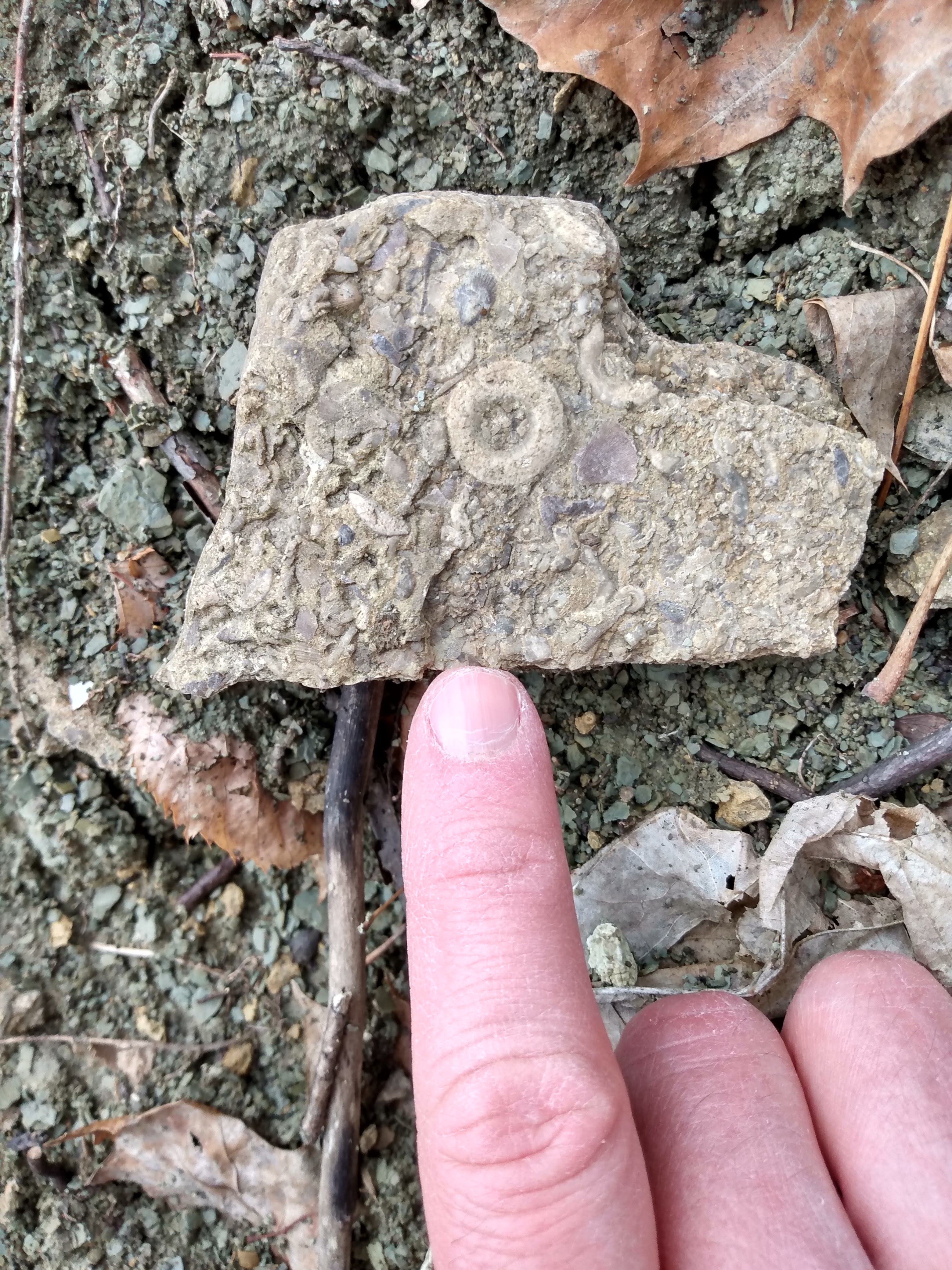
Yes! Time for the ironic photo!

Only yesterday, less than a week after returning from the above trip, I was visiting a couple of Decorah Shale sites and came across the above specimen. I happened to be caught short of a traditional scale bar, so you will have to take my word that the fingernail of the above finger is 1.1 cm (0.43 in) across at its widest point. Therefore, that columnal is 1.5 cm (0.59 in) across, which is pretty darn big for anything in the Decorah except for certain trilobites. In fact, it made me wonder if the stone might be a ringer transported from another formation, by glacier, river, or what-have-you. (Not impossible at all; here's a neat report on all kinds of exotic rocks and fossils found in Mississippi gravel, including Lake Superior agates and Sioux Quartzite; closer to home, a piece of an Upper Cretaceous ammonite was once found at the Brickyard, as related in Cobban and Merewether 1983:19.) However, the chunk shows no evidence of transport, and lithologically it looks the same as any piece of thin limestone eroded out of the Decorah. Were it not for the great honking columnal, I wouldn't have thought twice about its legitimacy. (I wouldn't even have thought once!) My guess is that this particular specimen originated from higher in the formation than the stuff I usually see, or that great honking crinoids were a very minor part of the Decorah fauna and this just happens to be my first encounter.

References

Cobban, W. A., and E. A. Merewether. 1983. Stratigraphy and paleontology of mid-Cretaceous rocks in Minnesota and contiguous areas. U.S. Geological Survey, Washington, D.C. Professional Paper 1253.

Sunday, April 10, 2022

Mitchell Caverns

Back in the fall of 2021, I made a work visit to Mojave National Preserve, located logically enough within the Mojave Desert of southern California. While there, I had the opportunity to tour Mitchell Caverns. Mitchell Caverns is in the unusual position of being part of a state land parcel (Mitchell Caverns Natural Preserve or State Natural Preserve, depending on the source), entirely surrounded by another parcel of state land (Providence Mountains State Recreation Area), which is itself surrounded by a National Park Service unit (Mojave National Preserve). For good measure, the cave system is also a National Natural Landmark. It's parks all the way down in the Providence Mountains. (To be fair, the natural preserve designation is kind of a map artifact; it's not really distinct from the state recreation area.)

Sunday, March 27, 2022

Detour into Choristodera

This week a paper on unusual prehistoric aquatic reptiles was published. I am speaking, of course, of Brownstein (2022) on choristoderes. (If you thought it was going to be spinosaurs, you must be new around here!)

We have a soft spot for choristoderes here at Equatorial Minnesota Towers, even if they rarely rate so much as an "and also featuring Champsosaurus" credit in sci-pop culture. Brownstein (2022) includes the classic Champ but is more focused on the short(er)-faced choristodere Simoedosaurus, although under a fresh coat of taxonomic paint: the North American species S. dakotensis is moved to the new genus Kosmodraco on the grounds of anatomical differences and differences in time and place from the type species, European S. lemoinei. It also gets a new friend, K. magnicornis. Which said, sure... but the species of Kosmodraco still clade more closely to Simoedosaurus than to anything else, so if your genericometer was so tuned, you could still include them in Simoedosaurus with a clear phylogenetic conscience. (There are a lot of anatomical differences between the two genera. My only quibble with Kosmodraco is that it's an awfully pretty name for a choristodere; it sounds more like an an extravagantly crested pterosaur. Meanwhile, Champsosaurus itself is still secretly a taxonomic booby trap waiting to be sprung. Sooner or later someone is going to do something with the various species that is entirely legal by the rules of taxonomy and yet manages to displease everyone else.)

The type skull of Kosmodraco magnicornis. It'll take a moment to orient yourself: the bitey part is surprisingly short (see the "r. lacrimal"? The eye was behind that). What you're looking at is a modest snout attached to a greatly flaring right "cheek" (which comes with a scalloped fringe). Figure 1 in Brownstein (2022). CC BY 4.0.

Either way, the skull is worth a look. There's garden-variety "weird" and then there's "why is this all practically all post-orbital?" (It certainly wasn't for intellect, most of the posterior of choristodere skulls being a series of struts and bars. Note that the maxillary teeth of Kosmodraco only go back as far as the eyes.) Champsosaurus, as we've already seen, had a long, narrow toothy muzzle, with the rest of the skull being broad and low. Kosmodraco had a skull that was still low but much more wedge-shape in dorsal view, as if someone smooshed or amputated a Champsosaurus-like snout. The business end of a Kosmodraco skull is an interesting analog for the modern alligator gar. It's the back of the skull where things get different, as Brownstein (2022) notes. Kosmodraco has a lot more skull going on behind the eyes, which themselves are elevated on skull like those of an alligator. The posterior margin is also ornamented with a series of knobs, and the skull is quite low (Brownstein 2022).

A comparison of the palatal regions of choristoderes Kosmodraco and Champsosaurus to an alligator and an alligator gar also serves as a comparison of basic facial shapes for the four. Similarities between Kosmodraco and the gar aren't as great if you continue through the rest of the skull. Figure 13 in Brownstein (2022). CC BY 4.0.

I'd like to take the opportunity to note that there's another extinct group of aquatic tetrapods with flat, blunt, broad skulls and eyes relatively far forward on the skull, which has so far avoided comparisons to Simoedosaurus/Kosmodraco: the metoposaurid amphibians of the Triassic. Again, it's not a perfect comparison (metoposaur snouts are blunter), but it would seem to point to the long-term existence of a niche for freshwater predators with certain cranial adaptations.

One of the other points noted by Brownstein is there is more diversity in choristoderes than you might suspect by simply looking at the number of genera. For example, as of this writing Champsosaurus is composed of several species over about 20 million years. North American specimens have tended to be lumped with either the short-faced Simoedosaurus or the long-faced Champsosaurus.

References

Brownstein, C. D. 2022. High morphological disparity in a bizarre Paleocene fauna of predatory freshwater reptiles. BMC Ecology and Evolution 22: article number 34. doi:10.1186/s12862-022-01985-z.

Sunday, March 20, 2022

The Grand Pitch Formation

Back in October I posted on a formation I saw in Maine, the Matagamon Sandstone. While going through my photos, I realized I had a number of scenic and interesting shots of another formation, also not widely known: the Grand Pitch Formation.

Comes with waterfalls!

The Grand Pitch Formation goes back in the literature to the 1930s, when it was known as the Grand Falls Formation (Ruedemann and Smith 1935). This name, though, was already in use, so the more specific Grand Pitch name was substituted (Neuman 1962). The name refers to the Grand Pitch, a waterfall on the East Branch of the Penobscot supported by more resistant beds of the formation.

Resistant beds like these.

If you've taken a historical geology class in North America, you've probably spent some time with the assembly of eastern North America. Back when I was taking that class, it was a three-stage process marked by the Taconic, Acadian, and Alleghanian (or Appalachian) mountain-building events (orogenies). Well, as you might guess, it's a bit more complicated than that. (Just a bit.) In actual practice, the North American craton, microplates, continental fragments, island arcs, and all and sundry were bumping and jostling and colliding with each other all the time. In the present example, the Grand Pitch Formation was deposited not in North America, but on a Gondwanan terrane known as Ganderia (or Gander) that eventually piled up on the continent after a series of its own adventures (including running into another terrane) (Neuman and Max 1989).

Just like our slice of the Equator in Minnesota, here in Maine you can stand on a former sliver of the tropics.

The Grand Pitch Formation is a heterogeneous unit, including beds of gray, green, and red siltstone and slate, quartzite, and minor amounts of graywacke and tuff (Neuman 1967). Siltstone and slate are charming lithologies but are not noted for resistance to weathering; instead, the falls are supported by quartzite beds. The depositional environment has been interpreted as a continental slope-rise setting (Wellensiek et al. 1990).

Finer-grained beds as seen at the surface: not recommended for load-bearing outcrops.

It's a pretty thick formation, encompassing at least 1,500 m (5,000 ft) (Neuman 1967), but it's not in mint condition, to say the least. The formation has undergone several episodes of deformation, going back to the Ganderia days with a Cambrian–Ordovician event termed the Penobscot Orogeny or Disturbance (Neuman and Max 1989).

Red and gray beds make it easy to see minor faulting here.

The age of the Grand Pitch Formation is not entirely clear. Only one kind of fossil has ever been reported from it, the invertebrate trace fossil Oldhamia, which looks kind of like a fireworks burst or a palm frond and is thought to have been produced by something "mining" beneath microbial mats (Seilacher et al. 2005). Oldhamia was most abundant in the early Cambrian, but is not limited to that time frame, nor does its occasional presence mean the entire Grand Pitch Formation has to be that age, either (Neuman 1962, 1967). Generally the formation is attributed to some interval of the Cambrian.

Going back to deformations and alterations, here we have a patch of the formation scored with glacial striations.

References

Neuman, R. B. 1962. The Grand Pitch Formation: new name for the Grand Falls Formation (Cambrian?) in northeastern Maine. American Journal of Science, series 5, 260:794–797.

Neuman, R. B. 1967. Bedrock geology of the Shin Pond and Stacyville quadrangles, Penobscot County, Maine. U.S. Geological Survey, Washington, D.C. Professional Paper 524-I.

Neuman, R. B., and M. D. Max. 1989. Penobscottian-Grampian-Finnmarkian orogenies as indicators of terrane linkages. Pages 31–45 in R. D. Dallmeyer, editor. Terranes in the circum-Atlantic Paleozoic orogens. Geological Society of America, Boulder, Colorado. Special Paper 230.

Ruedemann, R., and E. S. C. Smith. 1935. The Ordovician in Maine. American Journal of Science, series 5, 30:353–355.

Seilacher, A., L. A. Buatois, and M. G. Mángano. 2005. Trace fossils in the Ediacaran–Cambrian transition: behavioral diversification, ecological turnover and environmental shift. Palaeogeography Palaeoclimatology Palaeoecology 227(4):323–356.

Wellensiek, M. R., B. A. van der Phijm, R. Van der Voo, and R. J. E. Johnson. 1990. Tectonic history of the Lunksoos composite terrane in the Maine Appalachians. Tectonics 9(4):719–734.

Sunday, February 13, 2022

Your Friends The Titanosaurs: Abditosaurus kuehnei

Today we add Abditosaurus kuehnei to the long-running "Your Friends The Titanosaurs" series. January was pretty slow around here as far as new non-avian dinosaurs go, but coincidentally enough the dinosaur to break the dry spell was a titanosaur. Since then, we've also gotten Guemesia ochoai, an abelisaurid, which is very nice if you enjoy theropods. (It did make entry #1600 in the dinosaur sheet of The Compact Thescelosaurus.)

Genus and Species: Abditosaurus kuehnei. "Abditus" is Latin for "concealed", referring to the long gap between discovery and description, making this a comrade of our friend Thescelosaurus neglectus. "Kuehnei" honors the discoverer, Walter Georg Kühne (Vila et al. 2022). Together we get something like "Walter Georg Kühne's concealed lizard".

Citation: Vila, B., A. Sellés, M. Moreno-Azanza, N. L. Razzolini, A. Gil-Delgado, J. Canudo, and A. Galobart. 2022. A titanosaurian sauropod with Gondwanan affinities in the latest Cretaceous of Europe. Nature Ecology & Evolution. doi:10.1038/s41559-021-01651-5.

Stratigraphy and Geography: The type and only known specimen comes from the lower Conques Formation at a locality identified as Orcau-1 (also known as "Barranco de Orcau" or "Orcau"). This location is about 6 km (4 mi) east of Tremp, in the county of Pallars Jussà, Catalonia, Spain (Vila et al. 2022).

Holotype: The holotype is not catalogued as a unitary specimen. Instead, the bones are held at the Museo Nacional de Ciencias Naturales in Madrid (MNCN) and the Museu de la Conca Dellà in Isona (MCD) and catalogued under a variety of numbers. The bones pertain to an associated and semi-articulated partial skeleton found over an area about 6 m by 4 m (20 ft by 13 ft) and include: isolated teeth, 12 partial articulated cervical vertebrae, 7 anterior and middle dorsals, cervical and dorsal ribs, 3 chevrons, the right and partial left scapula, right coracoid, left sternal plate, a sternal rib (a titanosaurian rarity), a fragment of the left ilium, parts of both humeri, partial right radius, part of the right femur, the right tibia and fibula, and partial left fibula with attached calcaneum (another titanosaurian rarity). Some other material has gone missing (Vila et al. 2022).

Abditosaurus kuehnei, as its name suggests, is one of those dinosaurs that was not described until decades after it had been discovered. The history of the specimen is described in the supplementary information to the paper (here; ten times longer than the paper, so yeah, necessary stuff!). The abridged Abditosaurus story is that Kühne discovered the fossils September 25, 1954 while prospecting for Cretaceous mammals. Over the next couple of weeks he collected a few bones and jacketed a few more for later collection. He made a return trip in 1955 and collected more bones. Plans for additional collection were scuppered by lack of funds. Lapparent and Aguirre (1956) proposed that Kühne's sauropod was a new species of Hypselosaurus, which is what you did in 1956. The locality was revisited in the mid-1980s, but not fully collected until a series of expeditions 2012–2014 (Vila et al. 2022 supplementary information).

A few anatomical notes: The humerus is notably robust while the tibia is gracile. The ilium is pneumatized. There are several osteological indications of age, such as the presence of a sternal rib and a calcaneum, thought to have only ossified with great age (Vila et al. 2022). (Also, the cervical ribs are fused to their vertebrae.) In the supplementary information Vila et al. describe osteological samples from the limb bones that indicate the type individual had reached skeletal senility (histological ontogenetic stage HOS-14). Vila et al. estimated that the sauropod was 17.5 m (57.4 ft) long and a shade more than 14 metric tons (15.4 US tons) in body mass. These figures would make A. kuehnei somewhat larger than a typical titanosaur, and definitely larger than your typical subcompact European titanosaur.

The size of A. kuehnei is one of the major talking points. Along with its lengthy history, this species comes equipped with a full suite of implications. While titanosaurs seem to be big fans of some kind of phylogenetic uncertainty principle, in this case A. kuehnei shows no indication of clading with other European titanosaurs. Instead, it hangs out in the general vicinity of saltasaurs and its phylogenetic best friend appears to be the even larger Paralititan stromeri from the Cenomanian of Egypt. Vila et al. (2022) posited a scenario in which North African titanosaurs arrived in Ibero-Amorica during an early Maastrichtian marine lowstand via a loop through the various smaller landmasses then dotting the narrow Tethys Ocean. They tied this to an early Maastrichtian faunal turnover in which the previous mini-titanosaurs were replaced, and suggested something similar happened in Romania. Let the fossil record show that large(ish) titanosaurs in the Haţeg Basin fauna of Romania have been reported by Le Loeuff (2005), Stein et al. (2010), and Mannion et al. (2019).

I've mentioned this before, but I suspect that sauropods were excellent at dispersal over water, similar to elephants. They were big, full of air and fermenting plant gases, and had long necks that could have been held well above the water. Get 'em out to sea, and they could probably have gone a long way. Postulate that your traveling sauropod was a gravid female, and given what we know about the number of eggs a sauropod could lay, you've got a pretty good scenario for populating any landmass that was large enough to support sauropods and a reasonable distance from a landmass that already had sauropods.

References

Lapparent, A. F., and E. Aguirre. 1956. Présence de dinosauriens dans le Crétacé supérieur du bassin de Tremp (province de Lérida, Espagne). Comptes Rendus Sommaires de la Société Geólogique de France 14:261–262.

Le Loeuff, J. 2005. Romanian Late Cretaceous dinosaurs: big dwarfs or small giants? Historical Biology 17:15–17.

Mannion, P., V. Díez Díaz, Z. Ciski-Sava, P. Upchurch, and A. Cuff. 2019. Dwarfs among giants: resolving the systematics of the titanosaurian sauropod dinosaurs from the latest Cretaceous of Romania. Journal of Vertebrate Paleontology, Program and Abstracts, 2019:148.

Stein, K., Z. Csiki, K. Curry Rogers, D. B. Weishampel, R. Redelstorff, J. L. Carballidoa, and P. M. Sandera. 2010. Small body size and extreme cortical bone remodeling indicate phyletic dwarfism in Magyarosaurus dacus (Sauropoda: Titanosauria). Proceedings of the National Academy of Sciences of the United States of America 107(20):9258–9263.

Vila, B., A. Sellés, M. Moreno-Azanza, N. L. Razzolini, A. Gil-Delgado, J. Canudo, and A. Galobart. 2022. A titanosaurian sauropod with Gondwanan affinities in the latest Cretaceous of Europe. Nature Ecology & Evolution. doi:10.1038/s41559-021-01651-5.