Sunday, June 28, 2020

Revisiting Coldwater Spring and Fort Snelling State Park

The same day I got out to Shadow Falls Park, I also stopped at Coldwater Spring and Fort Snelling State Park. These locations are geologically restricted to the Platteville down to the St. Peter, and the exposures are much more in the bluff mode of expression.

Lo, the type section of the St. Peter Sandstone, mostly behind a wall (probably for the best, given the way people use any handy outcrop of the St. Peter to practice their rock-carving skills)

What impressed me at these sites were the numerous rockfalls. It seemed like a lot, but I don't have the numbers to judge. It would actually be a simple project: somebody could periodically go along the paved path and document new falls by photos and GPS. The rub is that it's also a long-term project; you wouldn't get useful information from a couple of years.

At this fall, out of the Mifflin Member of the Platteville, it's easy to see the lighter color where the rocks used to be.

The outcrops of the Hidden Falls and Magnolia members just north of Coldwater have been taking a beating lately, although I'll grant that it's not as impressive when they only fall a few feet. There's both day-to-day attrition and larger collapses.


If you should happen to go below the paved path, down toward the river (say if you're going into the dog park), you can also see evidence of older disruption, where large blocks of Platteville have been displaced.

If the beds are noticeably tilted, that's a good indication they aren't where they started. (And also the whole "lying in jumbled heaps" thing, that's a good clue.)

A small, gentle waterfall southeast of Coldwater, unnamed as far as I know, running through a cleft in the St. Peter.

Given the geology, fossils weren't terribly diverse or well-preserved. There were the usual brachiopod beds exposed on some of the fallen blocks:


There were also these things. 99.999% says they're a couple of weathered burrows, although the coincidental weathering on the longer of the two made me think of segmented stems when I first saw them, which would be rather odd for the Platteville. Further study of the photo showed that the "segmented" feature was longer than I thought, and that the apparent segmentation was limited to the two lines.


Same photo, light red lines added to trace the features.

Sunday, June 21, 2020

Your Friends The Titanosaurs, part 25: Quaesitosaurus, Quetecsaurus, and Rapetosaurus

Here we are, June 2020, and this is not only the 300th post at Equatorial Minnesota, but also the second anniversary of "Your Friends The Titanosaurs". It seems fitting enough that the two should coincide. This particular set of three titanosaurs covers a pretty broad spread, geographically, from Mongolia to Argentina to Madagascar.

Sunday, June 14, 2020

The gut contents of Borealopelta

Seems like we just had Borealopelta markmitchelli as a major part of a post. Unlike back in March, this time around the famously well-preserved nodosaur doesn't have to share space with any other ankylosaurs. The occasion is the publication of Brown et al. (2020), which describes plant material found inside the carcass of the ankylosaur. This publication is freely available, and if you have any interest in dinosaur paleobiology you ought to snag it (and its supplementary material; never forget the supplements!).

Sunday, June 7, 2020

A note

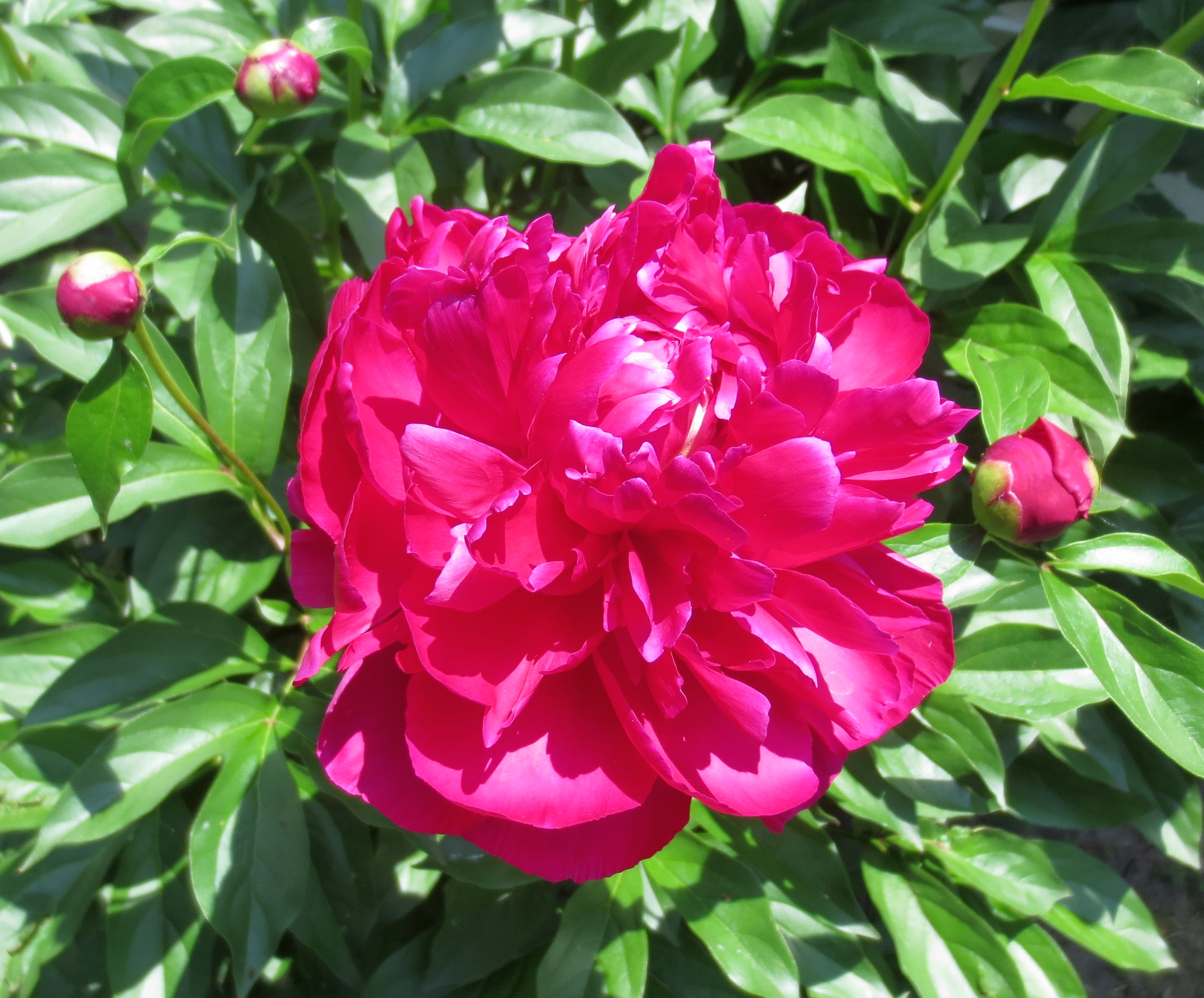
It's been an intense couple of weeks here in Minnesota, and I didn't feel that my usual thing made much sense. The peonies are just starting to bloom here, so would you accept a kind thought and a flower?


There's a family story with these plants. They're supposed to have been brought to Amery, Wisconsin by family members sometime in the 19th century, then my grandparents brought them to Cottage Grove. When they passed away and their house was being readied to be sold, their children, including my mother, each took some of the plants and planted them at their own homes. Now, that would make for some ancient plants, even for something as famously long-lived as peonies, but I can personally attest to a few of those decades. On the other hand, the flowers themselves are here and gone, blooming for just a short time in early June.

Sunday, May 24, 2020

National Park Service proboscideans revisited

You may recall that a few years ago I ran a post with a map summarizing proboscidean records in National Park Service areas. Sometimes these things take on a life of their own. I'm happy to share with you Mead et al. (2020), a fleshed-out compendium of fossil proboscideans from National Park Service units, affiliated areas, and National Natural Landmarks and Historic Landmarks. The citation is:

Mead, J. I., J. S. Tweet, V. L. Santucci, J. T. Rasic, and S. E. Holte. 2020. Proboscideans from US National Park Service Lands. Eastern Paleontologist 6:1–48.

Gomphotherium osborni in Elephant Hall, University of Nebraska State Museum. You may not realize it, but proboscidean fossils are very common in Nebraska. We haven't had a gomphothere photo yet, so it seemed appropriate.

The project had a serendipitous beginning; my supervisor Vince Santucci and I occasionally produce inventories of fossil groups from NPS lands, as thematic inventories. We'd been kicking around ideas for our next such inventory and put the proboscideans on the short list. At SVP 2018, Vince got in contact with Jim Mead of The Mammoth Site of Hot Springs about the planned Quaternary section of the Grand Canyon National Park report. He also brought up the proboscidean inventory, Jim was interested, and all that was left was assembling notes, writing, and revising (you know, the easy part). (One of the side effects of the work I do is that I have a very eccentric CV. Of course, that's one of the things I love about my work, getting to work with a bit of everything.)

Despite the ponderous subjects, this is not what you'd call a "heavy" paper. It's a compendium of various reports. Having said that, many of these reports we compiled are either published only in a very limited way elsewhere, or are unpublished. These include internal park reports, collections information, and other such documentation. We cast a very wide net to be as comprehensive as possible; as such, you might think that some of the things we included are very marginal. There's everything from mammoth bonebeds to a tooth fragment found in a cave at Grand Canyon NP. There's dung-filled caves and several track sites. There are artifacts carved from ivory from Alaska. There's even a mastodon tooth found in Philadelphia that might have belonged to Benjamin Franklin.

In terms of geography, the occurrences are spread throughout the country, but there is a definite bias to the West. This is probably due in large part to factors outside of the actual distribution of proboscideans: there aren't as many large parks in the eastern US, many of the park units are in urban areas, and many of them were established for human events that occurred in the past couple hundred years. (There's one eastern record I wish I could have confirmed. Another time, maybe.) Most of the records are for Pleistocene mammoths and mastodons, although there are a few going back into the Pliocene and Miocene. I certainly now have a much greater appreciation for the fossil record of the Niobrara National Scenic River corridor.

Did we get everything? Well, we cast a wide net, as I said, but I would not be surprised if we missed things, especially given that many of the reports we did include are of limited circulation; surely there are others lurking in file cabinets and in the recesses of hard drives? In fact, I'm hoping this will lead to people pointing out records we missed. If there was an update in ten years, I would absolutely expect that there would be additions from things we overlooked. In particular, our records of fossils in National Natural Landmarks and National Historic Landmarks are in an early stage of development, making these the most logical candidates for new information. Anyway, if you're curious about proboscideans in the Parks, we've got you covered!

Stegomastodon mirificus, same venue. Despite the name, it's not a close relative of mastodons (and certainly has nothing to do with Stegosaurus!); it's a later gomphothere.

Sunday, May 17, 2020

Your Friends The Titanosaurs, part 24: Pitekunsaurus, Puertasaurus, and Qingxiusaurus

This time around there are two more from Argentina to close out a streak of five consecutive entries from Patagonia which we began last time, and then one from China. Puertasaurus reuili completes the set of super-titanosaurs and again overshadows the other two entries, Pitekunsaurus macayai and Qingxiusaurus youjiangensis.

Sunday, May 10, 2020

Revisiting Shadow Falls Park

I like to periodically recheck various sites along the Mississippi corridor, to see how the elements are treating them, if there have been any major rock falls, damage from downed trees, changes in usage, etc. One of the places I get to more frequently than others is Shadow Falls Park. It has an informal reputation for collecting and is a place with soil on steep slopes (plus access is good and I like going there).

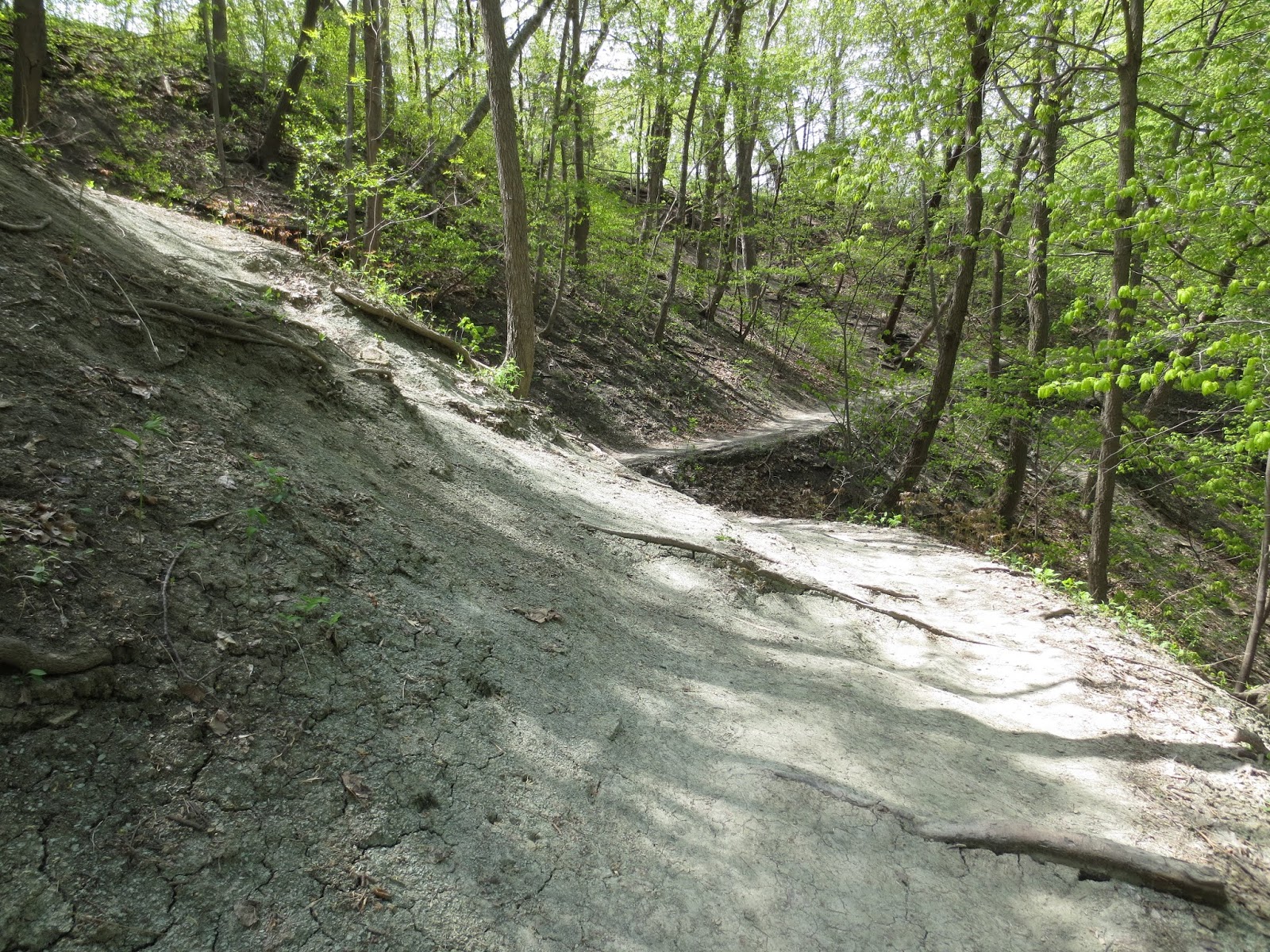
Here's the trail on the south side of the valley past the falls (which are essentially just to the right and a little below the vantage point of this photo).

Erosion may not be immediately evident if you don't have something to measure the loss of sediment, but in places with tree roots near the surface on the slopes it's easy to see how running water and gravity have done their work.

Almost a staircase of roots.

The usual array of lower Decorah fossils was present, in small chunks of rock and loose. It seemed to be a particularly good day for observing strophomenids (in the hash plates, primarily; they tend to break up otherwise). One example in the photo below is probably Rafinesquina, based on the thinness of the valve. This genus is named after Rafinesque, who we met last week and had a much more substantial career than getting into arguments about sloths. Another nice piece observed was a Bumastoides pygidium.

A. Probable Rafinesquina valve. B. Bumastoides pygidium

In one area I observed two pieces of a larger specimen of Rauffella palmipes. This is all catch-and-release, of course!

Two fragments of a large Rauffella palmipes.

Shadow Falls includes not only the falls, but a long valley oriented east-west with its head near but not quite reaching Cretin Avenue. I haven't spent much time in the valley above the falls because the area right above the falls tends to turn into a muddy swamp, but it's been a dry spring. The creek feeding the falls is in a very deep valley for its size, but would have been somewhat bigger in the days before sewers and roads.

The creek valley above Shadow Falls...

...opens up into this near its head.

There are several large fossiliferous blocks along the creek that include crinoid columnals notably larger in diameter than the run-of-the-mill lower Decorah columnals (note that the photo in the linked post is biased to larger, more photogenic columnals). The obvious guess is that they were brought to the area by glaciers and represent a different part of the stratigraphic column, say the upper Decorah or one of the overlying Ordovician formations that have been stripped from the area.

Large columnals